Showing posts with label Ancestry. Show all posts

Wednesday, 1 November 2023

Cruwys family tree on Ancestry

When I first started my family history research over twenty years ago I began by compiling the family information in Word files. It soon became too complicated to keep track of all the different family lines in separate files and so I bought a family history program to record all the information. After researching all the available family history programs I settled on Family Historian, which has an excellent reputation and is well-suited for one-name study work. The program has stood me in good stead over the years. I use it to record my own family tree but also all the other Cruwys and Cruse trees I've researched as part of my one-name study. 

When I first tested at AncestryDNA in 2012 I only had a very basic skeleton tree on Ancestry. I didn't get much out of the DNA test in the early years and it was another three years before Ancestry officially launched their test in the UK in 2015. Since then, the database has grown exponentially, allowing me to confirm much of my existing research and also to make some exciting new discoveries. I've found that there are distinct advantages to maintaining a detailed family tree on Ancestry. Having a publicly accessible tree means that I benefit from the Common Ancestor Hints and ThruLines. The more I build out the tree and build down the collateral lines the easier it becomes to work out the relationship to my matches. 

I find that Ancestry's online tree-building platform is by far the easiest to use of all the available options. The powerful hint system makes it very easy to find records. Other family historians will often already have done research into a particular line and found all the relevant census and parish register entries which saves the hassle of spending a long time searching indexes to find the people I'm looking for, especially when the names have been horribly mistranscribed. Many people have generously shared photos as well as images of birth, marriage and death certificates which has been extremely helpful.

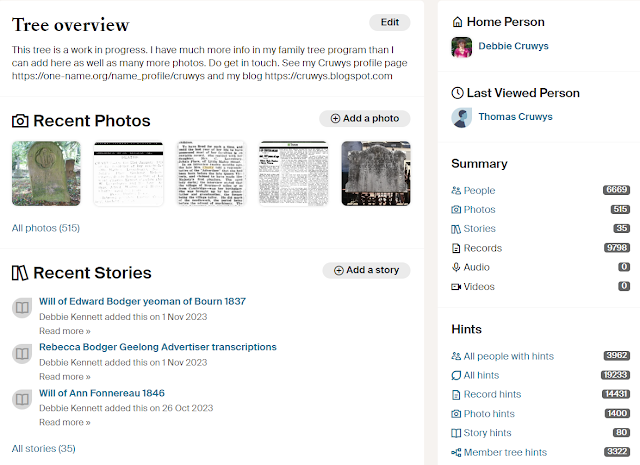
For all these reasons, over the last few years I've been slowly going through the process of trying to expand my tree on Ancestry by adding in all the research that I've done over the last twenty years which has been carefully stored in Family Historian. Rather than uploading a GEDCOM file and losing all the linked records and DNA matches I took the decision to curate my tree manually. I am gradually working through all the different branches of my tree adding census entries, uploading certificates and photos and linking them all to my tree. I've benefited greatly from the research that others have shared with me so I am effectively paying forwards the favour. This process has been invaluable in its own right. When I started out I was mostly working with indexed records and transcriptions. Increasingly records have been digitised and I am now able to link to census pages and original parish register records. I'm also making some very interesting new discoveries because of the consolidation process and because the hints often lead me to records which I hadn't previously discovered.

By adding sources to my tree I'm also hoping that my tree will have better exposure on Ancestry so that people can find my research. I'm also hoping that it will help to counter some of the mistakes I've found in some of the other online trees. Ancestry do not tell us how their algorithms work but it seems that the more sources you have linked to a person the more likely it is that your tree will appear in the hints list for other researchers.

I've made good progress but there is still a lot more work to do. However, I'm pleased to report that I've completed the work on my own Cruwys family. My tree on Ancestry now encompasses my own Cruwys family from Winkleigh, the Cruwys Morchard tree, and the Mariansleigh tree. The Winkleigh and Cruwys Morchard trees link together in the mid-1400s. I know from the Y-DNA testing for my Cruwys DNA Project that the Mariansleigh Cruwyses are related to the Winkleigh and Cruwys Morchard families but I have been unable to document the connection. It does not help that the parish registers for the period in question have not survived. However, I have a second connection to the Mariansleigh Cruwyses through the Eastmond family so I was able to link them into one big tree. The Mariansleigh Cruwyses are by far the most numerous branch of the family so it took me some time to add all these records. If you're connected to any of these Cruwys families do check out my tree. You can find it on Ancestry here. If you have any additional information on these families I would be delighted to hear from you.

One of my next steps will be to build out trees on Ancestry for all the other Cruwys families I've researched as part of my one-name study. The Y-DNA project has shown that we have two distinct Cruwys groups which do not share a common ancestor and which belong to two completely different haplogroups. To make the work easier I am intending to upload a GEDCOM file for these other Cruwys families to a separate tree on Ancestry. I will then repeat the process of linking in all the census entries, parish registers and other records. I know it will take me some time to do this but it will be very worthwhile and will help to make my research more accessible.

Friday, 5 February 2021

Changes at the top at Ancestry

At the beginning of December 2020 it was announced that Margo Georgiadis, Ancestry's President and CEO, was planning to step down at the end of the year. Georgiadis joined the company in 2018 and presided over the launch of the short-lived AncestryHealth test in the US which was subsequently discontinued in January 2021. During her tenure the subscriber base expanded to 3.6 million and the AncestryDNA database grew to nearly 20 million people. 

At the end of January, Ancestry announced that Mark Thompson, the former Director General of the BBC, had been appointed as Chairman of the Board at Ancestry.  Here is the text of the press release from Ancestry:
LEHI, Utah and SAN FRANCISCO -- Jan. 29, 2021-- Ancestry®, the global leader in family history and consumer genomics, today announced the appointment of Mark Thompson as chairman of the board.

Thompson formerly served as President & CEO at The New York Times Company, where he led the 170-year-old brand’s transformation into the world's fastest-growing and most successful news digital subscription business. During his tenure, digital subscriptions grew nine-fold to over five million and the company's market cap increased nearly five times.

Thompson’s appointment at The New York Times Company followed an eight-year term as Director General (CEO and Editor-in-Chief) of the BBC. He is widely credited with expanding the BBC’s digital and global reach and overseeing development of the BBC iPlayer. He joined the BBC from Channel 4, where he was Chief Executive from 2002 to 2004.

“I'm honored to be named as Chairman of the Board for Ancestry and excited to support the next chapter in the company's success,” said Thompson. “Ancestry is already the world leader in its category but I believe it has the potential to grow much further. I’m looking forward to working with the board and management team to build the business through innovation, product enhancements and investment in records, technology and data science so that many more people around the world can embark on their own journeys of personal and family discovery."

David Kestnbaum, a Senior Managing Director at Blackstone, and Sachin Bavishi, a Managing Director at Blackstone, said “Mark’s long history of leadership, coupled with his successful track record in leading subscription and content businesses makes him an ideal Chairman. He brings a great deal of skill and strategic expertise to Ancestry. The company and the board look forward to working closely with him to accelerate Ancestry’s next phase of growth.”

Thompson was educated at Stonyhurst College and Merton College, Oxford.

This week, a few day's after the announcement of Thompson's appointment, Ancestry's Board of Directors announced that they had appointed Deborah Liu as their new Chief Executive Officer. Here is the text of the press release from Ancestry:

LEHI, Utah and SAN FRANCISCO -- February 2, 2021-- Ancestry®, the global leader in family history and consumer genomics, today announced that its Board of Directors has appointed Deborah (Deb) Liu as Chief Executive Officer and a member of the company’s Board of Directors, effective March 1.

Liu joins Ancestry from Facebook where she most recently created and led Facebook's Marketplace product group. Prior to Facebook, Liu held leadership roles at eBay and PayPal. Liu is actively involved in promoting diversity and women in technology and co-created the Women in Product​ nonprofit. She is also a member of the Board of Directors of Intuit Inc.

“It’s an honor to join Ancestry. I’m excited to help craft the company’s next chapter, accelerating growth in Family History subscriptions and AncestryDNA by bringing the product to more people around the world,” said Liu. “I have tremendous admiration for Ancestry’s rich history and powerful mission to empower journeys of personal discovery to enrich lives. Finding and sharing our family history and understanding the challenges and triumphs our ancestors faced helps u​s feel a greater sense of connection and belonging and ultimately realize our shared humanity.”

“Ancestry already leads the field in its category but still has the potential to attract many new customers and grow its business still further,” said Mark Thompson, chairman of Ancestry’s Board of Directors. “In the course of an extensive search, it became clear to all of us that Deb was the perfect next CEO of Ancestry. She has a proven track record of product innovation and deep experience in building global consumer technology platforms. She is an outstanding leader able to inspire and motivate teams to achieve their goals.”

David Kestnbaum, a Senior Managing Director at Blackstone, and Sachin Bavishi, a Managing Director at Blackstone, said: “Deb is a terrific leader with a very strong track record of driving innovation and growth, as well as building world-class product and technology platforms. We are excited about Ancestry’s future and look forward to partnering with Deb as she leads the company into its next phase of growth.”
What does this mean?
These moves would appear to signal a welcome change of direction for Ancestry and a return to their core genealogy market with the aim of increasing family history subscriptions around the world and expanding sales of the AncestryDNA test in the international market. Of all the DNA testing companies, Ancestry has the smallest presence in the global market and their test is only sold in just over 30 countries so there is plenty of room for growth.

Friday, 15 January 2021

AncestryDNA's health test is to be discontinued


Bloomberg News reports that Ancestry are discontinuing their health test after just over a year to focus on their core family tree business. This will lead to the loss of 77 jobs. These job losses are on top of the 100 redundancies announced in February 2020 which were attributed to “a slowdown in demand across the entire DNA category” now that “most early adopters have entered the category.”  

There has also been speculation that sales of DNA kits have slowed because of privacy concerns and the use of genetic genealogy databases by law enforcement agencies in the US, though this effect has been difficult to quantify. Ancestry's Guide for Law Enforcement states:
Ancestry does not voluntarily cooperate with law enforcement. To provide our Users with the greatest protection under the law, we require all government agencies seeking access to Ancestry customers’ data to follow valid legal process and do not allow law enforcement to use Ancestry’s services to investigate crimes or to identify human remains.
However, the media reporting often conflates Ancestry with FamilyTreeDNA and GEDmatch, the two ancestry companies that do permit law enforcement access so there might well have been an indirect effect. 

Ancestry's health product, known as AncestryHealth, was launched to a great fanfare in October 2019, but the test was only ever available to customers in the US.

It was announced in August that Ancestry was to be acquired by the investment company Blackstone, though GIC, a sovereign wealth fund in Singapore, would continue to maintain a minority stake in the company. The $4.7 billion acquisition was duly completed in December 2020. At the same time, we learnt that Margo Georgiadis, Ancestry's President & CEO, was going to leave the company at the end of 2020. A new CEO is expected to be appointed in early 2021 who will "drive the next phase of the company's ongoing growth". Georgiadis was only appointed in 2018. In a blog post announcing her departure Ancestry said that during her tenure:
the company has grown to more than 3.6 million subscribers and built the largest consumer DNA network in the world with nearly 20 million people. Ancestry’s core Family History subscription revenue, which anchors the company, has reached $1 billion. The company has also dramatically strengthened margins and delivered record-setting cash flow.
Clearly sales of AncestryHealth have not met expectations but this may be good news for genealogists and we might well see more investment in the genealogy and genetic genealogy side of the business.

Blackstone's acquisition of Ancestry was apparently done with an eye on expanding Ancestry's appeal in international markets. The AncestryDNA test is currently only available in just over 30 countries, and is not sold in some major European countries such as France, Italy and Spain. The test was at one time sold in Belgium but was withdrawn last year for undisclosed reasons. The market might well have reached saturation point in the US but there is still plenty of scope for expansion in the rest of the world. It will be interesting to see what happens in the coming year.

Update 22nd January 2021
Three further articles provide more information about the discontinuation of AncestryHealth:

Sunday, 20 April 2014

Guild of One Name Studies 2014 Conference in Ashford, Kent

Last weekend I spent a very enjoyable couple of days in Ashford in Kent at the Guild of One-Name Studies' Conference. I do not like driving on motorways at the best of times, and especially not the M25, so I decided to travel by train, which gave me the chance to see for the first time the interior of the magnificently restored St Pancras Station, the terminus for the Eurostar services to Europe, and where I picked up my connection for Ashford International Station. The Ashford train is on the new high speed line to the Kent coast with shiny new carriages that are so posh that I thought I'd sat down in first class by mistake! At Ashford station I met up with fellow Guild members Jennifer Tudbury and Denise Bright who were sharing the lift with me from the station to the hotel. Cliff Kemball, who organised the conference with Bob Cumberbatch, had somehow managed to find the time in his busy schedule to act as our chauffeur. We got to the hotel soon after 5.00 pm. After checking in and unpacking there was time for a quick cup of tea and an impromptu Berkshire meeting with Gillian Stevens, Chad Hanna and Ivan Dickason, before heading off to the buffet supper.

After the meal there was an option to attend a presentation by Peter Hagger on the proposed changes that are planned for the Guild's Constitution. Although a somewhat dry subject Peter managed to make the review sound very interesting and gave us much food for thought. We were also given the chance to provide feedback on the proposed changes. Peter's constitutional review was followed by a fascinating talk by local author Bob Ogley on life in nineteenth-century Kent which included anecdotes about some of the famous names associated with the county such as Charles Darwin and Charles Dickens. Many of us then retreated to the bar for a few drinks and a chat.

We had to be up early on Saturday as the programme started at 9.00 am. Derek Palgrave, the President of the Guild, opened the meeting, and Kirsty Gray, the Guild Chairman for the preceding year, provided a review of Guild activities. For the third year running the conference proceedings were livestreamed. The recordings will eventually be spliced and diced and uploaded to the Guild's YouTube channel, provided that the speakers have given permission. I therefore won't go into too much detail about the individual talks but would encourage you to watch the recordings. Until the individual recordings have been uploaded you can watch the proceedings from Day 1 here and the proceedings from Day 2 here. I took my camera with me to the conference but somehow did not manage to take any photographs. I was at the back of the room and not in a good position to photograph the speakers. However, Peter Hagger has very kindly shared his photographs with me and given me permission to publish some of them here. Further photos will appear in the next issue of JOONS - the Journal of One-Name Studies.

The Guild President Derek Palgrave opens the 2014
Conference. Photograph by Peter Hagger.
Dick Eastman was the keynote speaker for the conference, and he was the first speaker on Saturday morning. He shared with us his vision of the future of genealogy which included a strong emphasis on the role of DNA testing, particularly for medical purposes.

Paul Cullen from the Family Names of the UK (FanUK) project, sporting a colourful Mohican haircut, was the next speaker talking on the subject of the Kentish surnames in the FanUK database. His talk was the highlight of the conference for me. I wrote previously about FanUK after attending my first Guild conference back in 2011. The project is attempting to provide a comprehensive database of the family surnames of the UK, and will look at their origins, history and geographical distribution. There are currently 45,281 entries in the FanUK database. Of these, 19,524 are main entries and 27,778 are variant spellings. (The maths doesn't add up because some main entries are also variant spellings of other surnames and vice versa.) For British surnames Reaney and Wilson's sets of early bearers were augmented with references from many different sources such as the fourteenth-century poll taxes, the patent rolls, the feet of fines and the International Genealogical Index. There are 5,308 Irish entries. Woulfe and MacLysaght were corrected and augmented with early name bearers from the Annals of Ulster, the Tudor Fiants, Flaxgrowers and other sources. There are 1,074 Scottish Gaelic names, and 3,650 non-Gaelic Scots names. Finally there are 3,781 recent immigrant surnames (for example, Aziz, Mehmet, Patel and Wong). The project officially ended on the last day of March and is currently 96% complete (there are a few stragglers for the letter W). The database will be published by Oxford University Press and will be available in book form and also as an online database. The copy-editing and production process will take two years, so we are looking at publication some time in 2016. There is further information on the Arts and Humanities Research Council's website. Funding has now been received to continue the research for an additional two years and nine months. The second stage of the project, known as FanUK 2, will allow the researchers to study an additional 15,000 surnames which have over 20 name bearers (the original cut-off point was 100 name bearers). Paul then took us on a tour of some of the Kentish surnames that he has researched for FanUK. Maps generated from Steve Archer's excellent Surname Atlas CD featured very prominently in the presentation.

Cliff Kemball who organised the conference with
 Bob Cumberbatch. Photograph by Peter Hagger.
After lunch there was a panel session on “How I run my one-name study”. Through the wonders of modern technology Tessa Keough joined us from the West Coast of America having bravely got up at an unearthly hour of the morning to contribute to the session. The technology didn't work out quite as planned as we could only hear Tessa and see her slides but we couldn't see her on the video link, but it was nevertheless very exciting that she was able to participate in this way. Paul Howes discussed the collaborative approach adopted by the Howes/House one-name study, and Colin Spencer told us about his Lefever one-name study.

After tea there were breakout sessions provided by the three major genealogy companies, Findmypast, Ancestry and MyHeritage. I went along to the Ancestry session presented by Miriam Silverman which I found very useful. She explained that the much-loved Ancestry Old Search cannot be restored because the underlying code is broken and it can’t cope with the sheer volume of new records that are being added. While we might lament the simplicity of the Old Search it does seem that it is possible to achieve the same results using New Search but sometimes workarounds are necessary. As an aside, note that if you wish to simulate the Old Search experience you can adjust your site preferences by following the instructions here.

There were a number of comments from Guild members that it often takes several extra clicks to do something in New Search. The place name search is probably the most frustrating feature with that infuriating dropdown menu where you are presented with a long list of places that you have no interest in whatsoever, and you have to scroll through to find the one you are interested in. Ancestry recognise the problem and it is hoped to improve the place search but it does not seem to be an immediate priority. Often it is easier to type the place name into the keyword search field. Another complication is that archives sometimes have different names for a parish. This is a particular problem in London. Ancestry will always use both names for indexing purposes.

It is important to understand the record collections so that you can learn how to use them. Miriam cited the example of the British Phone Book collection. It is not possible to search the phone book database by surname alone because of a contractual obligation, and you have to enter both name and place. However, one very handy hint that she gave us is that it is possible to return a list of all surnames in the phone books by doing a generic search.

The partner pages are another useful feature that Miriam brought to our attention. These pages are very helpful if you want to see which records have been digitised and indexed from a particular repository. The example that Miriam gave us was the following link which allows you to see all the records from the London Metropolitan Archives:  www.ancestry.co.uk/london. I presume other partner pages must exist but so far I've not been able to find any.

After the breakout sessions we were gathered together in the foyer for the announcement of the new Committee and postholders. This announcement is normally made at the start of the afternoon session, but this year the deliberations seem to have taken much longer. The big surprise was that Corrinne Goodenough is taking over as Chairman from Kirsty Gray.

Corrinne Goodenough, the new Chairman of the Guild
of One-Name Studies. Photograph by Peter Hagger.
In the evening there was a banquet which provided a good chance for everyone to get together and have a chat. Fortunately this year the band were in a different room so those who wanted to talk could stay behind in the banquet room while others enjoyed themselves on the dance floor.

Jackie Depelle, Bob Cumberbatch and Pam Smith taking
 a twirl on the dance floor. Photograph by Peter Hagger.
Having not got to bed until after 2.00 am the night before I was relieved that we had a late start to the Sunday sessions! There was some confusion over the start times with two competing timetables but it all seemed to work out in the end. I went along to the FamilySearch breakout session hosted by Paul Smart. He provided us with a very useful overview of all the different FamilySearch features. There are now 4.43 billion names in FamilySearch. There are over 100,000 indexers but there are still many more records waiting to be indexed and more indexers are always needed. FamilySearch has a little-known labs feature where they try out new services. One of my favourite FamilySearch features is the wonderful England 1851 jurisdictions map. This map is continuing to be developed and is in the process of being expanded to include Welsh parishes. FamilySearch now provide the facility to export search results in a spreadsheet but you must be signed into your FamilySearch account first before you can do so.

Jayne Shrimpton, the keynote speaker for Sunday, was unfortunately unable to attend at the last minute because of a family crisis. As a result the schedule was juggled around. Bob Cumberbatch moved his talk forward and Dick Eastman kindly stepped in by offering a second talk in the afternoon to fill the vacant slot.

Bob Cumberbatch gave an excellent talk on his top ten free tools for a one-name study. I am already using some of the tools that he recommends but he mentioned some other tools which I have not yet had a chance to explore and which I now hope to find time to investigate. One of the tools he recommended is Evernote which has been recommended to me by a number of other people too. Evernote has a particularly useful OCR (optical character recognition) facility which is very handy for converting digital newspaper images into text files. A similar facility is offered by Google Docs (now part of Google Drive) though file sizes are limited to 2 megabytes. Google Fusion Tables can be used to generate heat maps, and is another tool I hope to explore. Outwit Hub is a scraper which can be used to extract records from a database in an orderly fashion. Jo Tillin has written an excellent blog post on how she uses Outwit hub in her one-name study, and Tony Timmins has also written about Outwit Hub on on his blog. Bob has kindly made his slides available online and they can be downloaded from this link.

Bob Cumberbatch recommends his top ten free tools
 for one-name studies. Photograph by Peter Hagger.
After a break for lunch we returned for a talk on surname mapping from Tyrone Bowes. Tyrone runs a commercial mapping company which trades under the names of Irish Origenes, Scottish Origenes and British Origenes. He produces some nice-looking maps on his website and I was hoping that he might provide us with some hints and tips on how to produce maps for our one-name studies. Instead, he focused on his methodology for pinpointing the “genetic homeland” of a surname. His talk was rather muddled and the methodology was not properly explained. There were also many flaws in the assumptions he made. For example, his method seems to work on the assumption that 37-marker matches all fall within the last 1000 years since the formation of surnames. The reality is somewhat different and we are now finding that when SNP testing is done to determine the subclade some 37-marker and 67-marker matches actually fall within different subclades because of a process known as convergence. As a result, their common ancestor will date back several thousand years.  When investigating matches with other surnames, especially in haplogroup R1b, it is essential to upgrade to 67 markers and to get some basic SNP testing done to determine the subclade. Tyrone is also drawing conclusions on surname origins based on matches within the Family Tree DNA database. However, the FTDNA database is very US-biased. It is estimated that around 70% of the people in the FTDNA database are in America. Close matches with other surnames will, therefore, more often than not be an indication of non-paternity events in America in the last few hundred years rather than in the British Isles. There was only a short time for questions and there was not time to discuss all these problems, but if anyone is interested in reading more on the limitations of the methodology it is worth looking at this lengthy discussion on the Anthrogenica Forum.

Time for questions after the talk by Tyrone Bowes.
 Photograph by Peter Hagger.
We were finally treated to a very interesting talk on cloud computing for genealogists by Dick Eastman. Despite being asked to give the talk at very short notice, he still went to great trouble to anglicise his talk by using British English spellings and converting the dollars into pounds, though a few astute Guild members did manage to catch him out and tease him about a few Americanisms that got overlooked! Dick's slides can be downloaded from: http://www.eogn.com/handouts/cloud

There was just time for afternoon tea and a final chat with a few more friends before it was time to depart and make our way home. Lifts to the station were kindly arranged for those of us travelling by train.

Although it is now possible to attend the Guild conference virtually by watching the livestream or by watching the recordings at a later date to my mind the best part of the conference is the fact that we have the chance to meet up with our fellow Guild members and get to network with them. I was particularly pleased to have the chance to meet some of the Guild members that I “know” on Twitter including Paul Carter, Amelia Bennett, and Maggie Gaffney. Next year we have vowed to have a tweet up so that all the Guild members who are on Twitter can get together. There were also many people I would like to have had the chance to meet but the opportunity did not arise.

The next conference is scheduled to take place from 17th to 19th April 2015 at the Forest Pines Hotel in North Lincolnshire so put the date in your calendar now!

Further reading
- Christine Hancock's report from the Conference
- Dick Eastman's account of his weekend at the Conference

© 2014 Debbie Kennett


Monday, 21 January 2013

New Conditions of Use and Privacy Policy for SMGF site

Two new updates have been made to the Sorenson Molecular Genealogy Foundation website in the last week.

1) New Conditions of Use which took effect from 15th January:

www.smgf.org/terms.jspx

2) A new Privacy Policy which similarly took effect from 15th January (retrieved from the Wayback Machine):

https://web.archive.org/web/20130122122334/www.smgf.org/privacy.jspx

The Sorenson Molecular Genealogy Foundation was acquired by Ancestry.com in March 2012.  Ancestry have previously indicated that the SMGF site "will continue to operate for the foreseeable future". However, in October 2012 it was announced that Ancestry was to be acquired by the European private equity firm Permira. The sale was completed in December 2012.

It remains to be seen what will happen to the SMGF database now that ownership has effectively passed from Ancestry to Permira. The forms on the SMGF website clearly state that the database is now owned by AncestryDNA but do not mention the acquisition by Permira. The terms of the new conditions suggest that in future it will probably be necessary to "register for an AncestryDNA account in order to access certain services".

The new Privacy Policy allows for the sale or transfer of SMGF assets:
As our business continues to grow, we might buy or sell subsidiaries or business units. In these transactions, personal information is often one of the transferred assets. Also, in the event that AncestryDNA, or substantially all of its assets are acquired, personal information will, as a matter of course, be one of the transferred assets.
If you have submitted a DNA sample to SMGF I would suggest you review the new Conditions of Use and Privacy Policy. It should be noted that you have the right to remove your DNA record from the SMGF database. Instructions can be found on the SMGF Consent Form which specifically states:
Participation in this study is strictly voluntary. You may choose not to participate. You also have the right to end your participation at any time, and to decide whether the biological sample, genetic information, or genealogy you provided can remain part of the study or must be destroyed.
The consent form can be found here: 

https://web.archive.org/web/20120721015714/www.smgf.org/resources/forms/ConsentForm_English.pdf 

[The original link is no longer accessible. The above link now points to the consent form dated May 2008 retrieved from the Wayback Machine.]

The consent form also states: "You will be told about any new information that might change your decision to be in this study."

As far as I am aware SMGF participants have not yet received any communications from AncestryDNA or Permira to advise them of the sale, the new Privacy Policy and the changed Conditions of Use. I hope this situation will soon be rectified.

© 2013 Debbie Kennett

Saturday, 27 October 2012

Shareholders sue Ancestry.com over proposed buyout

Further to the announcement earlier this week that Ancestry.com was to be sold to the European equity firm Permira, it now transpires that Ancestry shareholders have sued the company and are contending that they will be "shortchanged" by the proposed $1.6 billion buyout.

Business Week reports that investor John Heck has "asked the court to block the buyout as currently proposed and to consider awarding damages and legal fees". They further comment that Heather Erickson, an Ancestry.com spokeswoman, "didn't immediately return an e-mail message seeking comment on the lawsuit".

The full story can be found here.

Debbie Kennett

Wednesday, 24 October 2012

What next for Ancestry.com?

The big news in the family history world this week is the announcement that the genealogy website Ancestry.com is to be acquired for $1.6 billion by the European private equity firm Permira. It remains to be seen what effect this will have on the company. Ancestry's third quarter accounts were released today, which show that the company continues to make a healthy profit and, as of 30 September 2012, had around 2,020,000 subscribers. Within the genetic genealogy community we are wondering what impact this acquisition will have on Ancestry's DNA testing programme. In the official press release Ancestry and Permira stated the following:
There are no anticipated changes in Ancestry.com's operating structure. Ancestry.com's focus will continue to be on investing in content, technology and its user experience, expanding its product offerings in areas like DNA, and building the Ancestry.com brand and the family history category, all on a global basis. Ancestry.com will remain headquartered in Provo, Utah, with a continued large presence in San Francisco, Dublin, London and other international markets.
Ancestry started offering Y-chromosome DNA (Y-DNA) and mitochondrial DNA (mtDNA) tests in 2007 after acquiring the assets of the now defunct company Relative Genetics. These tests are no longer being actively marketed, and Ancestry have instead focused all their attention on their new autosomal DNA test which was launched in May 2012. It remains to be seen whether this test will be marketed outside the US. As I commented when I reviewed the test on this blog earlier this year, it is very much geared towards the American market with its emphasis on ethnicity percentages. The database is also 99.9% American and anyone who does not have Colonial American ancestry will gain little if any benefit from the test at present.

A significant drawback of the Ancestry autosomal test, in comparison with the equivalent offerings from Family Tree DNA and 23andMe, is that you are not able to access your raw genetic data and you are also not given any segment matching data. This makes it impossible to interpret your results in any meaningful way, and prevents you from uploading your results to third-party tools such as GedMatch for further analysis. I wrote to Ancestry about this problem in August. Other bloggers, including CeCe Moore and Judy Russell, have also been campaigning for Ancestry to make the raw genetic data available to customers. It is therefore gratifying that Ancestry have listened to the criticisms and have now announced that they will make the data available to customers some time in 2013.

However, the problems with Ancestry's admixture tools have yet to be resolved. My own documented ancestry, as far back as I can trace it, is all from the British Isles, yet according to the Ancestry test I am 58% Central European, 25% British Isles, 13% Eastern European and 4% unknown. I wrote about this aspect of the testing in more detail in a previous blog post. In contrast many of the Americans who are my genetic cousins have much higher percentages of  "British" ancestry, despite having a large proportion of their documented ancestry from other European countries. For example, the American blogger Roberta Estes, who has also commented on the deficiencies of Ancestry's admixture results, reports that according to Ancestry she is 80% British Isles, 12% Scandinavian and 8% unknown. However, Roberta's genealogy research shows that only 22% of her ancestry is from the British Isles, with her remaining known ancestry being from a variety of different European countries. There is, of course, a perfectly simple explanation for these discrepancies. The ethnicity predictions are based on a very limited number of publicly available datasets from reference populations, and the sequences that are in the public domain often have little in the way of accompanying ancestral information. For those people of British ancestry more detailed analyses should be possible once the People of the British Isles Project start to publish their results later this year. Other companies are more open about the limitations of the tests and publish details of the reference populations they use. For example, Family Tree DNA use a population from the Orkney Islands as a proxy for British DNA. Ancestry unfortunately have not released details of the reference populations they are using for their calculations. They have access to the same public datasets as the other companies. In addition, Ancestry purchased the assets of the Sorenson Molecular Genealogy Foundation (SMGF) in March 2012, and may have access to data from the SMGF database. However, they almost certainly do not have any data from any large British reference populations and it seems that the most plausible explanation for the bizarre results that we are seeing from Ancestry is that their "British" populations are probably Americans from Salt Lake City with mixed European ancestry rather than people living in the British Isles like me with many generations of documented British ancestry.

We are all aware of the limitations of these tests, and there will no doubt be many improvements in the years to come as more reference populations become available allowing the companies to provide more accurate results. Ancestry's autosomal test is in any case still in the beta-testing phase as is FTDNA's Population Finder tool. I am, however, concerned that Ancestry are compounding the problem by presenting the data in a very misleading and dishonest way. A link was posted on the ISOGG Project Administrators' mailing list this week to a new video that is now available on Ancestry's YouTube channel.

In this presentation Ancestry's blogger Crista Cowan provides a somewhat dumbed down overview of the Ancestry autosomal DNA test. However, what is of most concern is that nowhere in the video does Crista admit the limitations of Ancestry's admixture result. Instead she is trying to suggest that the reason why people are getting these unexpected percentages is because they haven't yet researched all their family lines. In other words it is not Ancestry's fault but the customers' for not doing their research properly! We are supposed to believe, for example, that there was some significant migration from Germany to Scotland which might account for some of these unexpected results. I was told by an Ancestry rep that there might have been a large migration from Eastern Europe to account for the 13% of my DNA that is supposedly from Eastern Europe. This is all of course total nonsense. It might well suit Ancestry's purpose to encourage people to search for their phantom ancestors throughout Europe to explain their mysterious DNA results. They are undoubtedly selling their test at $99 as a loss leader and are hoping to make up the deficit by increasing their subscription revenue. It is in their interests to encourage people to renew their subscriptions and to reduce the churn level. I just hope that most people have the good sense not to be taken in by this misleading hype.

For anyone who has had unexpected results from the Ancestry test I would advise that you provide the company with feedback and, more importantly, ask them to publish the information about the reference populations they are using. If enough pressure is brought to bear on Ancestry then perhaps they will make this information available so that the admixture results can be put into context.

© 2012 Debbie Kennett

Thursday, 6 August 2009

Genealogy companies in the news

There have been some interesting developments in the genealogical world in the last few days. On 3rd August it was announced that Ancestry.com will be selling shares to the public for the first time in what is known as an initial public offering (IPO). A report can be found on the Techcrunch website. As part of the process Ancestry were required to file a Registration Statement with the Securities and Exchanges Commission in America. The full document can be read online here. There are some interesting facts and figures concealed in the small print:

- In the six months ending 30th June 2009 Ancestry had 990,959 subscribers, compared to 913,683 in the equivalent period in 2008.

- Revenues from subscribers in the United States, the United Kingdom and other countries collectively were 74%, 19% and 7%, respectively, in the first half of 2008 compared to 76%, 16% and 8%, respectively, in the first half of 2009.

- Ancestry plan to launch a new multi-language website called Mundia.com later this year. No further details are provided.

- The BBC television programme "Who do you think you are" was largely responsible for an increase in Ancestry subscribers in the UK: "Our subscriber additions were 569,851 in 2006, principally driven by the airing of “Who Do You Think You Are?” in the United Kingdom, and 479,663 in 2007".

- Ancestry have already purchased "product integration" in anticipation of the launch of the US version of “Who Do You Think You Are?” in 2010. They are no doubt hoping that the programme will have a similar impact on subscriptions in the US. (The US programme was initially scheduled to be shown in April 2009 in the US and in the summer of 2009 in the UK, but was postponed at the last minute for unknown reasons and the revised dates have not yet been announced.)

Yesterday it was reported in The Guardian that Ancestry was one of the companies in the running to purchase Friends Reunited and Genes Reunited from ITV. The other prime candidate was Ancestry's main UK rival Brightsolid, the parent company of Findmypast.com and Scotland's People. In the event Brightsolid emerged as the eventual winners and the news of the purchase was officially announced today on their website. There was another report on the acquisition on the BBC website. (As an intriguing aside I was amused to learn from the BBC report that the German equivalent of the reality TV programme "I'm a celebrity… " is known as "Ich bin ein Star"!)

I suspect the future of Friends Reunited is now in doubt as it has effectively been superseded by Facebook. In contrast, Genes Reunited is a thriving community with nine million loyal members, and it has proved to be an effective way of making contact with other family history researchers in the UK. The interface is however very clumsy and there is plenty of room for improvement. It will be interesting to learn what plans Brightsolid have for the site in the coming months.