Showing posts with label AncestryDNA. Show all posts

Friday, 15 April 2022

Comparing ethnicity estimates and ethnicity inheritance results from AncestryDNA for a child and her parents

I wrote about AncestryDNA's new SideView technology and the new ethnicity inheritance tool earlier this week. My results for my parents weren't yet available when I wrote the post and I thought it would be interesting to do a three-way comparison.

Ethnicity estimates


Debbie's dad
My dad's ancestry within the last few hundred years is all English apart from one maternal great-great- grandfather who is from Scotland. His paternal side is from Devon, Bristol and Gloucestershire. His maternal side is from Essex, Hertfordshire, Oxfordshire and London. Here is his updated ethnicity estimate.

The ranges are:
  • England and Northwestern Europe 49% to 69%
  • Wales 2% to 28%
  • Scotland 0% to 30%
  • Sweden and Denmark 0% to 16%
  • Norway 0% to 15%.
The ranges can be found by clicking on the country names.

Debbie's mum
My mum's ancestry in the last few hundred years is all from England apart from one paternal great-great-grandmother from Ireland. Her paternal ancestry is from Hampshire (via London), Somerset and Ireland. She has an unknown paternal great-grandfather who is probably from Oxfordshire. Her maternal ancestry is from Hertfordshire, London, Hampshire, Berkshire, Bedfordshire, Buckinghamshire, Gloucestershire and Wiltshire. Here is her updated ethnicity estimate.

The ranges are:
  • England and Northwestern Europe 70% to 100%
  • Wales 0% to 17%
  • Ireland 0% to 17%
  • Norway 0% to 5%.
Debbie
Here is my updated ethnicity estimate.
The ranges are:
  • England and Northwestern Europe 65% to 99%
  • Scotland 0% to 29%
  • Wales 0% to 18%
  • Ireland 0% to 9%
I am disregarding Norway, Sweden and Denmark in the results for my parents as noise. The reference population labelled as Wales actually stretches into North Devon, North Somerset, Bristol, Gloucestershire and Herefordshire so this may be a real representation of my dad's paternal ancestry from Devon, Bristol and Gloucestershire and my mum's maternal ancestry from Gloucestershire. There was a big migration from North Devon to South Wales in the 1800s with people moving to Wales to work in the copper and coal mines so many people from South Wales have Devon ancestry which may account for the overlap. The Scotland component is over-represented in many people at AncestryDNA and this reference population probably should have been labelled as Scotland, Ireland and England.

The genetic communities (also known as regions) are uncannily accurate. It's interesting to note how I get Gloucestershire, Wiltshire and Oxfordshire as a region despite the fact that neither of my parents has this region. This can easily explained by the fact that both of my parents have ancestry from both Gloucestershire and Oxfordshire so I actually get a double dose of DNA from these counties.

Ethnicity inheritance overview


Debbie's dad
This is the ethnicity inheritance overview and detailed comparison for my dad. If the Welsh component represents my dad's paternal ancestry from Devon, Bristol and Gloucestershire then Parent 1 is his dad. However, my dad's Scottish ancestry is on his mother's side yet the Scottish percentages appear in both parents but are much higher for Parent 1 than Parent 2. I therefore do not feel confident in assigning parental sides to these results.

Debbie's mum
This is the ethnicity inheritance overview and detailed comparison for my mum. Ireland only appears in Parent 1 and Wales only appears in Parent 2 so I am assuming that Parent 1 is her father and Parent 2 is her mother.
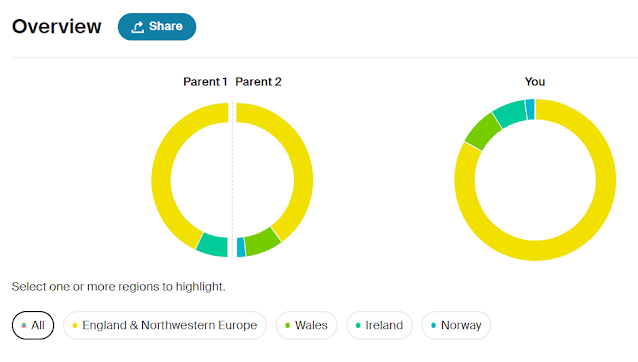
Debbie
Here is my ethnicity inheritance overview and detailed comparison. The Scotland component is the odd one out here as it appears in both parents whereas it is only reported in my dad's results. Ireland only appears in Parent 1. I had originally assumed therefore that Parent 1 is my mum. However, the absence of Wales on my dad's side is surprising given that he had a much higher percentage of the Welsh component than my mum so it's quite possible that Parent 1 and Parent 2 are the other way round instead.

Conclusion

SideView is an innovative new technology from AncestryDNA and I remain excited by the possibilities it has opened up. While the "ethnicity" estimates are still a work in progress they are a huge improvement compared to the early days of autosomal DNA testing. When I received my first biogeographical ancestry report from 23andMe back in 2010 they were only able to tell me that I was 100% European. We are now getting much more granularity within Europe, even if the country-level assignments, especially with the low percentages, are not very accurate. We can expect the results to improve over time. AncestryDNA regularly add new regions and provide updated ethnicity estimates every year. We can probably expect a further update this summer or in the autumn. 

The genetic communities are worked out in a different way and are based not on reference populations but on large segments of DNA shared in genetic networks. They are reflective of our recent ancestry within the last 200-300 years. They are remarkably accurate and for most people generally correspond with their known ancestry. Another possible application for the SideView technology would be to assign genetic communities to parental sides though, as in my case, it may be that some communities would need to be assigned to both sides. We have much to look forward to this year!

Wednesday, 13 April 2022

SideView: a new method for assigning matches and biogeographical ancestry to paternal and maternal sides at AncestryDNA

I am fortunate that I have been able to test both of my parents at AncestryDNA which means that I am able to determine whether my matches are on the paternal or maternal sides. For matches sharing over 20 centiMorgans (cM) AncestryDNA automatically label matches as belonging to the father's side or the mother's side if you have tested your parents. This does of course mean that matches sharing lower amounts of DNA are not labelled, though I can still check to see which parent matches my cousins and I can assign the match manually using the relationship assignment tool. Some matches cannot be assigned to a side as they do not match either of my parents and are therefore probably false matches, though this is less of a problem now that AncestryDNA have removed all the 6 and 7 cM matches which accounted for the bulk of the false matches.

Sorting matches into paternal and maternal sides is a much more difficult and time-consuming process when working with DNA results when data from the parents is not available. When working with my parents' matches I use the Shared Matching Tool and the coloured dots to group the matches into clusters. If I can work out the relationship with the match or assign a common ancestral couple to the cluster I can then manually assign the matches in the cluster to the paternal or maternal side but this is a slow and laborious process.

Wouldn't it be wonderful if the parental sides could be determined automatically? Fortunately that is now likely to be a reality in the very near future thanks to some ground-breaking new research from the scientists at AncestryDNA. 

AncestryDNA have developed a new methodology known as SideView which allows them to separate out the DNA inherited from each parent throughout the genome without the parents taking a DNA test. SideView will be used to power a number of new DNA features at AncestryDNA in the coming months. It will eventually allow us to see our matches separated by parental side and there will be genetic community and journey patterns for each parental side. The sides will be labelled for all of our matches down to 8 cM but the methodology is not perfect and there will be around 15% or 20% of our matches that aren't labelled. There will also some people with both parents falling in the same group and their matches will be labelled as both sides. This applies to about 3% of the AncestryDNA database.

The technology also opens up many exciting possibilities for the future. AncestryDNA now provide traits reports so I wonder if it might one day be possible for them to identify which traits have been inherited from each parent.

"Ethnicity" inheritance
The first feature enabled by this new SideView technology is known as ethnicity inheritance. If you log into your Ancestry account you should now see this new feature which allows us to see which biogeographical ancestries we have inherited from each of our parents.  It may take a while for the feature to roll out to the entire database. (As a side note, the term ethnicity in this context is a misnomer because ethnicity refers to our social, cultural, religious and linguistic heritage and is not necessarily a reflection of our genetic ancestry inheritance though there is often some overlap.) Despite the quibble about the name, this is potentially a very useful tool, particularly for those people who know nothing about their ancestral origins.

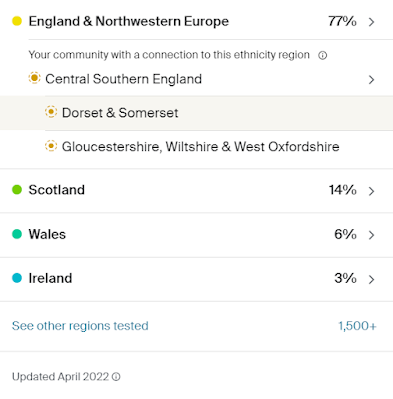
In addition to the rollout of the ethnicity inheritance feature, our "ethnicity" estimates have also been updated based on the new technology, though no new regions have been added in this latest update. Here is my updated "ethnicity" estimate: 

England has gone up from 71% to 77% since the last update in July 2021. Scotland has dropped from 20% to 14%, Wales has decreased from 8% to 6% and Ireland has gone up from 1% to 3%. The results are not too far off my documented ancestry though the Scottish percentages are still too high. I have one maternal great-great-great grandparent from Ireland and one paternal great-great-great grandparent from Scotland. All my other documented ancestry is from England. Ancestry's Wales region extends across the English border into Gloucestershire which probably explains my Welsh assignment.

As a reminder, it's always worth clicking on the country name to see the ranges for each different ancestry. As you can see, the range for my Scottish component is anywhere between 0% and 29%.

When you log into your account you will now be invited to view the new "ethnicity" inheritance feature.
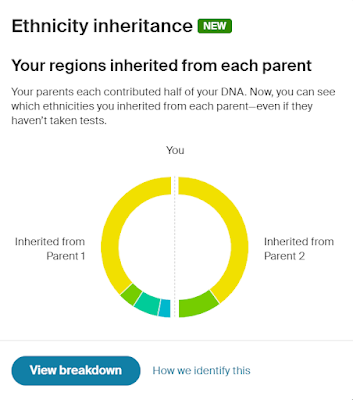
Ancestry explain that your parents contributed to half of your DNA. You can see which ancestries you have inherited from each parent even if they haven't taken a DNA test. It is important to remember that this is not providing an estimate for our parents as we only have 50% of our DNA from each of our parents so they will have DNA that we don’t. If you are able to test your parents then you will receive insights into the DNA that they have inherited from your grandparents. For those of us who have tested our parents the ethnicity inheritance feature is currently based on the SideView technology rather than using the data from your parents, though of course your parents are your matches so they are considered part of the process.

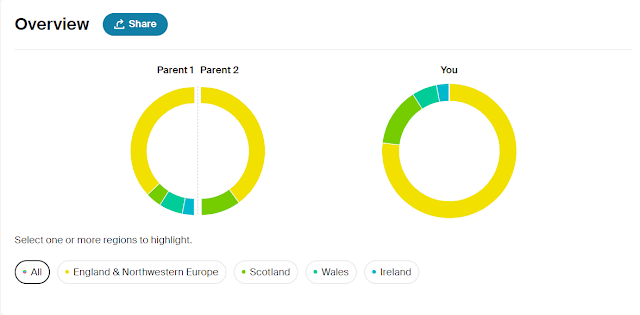
If you click on "View breakdown" you will be able to see your overview report comparing your ancestry breakdown with the two halves inherited from your parents.

There is also a detailed comparison showing the information in a tabular format.

The algorithm is not able to identify which parent has contributed the ancestries to the different parental sides but from the evidence of my family tree I can infer that Parent 1 with England, Scotland, Wales and Ireland is my mum (though she has no Scottish ancestry) and Parent 2 is my dad. Ancestry intend to provide us with an Edit Parents button which will allow us to label the parental sides if you are able to determine which parents have contributed the different ancestries to your DNA. The "ethnicity" features will be integrated with the match lists and vice versa so any changes you make will be reflected throughout the entire website.

Technical details
The new SideView system uses the power of AncestryDNA's massive database of over 21 million people and the vast networks of shared matches. It works on the premise that the DNA we share with our matches is only shared on one parental side. This means that if the matches can be sorted into two separate groups it will be possible to determine which side of your DNA is associated with each parent. Ancestry have found a way to assign matches into parental groups by looking at the segments of DNA shared in common with our matches. 

AncestryDNA claim that because of the size of their DNA database, SideView groups matches with a precision rate of 95% for 90% of Ancestry customers. With 11.5 million people in the database the accuracy drops to 85% for the majority of customers. With a database of five million the accuracy is around 65% and with a million people it is 50%.

Ancestry have published an excellent article in their Support Centre explaining how the SideView technology works.

There is also a new article in the Support Centre explaining how "ethnicity" inheritance works.

They are also planning to have some interactive educational material available soon using animated GIFs to explain how DNA inheritance works and to give people a better understanding of the new SideView technology. 

The full technical details of the methodology behind SideView have been published in a new preprint by the AncestryDNA scientists Keith Noto and Luong Ruiz. The paper is entitled "Accurate genome wide phasing of IBD data" and is available on the BioRxiv preprint server: https://doi.org/10.1101/2022.04.11.487932. 

AncestryDNA have also lodged a patent application with the United States Patent and Trademark Office which provides further highly technical information: https://uspto.report/patent/app/20210034647

There will also be an updated "ethnicity" white paper which will be available in a couple of months.

Further reading 

Friday, 5 February 2021

Changes at the top at Ancestry

At the beginning of December 2020 it was announced that Margo Georgiadis, Ancestry's President and CEO, was planning to step down at the end of the year. Georgiadis joined the company in 2018 and presided over the launch of the short-lived AncestryHealth test in the US which was subsequently discontinued in January 2021. During her tenure the subscriber base expanded to 3.6 million and the AncestryDNA database grew to nearly 20 million people. 

At the end of January, Ancestry announced that Mark Thompson, the former Director General of the BBC, had been appointed as Chairman of the Board at Ancestry.  Here is the text of the press release from Ancestry:
LEHI, Utah and SAN FRANCISCO -- Jan. 29, 2021-- Ancestry®, the global leader in family history and consumer genomics, today announced the appointment of Mark Thompson as chairman of the board.

Thompson formerly served as President & CEO at The New York Times Company, where he led the 170-year-old brand’s transformation into the world's fastest-growing and most successful news digital subscription business. During his tenure, digital subscriptions grew nine-fold to over five million and the company's market cap increased nearly five times.

Thompson’s appointment at The New York Times Company followed an eight-year term as Director General (CEO and Editor-in-Chief) of the BBC. He is widely credited with expanding the BBC’s digital and global reach and overseeing development of the BBC iPlayer. He joined the BBC from Channel 4, where he was Chief Executive from 2002 to 2004.

“I'm honored to be named as Chairman of the Board for Ancestry and excited to support the next chapter in the company's success,” said Thompson. “Ancestry is already the world leader in its category but I believe it has the potential to grow much further. I’m looking forward to working with the board and management team to build the business through innovation, product enhancements and investment in records, technology and data science so that many more people around the world can embark on their own journeys of personal and family discovery."

David Kestnbaum, a Senior Managing Director at Blackstone, and Sachin Bavishi, a Managing Director at Blackstone, said “Mark’s long history of leadership, coupled with his successful track record in leading subscription and content businesses makes him an ideal Chairman. He brings a great deal of skill and strategic expertise to Ancestry. The company and the board look forward to working closely with him to accelerate Ancestry’s next phase of growth.”

Thompson was educated at Stonyhurst College and Merton College, Oxford.

This week, a few day's after the announcement of Thompson's appointment, Ancestry's Board of Directors announced that they had appointed Deborah Liu as their new Chief Executive Officer. Here is the text of the press release from Ancestry:

LEHI, Utah and SAN FRANCISCO -- February 2, 2021-- Ancestry®, the global leader in family history and consumer genomics, today announced that its Board of Directors has appointed Deborah (Deb) Liu as Chief Executive Officer and a member of the company’s Board of Directors, effective March 1.

Liu joins Ancestry from Facebook where she most recently created and led Facebook's Marketplace product group. Prior to Facebook, Liu held leadership roles at eBay and PayPal. Liu is actively involved in promoting diversity and women in technology and co-created the Women in Product​ nonprofit. She is also a member of the Board of Directors of Intuit Inc.

“It’s an honor to join Ancestry. I’m excited to help craft the company’s next chapter, accelerating growth in Family History subscriptions and AncestryDNA by bringing the product to more people around the world,” said Liu. “I have tremendous admiration for Ancestry’s rich history and powerful mission to empower journeys of personal discovery to enrich lives. Finding and sharing our family history and understanding the challenges and triumphs our ancestors faced helps u​s feel a greater sense of connection and belonging and ultimately realize our shared humanity.”

“Ancestry already leads the field in its category but still has the potential to attract many new customers and grow its business still further,” said Mark Thompson, chairman of Ancestry’s Board of Directors. “In the course of an extensive search, it became clear to all of us that Deb was the perfect next CEO of Ancestry. She has a proven track record of product innovation and deep experience in building global consumer technology platforms. She is an outstanding leader able to inspire and motivate teams to achieve their goals.”

David Kestnbaum, a Senior Managing Director at Blackstone, and Sachin Bavishi, a Managing Director at Blackstone, said: “Deb is a terrific leader with a very strong track record of driving innovation and growth, as well as building world-class product and technology platforms. We are excited about Ancestry’s future and look forward to partnering with Deb as she leads the company into its next phase of growth.”
What does this mean?
These moves would appear to signal a welcome change of direction for Ancestry and a return to their core genealogy market with the aim of increasing family history subscriptions around the world and expanding sales of the AncestryDNA test in the international market. Of all the DNA testing companies, Ancestry has the smallest presence in the global market and their test is only sold in just over 30 countries so there is plenty of room for growth.

Friday, 15 January 2021

AncestryDNA's health test is to be discontinued


Bloomberg News reports that Ancestry are discontinuing their health test after just over a year to focus on their core family tree business. This will lead to the loss of 77 jobs. These job losses are on top of the 100 redundancies announced in February 2020 which were attributed to “a slowdown in demand across the entire DNA category” now that “most early adopters have entered the category.”  

There has also been speculation that sales of DNA kits have slowed because of privacy concerns and the use of genetic genealogy databases by law enforcement agencies in the US, though this effect has been difficult to quantify. Ancestry's Guide for Law Enforcement states:
Ancestry does not voluntarily cooperate with law enforcement. To provide our Users with the greatest protection under the law, we require all government agencies seeking access to Ancestry customers’ data to follow valid legal process and do not allow law enforcement to use Ancestry’s services to investigate crimes or to identify human remains.
However, the media reporting often conflates Ancestry with FamilyTreeDNA and GEDmatch, the two ancestry companies that do permit law enforcement access so there might well have been an indirect effect. 

Ancestry's health product, known as AncestryHealth, was launched to a great fanfare in October 2019, but the test was only ever available to customers in the US.

It was announced in August that Ancestry was to be acquired by the investment company Blackstone, though GIC, a sovereign wealth fund in Singapore, would continue to maintain a minority stake in the company. The $4.7 billion acquisition was duly completed in December 2020. At the same time, we learnt that Margo Georgiadis, Ancestry's President & CEO, was going to leave the company at the end of 2020. A new CEO is expected to be appointed in early 2021 who will "drive the next phase of the company's ongoing growth". Georgiadis was only appointed in 2018. In a blog post announcing her departure Ancestry said that during her tenure:
the company has grown to more than 3.6 million subscribers and built the largest consumer DNA network in the world with nearly 20 million people. Ancestry’s core Family History subscription revenue, which anchors the company, has reached $1 billion. The company has also dramatically strengthened margins and delivered record-setting cash flow.
Clearly sales of AncestryHealth have not met expectations but this may be good news for genealogists and we might well see more investment in the genealogy and genetic genealogy side of the business.

Blackstone's acquisition of Ancestry was apparently done with an eye on expanding Ancestry's appeal in international markets. The AncestryDNA test is currently only available in just over 30 countries, and is not sold in some major European countries such as France, Italy and Spain. The test was at one time sold in Belgium but was withdrawn last year for undisclosed reasons. The market might well have reached saturation point in the US but there is still plenty of scope for expansion in the rest of the world. It will be interesting to see what happens in the coming year.

Update 22nd January 2021
Three further articles provide more information about the discontinuation of AncestryHealth:

Tuesday, 1 September 2020

The AncestryDNA matching updates have now been completed

I wrote back in mid July that AncestryDNA would be updating their matching algorithms to provide information on the length of the longest segment and a more accurate tally of the number of matching segments. AncestryDNA also announced that they would no longer be reporting matches that shared a total of 8 cM or less after the application of the Timber algorithm. These changes were rolled out gradually in August with the small matches finally disappearing shortly before midnight last night UK time.

I made a note yesterday afternoon before the small matches disappeared of the number of matches at AncestryDNA for me, my mum and my dad. I've done a before and after comparison along with a comparison of the number of matches, where available, at the other testing companies. The number of 4th cousin or closer matches at AncestryDNA remains unchanged.


I've lost 66% of my matches at AncestryDNA but in reality this is no great loss as so many of these small matches are false matches which don't match either of my parents. Even when the person does match one of my parents I often find that the documentary link is on the wrong side, for example, the person has a DNA match with my dad but I've identified a genealogical link on my mum's side. Even if these small matches are valid, they are far more likely to trace back 10, 20 or 30 generations rather than fall within a useful genealogical timeframe. There are currently no tools which can determine the age of a single segment match and tell us whether we are matching a fifth cousin rather than a twentieth cousin. It's impossible to work with such small DNA matches when probably 95% or more of them are either false matches or very old matches. With whole genome sequencing we will probably have the ability to make these distinctions but that is currently a long way off.  

AncestryDNA previously set a much lower threshold for matching than 23andMe, FamilyTreeDNA and MyHeritage so this update now brings them more into line with the other companies. Ancestry have by far the largest database with over 18 million people tested so it's not surprising that my family have far more matches there than at any other company even after the purge. I was surprised to find that my transfer kit at MyHeritage had nearly 2000 more matches than the test I did directly with the company when I ordered their Health and Ancestry test. 23andMe restrict the number of matches to 2000 and this total includes people in the database who have not opted in to relative matching. However, they have just launched a new invite-only subscription Premium Membership which will provide new health reports as well as additional ancestry features such as the ability to view four times more DNA Relatives. For details see this page on the 23andMe website though you will need to be logged into your 23andMe account to view the page. If this trial is successful we may well see other companies offering access to a more extensive match list for a fee though I suspect that for the vast majority of AncestryDNA users a list of 10,000 or more matches is more than they can realistically handle.  

I've not yet had much time to look at the new information about the number of matching segments and the length of the longest segment. However, if a match only shares a single segment we can now get an idea of how Ancestry's Timber algorithm works because it is applied after the longest segment has been identified. Timber has the effect of downweighting regions where there are large numbers of matches. Matches are only likely to be genealogically relevant if they fall in a region which is shared with just a few cousins in your family rather than being shared with large numbers of people in the general population. Timber is only applied to matches sharing 90 cM or less. For full details see the updated AncestryDNA Matching White Paper.

Unless you're from an endogamous population you'll probably find that Timber has had little or no effect on most of your matches. For my match below, the longest segment size is identical to the total cM shared.
In other cases I am finding minor discrepancies in the matches, sometimes of just one or two cM or, as in the case below, a small reduction of just 0.1 cM.
However, I have found one single segment match where there was a sizeable discrepancy.
This match lives in Canada and has ancestry from Scotland, Wales, Norway and Newfoundland. I can see that the match is on my maternal side. For my mum the match has been similarly reduced in size from 56 cM to 38 cM. My mum has no known ancestry from Scotland, Wales or Norway and I'm not aware of any maternal ancestors or relatives who emigrated to Newfoundland. It seems unlikely that I will be able to document a connection and the fact that the match has been so drastically reduced is probably a red flag that this match should be treated with caution. I've clicked through to look at quite a few more matches but have not found any others with quite such a big discrepancy though I've found a few matches where there is a difference of 5 or 10 cM.

It will be interesting to see if people are able to make use of the longest segment data. I think it might be helpful, as in the example above, in highlighting matches that appear to fall into problem areas and which are likely to be less useful for genealogical purposes. See for example this very interesting blog post from Kalani Mondoy where he has shown how useful the longest segment data has been for him to distinguish between his genuine Hawaiian matches and the very distant Maori matches which are indicative of shared ancestry from about a thousand years ago before the two populations split.

I would hope that AncestryDNA will eventually be able to use the longest segment data to refine the matches for people with ancestry from endogamous populations. I have access to a British Ashkenazi Jewish account at Ancestry where the individual previously had 224,377 matches. After the match reduction there are still 169,928 matches remaining. There is clearly great scope for improving the matching for these populations.


The reduction in matches at AncestryDNA proved surprisingly controversial with some people, particularly those of African American heritage, arguing passionately for their retention. See, for example, this blog post by Fonte Felipe. However, the reduction has taken place and the decision is not likely to be reversed. We need to focus on what we can do and not what we can't do. How are you making use of the new segment data and the information about the longest segment? What tips do you have for making the most of your AncestryDNA matches? Do let me know what you think.

Update 3rd September 2020
AncestryDNA confirmed today in a conference call that they will soon be showing us the unweighted pre-Timber total cM shared. This will allow us to see at first hand how much of an effect, if any, the Timber algorithm is having on our matches. No exact date has been promised but the information is expected to be added to our accounts in the next two weeks or so.

Further reading

Tuesday, 14 July 2020

Some updates to AncestryDNA's matching system and a database update


Ancestry announced at a conference call today that there are some changes in the pipeline in terms of how our matches are reported. There will be three main changes:

1) Ancestry will provide a more accurate report on the number of segments shared with your matches. The updated matching algorithm may reduce the estimated number of segments you share with some. of your DNA matches. However, it won't change the estimated total amount of shared DNA (measured in centimorgans/cM) or the predicted relationship to your matches.

2) Ancestry will report the length of the largest shared segment. This is particularly important for people who are descended from endogamous populations. Knowing the length of the longest segment you and a DNA match have in common can help determine if you’re actually related. The longer the segment, the more likely you’re related. Segment length is also the easiest way to evaluate the difference between multiple matches that all show the same estimated relationship.

3) The matches will be re-calibrated to remove false matches so that the reported matches are more likely to be related through a recent common ancestor. Once the update is implemented, only matches which share 8 cM or more will be reported. Ancestry estimate that this will remove about two thirds of the false matches. All matches that fall below the new threshold will disappear from your match list with the exception of matches you have messaged, matches where you've added a note and matches you have added to a group by using the system of coloured dots. Starred matches will also be retained as they are considered part of a group. If you save a match below 8cM, your match will also have it saved without additional action needed. Any matches sharing less than 8 cM in total will no longer appear as common ancestor hints or in the ThruLines feature and this change may affect the number of ThruLines you see. If you want to save these matches you'll need to make sure you add them to one of your groups or add a note. Note that it is only the total cM shared after the application of the Timber algorithm that is affected so you could still have matches which share some individual segments that are smaller than 8 cM so long as the sum total of all the segments is over 8 cM.

On site messaging will start to appear on the site in the next few days (this messaging is now live) to alert users to the updated matching system and a new matching white paper will be available later this week. (The White paper has now been published and can be accessed here.) We can expect to see the new matching system rolled out in early August.

The increase in the match threshold will mean that many matches will disappear from our match lists. However, in practice, this is not going to have any effect on our genealogical research as these small matches have proved to be so unreliable that they are impossible to work with. The last time I analysed my matches at AncestryDNA and compared them with my parents' match lists I found that 54% of my matches in the 6-7 cM range did not match either of my parents and were therefore probably false positives. (1) Clearly if there is over a 50% chance that a match will be false we cannot reliably assign these matches to a common ancestor, even if we can identify one in our shared family trees. Even if the match is real, the chances are still very low that it will be a reflection of a recent genealogical relationship and it is far more likely to be the result of very distant sharing. (2)

I currently have over 32,000 matches at AncestryDNA which is far more than I can ever possibly cope with. However, if you really are desperate to go through your matches and check the 6 and 7 cm matches before they disappear you can use the filter under Shared DNA to set a custom cM range to identify these matches.

In other news AncestryDNA's corporate page has been updated to show that they have now tested 18 million people. AncestryDNA now have by far the largest genetic genealogy database in the world. 23andMe is the next largest with a database of 12 million people. MyHeritage have 4 million people in their database, while FamilyTreeDNA have tested over two million people. (3)

The lockdown seems to have encouraged a renewed interest in family history so we can also look forward to receiving many more matches in the months and years to come.

Update 4th August
The roll out of the update has been delayed and will now be rolled out in stages. You will find full details, including FAQs, when you log into your AncestryDNA account.


Ancestry is now displaying decimal points for all matches sharing under 10 cM. All matches sharing under 8 cM will be removed at the end of August. This includes matches in the 7.5 to 7.9 cM range which were previously rounded up to 8 cM.

Further reading
Footnotes
1. See my blog post Comparing parent and child matches at AncestryDNA from August 2017 for the full details of this analysis.
2. See the ISOGG Wiki page on identity by descent which includes a chart from a 2015 paper by Doug Speed and David Balding providing the distribution of different-sized segments by generation.
3. FamilyTreeDNA do not publish details of the size of their autosomal DNA database. The two million figure about the number of people tested is taken from the FAQs on their home page. In the section headed "Who is FamilyTreeDNA?" they say: "Over 2 million people have tested with FamilyTreeDNA, resulting in the most comprehensive DNA matching database in the industry." FTDNA used to publish daily updates on the number of Y-DNA and mtDNA records in the database on their "Why choose FamilyTreeDNA page?" However, the figures on this page have not been updated since July 2019. Martin McDowell did an analysis in February 2020 based on FTDNA kit numbers in which estimated that FTDNA's autosomal DNA database was approaching two million. See the blog post "How big is the FamilyTreeDNA database" on the Genetic Genealogy Ireland website.

Updates
This page was updated on 15 July 2019 to include a third footnote to clarify information about the size of the FamilyTreeDNA database. It was updated on 16 July to include a link to the updated AncestryDNA white paper and a further reading list. It was also updated to clarify that starred matches will not be retained. The page was updated on 17 July to include a link to blog posts from Blaine Bettinger and Leah Larkin. The page was updated on 19 July following the receipt of an e-mail from AncestryDNA which clarified that starred matches would be retained after all and that any matches you save will also be automatically saved on your match's account. Additional information was added to the number points 1 and 2 with additional information from Ancestry about the changes in the reporting of segments. A link to Judy Russell's blog post was added on 28 July.