Showing posts with label Cruwys Morchard. Show all posts

Wednesday, 1 November 2023

Cruwys family tree on Ancestry

When I first started my family history research over twenty years ago I began by compiling the family information in Word files. It soon became too complicated to keep track of all the different family lines in separate files and so I bought a family history program to record all the information. After researching all the available family history programs I settled on Family Historian, which has an excellent reputation and is well-suited for one-name study work. The program has stood me in good stead over the years. I use it to record my own family tree but also all the other Cruwys and Cruse trees I've researched as part of my one-name study. 

When I first tested at AncestryDNA in 2012 I only had a very basic skeleton tree on Ancestry. I didn't get much out of the DNA test in the early years and it was another three years before Ancestry officially launched their test in the UK in 2015. Since then, the database has grown exponentially, allowing me to confirm much of my existing research and also to make some exciting new discoveries. I've found that there are distinct advantages to maintaining a detailed family tree on Ancestry. Having a publicly accessible tree means that I benefit from the Common Ancestor Hints and ThruLines. The more I build out the tree and build down the collateral lines the easier it becomes to work out the relationship to my matches. 

I find that Ancestry's online tree-building platform is by far the easiest to use of all the available options. The powerful hint system makes it very easy to find records. Other family historians will often already have done research into a particular line and found all the relevant census and parish register entries which saves the hassle of spending a long time searching indexes to find the people I'm looking for, especially when the names have been horribly mistranscribed. Many people have generously shared photos as well as images of birth, marriage and death certificates which has been extremely helpful.

For all these reasons, over the last few years I've been slowly going through the process of trying to expand my tree on Ancestry by adding in all the research that I've done over the last twenty years which has been carefully stored in Family Historian. Rather than uploading a GEDCOM file and losing all the linked records and DNA matches I took the decision to curate my tree manually. I am gradually working through all the different branches of my tree adding census entries, uploading certificates and photos and linking them all to my tree. I've benefited greatly from the research that others have shared with me so I am effectively paying forwards the favour. This process has been invaluable in its own right. When I started out I was mostly working with indexed records and transcriptions. Increasingly records have been digitised and I am now able to link to census pages and original parish register records. I'm also making some very interesting new discoveries because of the consolidation process and because the hints often lead me to records which I hadn't previously discovered.

By adding sources to my tree I'm also hoping that my tree will have better exposure on Ancestry so that people can find my research. I'm also hoping that it will help to counter some of the mistakes I've found in some of the other online trees. Ancestry do not tell us how their algorithms work but it seems that the more sources you have linked to a person the more likely it is that your tree will appear in the hints list for other researchers.

I've made good progress but there is still a lot more work to do. However, I'm pleased to report that I've completed the work on my own Cruwys family. My tree on Ancestry now encompasses my own Cruwys family from Winkleigh, the Cruwys Morchard tree, and the Mariansleigh tree. The Winkleigh and Cruwys Morchard trees link together in the mid-1400s. I know from the Y-DNA testing for my Cruwys DNA Project that the Mariansleigh Cruwyses are related to the Winkleigh and Cruwys Morchard families but I have been unable to document the connection. It does not help that the parish registers for the period in question have not survived. However, I have a second connection to the Mariansleigh Cruwyses through the Eastmond family so I was able to link them into one big tree. The Mariansleigh Cruwyses are by far the most numerous branch of the family so it took me some time to add all these records. If you're connected to any of these Cruwys families do check out my tree. You can find it on Ancestry here. If you have any additional information on these families I would be delighted to hear from you.
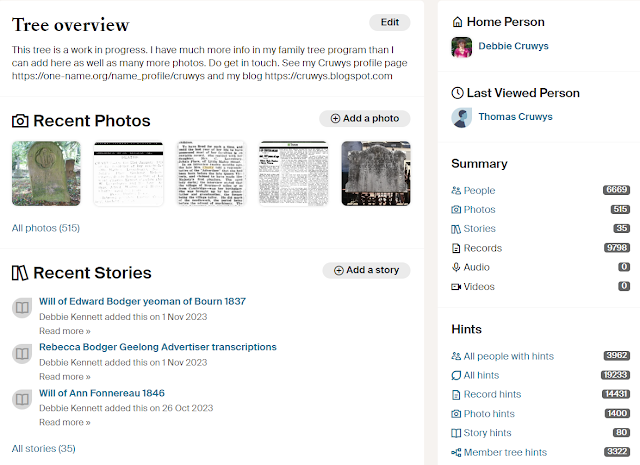
One of my next steps will be to build out trees on Ancestry for all the other Cruwys families I've researched as part of my one-name study. The Y-DNA project has shown that we have two distinct Cruwys groups which do not share a common ancestor and which belong to two completely different haplogroups. To make the work easier I am intending to upload a GEDCOM file for these other Cruwys families to a separate tree on Ancestry. I will then repeat the process of linking in all the census entries, parish registers and other records. I know it will take me some time to do this but it will be very worthwhile and will help to make my research more accessible.

Thursday, 20 May 2010

Domesday descendants

A friend in Devon has very kindly sent me a photocopy of a page containing the Cruse entries from the Katherine Keats-Rohan book Domesday Descendants. Keats-Rohan is a fellow of Linacre College, Oxford, and has pioneered the use of prosopography in historical research. If you are not familiar with the term prosopography it is explained in this Wikipedia article. Keats-Rohan has written two very important books which are very useful for anyone with a genealogical interest in medieval history:

 - K.S.B. Keats-Rohan.  Domesday People: A Prosopography of Persons Occurring in English Documents 1066-1166. Volume  I: Domesday Book.  Boydell Press, 1999, 572pp.

-  K.B.S. Keats-Rohan. Domesday Descendants: A Prosopography of People Occurring in English Documents 1066-1166. Volume  II Pipe Rolls to Cartae Baronum. Boydell Press, 2002, 1179pp.

The entries of interest to me were found in the second volume on Domesday Descendants. I have copied the details below:
de Cruce, Rainald
Attested several of the charters of Roger earl of Hertford (d.1173), from whom he held half a fee de novo in 1166. Perhaps the same as the earl's steward Rainald. Geoffrey de Cruce held half a fee of Clare in Walton, Surrey, in 1242 (Fees, 685).

Harper-Bill and Mortimer, Stoke by Clare Cartulary, nos 28, 30-31, 36; Hart, Cartularium Monasterii de Rameseia, no. CXCIII; Red Book of the Exchequer, ed. Hall (1897), pp. 403-7; Stenton, Documents illustrative of Danelaw (1920), no. 333.

de Cruce, Ricardus
Mentioned in charters of Ranulf I of Chester as having given land at Mostyn to St Werburga when he became a monk. Father of Norman.

Barraclough, Charters of Anglo-Norman Earls of Chester, nos 13, 28, 49.

de Crues, Ottuel
Attested Colne charters of c.1160. Held half a fee de novo from Oliver de Tracy of Barnstaple in 1166, at Cruwys Morchard, Devon. This was held for one fee by the heirs of Alexander de Crues in 1242 (Fees, 748). In 1242 Richard de Crues held one fee of Barnstaple in 'Nytheresse' (Fees, 773).

Fisher, Cartularium Prioratus de Colne, nos 36, 65; Pipe Roll 9 Henry II, 24-e/ht; Red Book of the Exchequer, ed. Hall (1897), p. 255.
I've come across early references to the surname de Cruce when searching the online Patents Rolls database. As far as I can establish there is no connection with the Cruwys family from Cruwys Morchard. It is however possible that the de Cruces are the ancestors of some of the present-day Cruse lines, which clearly have multiple origins.

Keats-Rohan makes no mention of two early references to the Cruwys surname which were quoted by Margaret Cruwys in her book A Cruwys Morchard Notebook: 1066-1874 (James Townsend and Sons, Exeter, 1939):
c. 1175 Robert de Cruwys, mentioned in a Pipe Roll of 1175, and Robert Cruwys, an undertenant of Henry Pomeroy, 1198, probably father and son.
Unfortunately Margaret Cruwys does not provide any sources for these references. The Pipe Rolls have been transcribed and published and are available at my local record office. I hope to check them out at some point. It seems strange that Keats-Rohan did not discover these other two early references.

The earliest references to the surname in the family collection of papers held at Cruwys Morchard House in Devon are found in the Tracy Deed which probably dates from the early 1200s. The names of Richard de Cruwes and Alexander de Cruwes appear as witnesses to this deed. I have made a transcription of the Tracy Deed available online on Genuki Devon which can be read here. The Tracys were a powerful baronial family. A William Tracy or William de Tracy was one of the four barons who assassinated Thomas Becket, the archbishop of Canterbury, in Canterbury Cathedral on 29th December 1170. There is an unsubstantiated story that a member of the Cruwys family was present at this event.

The pedigree of the Cruwys family, as recorded at the College of Arms, is believed to commence with the Richard de Cruwes mentioned in the Tracy Deed. I have not seen any document confirming the relationship between Richard de Cruwes and Alexander de Cruwes. Richard appears in numerous documents around this time as he was a justice of the assize for the county of Devon. The earliest reference dates from 1200 when, according to Margaret Cruwys,  he was  “taken into custody being accused of the death of Jordan de la Cell on Exmoor" though again rather frustratingly the source is not given. The most recent reference I have found is in the Patent Rolls when Richard de Crues was appointed a justice for the assizes of novel disseisin at Exeter in the twenty seventh year of the reign of King Henry the Third [1242/3]. Alexander de Cruwys was probably either the brother or son of Richard de Cruwys. He is mentioned in an Assize Roll dating from 1238 which is summarised in The Cruwys Morchard Notebook. Clearly much more work remains to be done to unravel this early part of the Cruwys family tree.

© Debbie Kennett 2010

Wednesday, 9 December 2009

Cruwys Morchard pens

The residents of Cruwys Morchard are currently trying to raise funds to build a new parish hall to replace the existing hall which was built back in 1928 and is now no longer fit for purpose. Details of the plans for the new hall can be found on the parish website. As part of the fundraising efforts the committee have commissioned some special Cruwys Morchard pens which cost just £1 each and can be bought from The Cruwys Arms. The pens would make ideal stocking fillers. If you are not able to visit Cruwys Morchard, Mary Davey, the newsletter editor, has kindly offered to supply pens by mail order. If you are interested in placing an order please contact Mary direct. Details of the pens and Mary's contact details can be found here.

Tuesday, 2 June 2009

Cruwys Morchard wills and inventories

I have added another set of transcriptions to the pages of Genuki Devon. The latest transcriptions are abstracts and catalogue entries for the wills and inventories which are held in the Cruwys family archives at Cruwys Morchard House in Devon. The transcriptions can be found online here. Some of the wills in the Cruwys Morchard collection are now the only surviving copies. As Devon researchers will know, the Exeter Probate Registry was bombed in World War II and all the wills stored there were lost. It is unfortunate that the original Cruwys Morchard wills are still in private hands and are therefore inaccessible to the public. I hope that one day it will be possible to have these records digitised or microfilmed so that they can be made available to interested researchers. I would be particularly interested in seeing the two original Cruwys inventories.

My latest contributions to Genuki Devon were in response to the announcement of the new Devon Wills Project. This resource is now growing very rapidly, and if you have any ancestors from Devon it is well worth checking out. I have already transcribed a number of Cruwys/Cruse wills along with a few wills for some of the other Devon surnames I am researching such as Dillon, Westcott and Acland. The links to these transcriptions are now all included in the new consolidated index.

Wednesday, 17 December 2008

The Cruwys coat of arms

Joseph M. Crews in Texas has sent me the most stunning drawing of the Cruwys arms, which he did while on a recent visit to Cruwys Morchard in Devon. The drawing is a copy of the Cruwys arms as depicted in a stained glass window in the church. I liked the drawing so much that I have now decided to use it on my Guild profile page, and I am very grateful to Joseph for giving me permission to reproduce his artwork. The picture can only be reproduced as a thumbnail image on the profile page so I have also provided a full-size copy below.In heraldic terms the Cruwys arms are described thus: Azure. a bend per bend indented argent and gules between six escallops or. Escallop is the heraldic word for a sea shell or oyster shell. The shell was used as a badge by palmers on their way to and from Palestine and is thought to be connected in some way with the crusades. It is therefore quite possible that the first bearer of the Cruwys arms was involved in the Crusades, perhaps accompanying Richard the Lionheart on the Third Crusade. Richard I reigned from 1189 until his death in 1199. If the Cruwys arms were adopted during the later Crusades there are two possible candidates: Richard Cruwys and Robert Cruwys. Margaret Cruwys advises in A Cruwys Morchard Notebook that a Robert de Cruwys was mentioned in a Pipe Roll in 1175, and that in 1198 a Robert Cruwys was an undertenant of Henry Pomeroy. Richard de Cruwes, who was most probably Robert's son, was "taken into custody being accused of the death of Jordan de la Cell on Exmoor in 1200". This is probably the same Richard de Cruwes who witnessed the Tracy Deed, the earliest document in the Cruwys family papers. The document was also witnessed by Alexander de Cruwes who is probably Richard's son. I have provided a transcription of the Tracy Deed for Genuki Devon and it can be seen here. Richard was appointed as a justice of assize by the King, and there are many references to Richard de Crues in the early 1200s in the Patent Rolls. There is still a lot of work to be done on the early records, but it is unlikely that we will ever know for sure which Cruwys was the original bearer of the arms.

Sunday, 24 August 2008

Thomas Cruwys and the Battle of Towton

There is an interesting article in today's Sunday Times magazine about the Battle of Towton, which can also be read online on the Sunday Times website. The Battle of Towton is of particular interest to me because my ancestor Sir Thomas Cruwys (d. 1471) fought at the battle on the Lancastrian side in support of Henry VI. The battle took place on 29th March 1461 (Palm Sunday), between the villages of Towton and Saxton in Yorkshire (about 20 kilometres south-west of York). It is remembered as the bloodiest battle ever fought on British soil. Henry VI and his supporters were defeated by the Yorkist army of Edward IV, and some 28,000 men are believed to have lost their lives. Sir Thomas Cruwys miraculously managed to survive the massacre of the Lancastrian army. After the battle he received a royal pardon from King Edward IV, but was forced to forfeit many of his lands. The Deed of Pardon is in the family archives at Cruwys Morchard House. Sir Thomas survived for another ten years after the Battle of Towton. Undeterred by the carnage he had witnessed at Towton he fought again at the Battle of Tewkesbury on 4th May 1471, but was again on the losing Lancastrian side. Sir Thomas Cruwys's inquisition post mortem records that he died on 12th May 1471. After the battle some of the defeated Lancastrians sought sanctuary in Tewkesbury Abbey. The victorious Yorkists forced their way into the abbey and the surviving Lancastrians were all beheaded. Sir Thomas was quite possibly one of the group who was slaughtered in the Abbey, or he might simply have died of his wounds.

Monday, 18 August 2008

It's raining frogs!

I've just learnt of a useful new website Chronicling America: Historic American Newspapers which is provided by the US Library of Congress. The website provides searchable digital images from a range of US newspapers for the period from 1890 to 1910. The website can be found here. I was most surprised to find the following story from Cruwys Morchard in The San Francisco Call on 11th September 1910. Enjoy!
FROGS FALL FROM SKY AND CRY LIKE RABBITS
Death Ends Croaking When Sun Rises After Storm

LONDON, Sept. 10 – Gloucestershire recently reported the arrival in that section of snakes which milked the cows. Now Jack Ayre of Temple Bottom, near Cruwys-Morchard in Devonshire, reports that after a violent thunder storm he found a long stretch of road covered with thousands of frogs, "which cried like rabbits".

Ayre expresses the opinion that the frogs came down from the sky, and he is supported in his view by another resident of the district, who has had experience of monsoons abroad.

This expert says that in the stillness which precedes monsoons in tropical regions all sorts of creeping things come out of their hiding places and croak. They are often carried up into the air by whirlwinds, and when the monsoons break, down they come again, as appears to have done at Cruwys-Morchard.

It was midnight when Ayre made his discovery. In the morning there were still a number of frogs left but many were dead.

Monday, 7 April 2008

Newspaper transcriptions

I have taken advantage of an opportunity to access a free trial of the Gale Digital Collections, which includes a large collection of digitised British newspapers from the 16th to the 19th century. The digital newspaper archive is a brilliant resource but sadly access in the UK is restricted to institutes of higher education. I hope that funds will eventually be made available to make this important resource accessible to the general public, though the response from my local library was not very encouraging.

I have now downloaded a large collection of newspaper articles from the collection and am slowly updating my records. I have transcribed some of the more interesting Devon-related articles for the pages of Genuki Devon. There is an interesting story about a "supernatural piggery" which was found at Cruwys Morchard in 1789 which is now included in a selection of newspaper extracts on the Cruwys Morchard page. I have also transcribed accounts of four Cruwys Morchard ploughing matches from the 1860s. The final contribution is an account of a fire at George Cruwys's house in Witheridge.

I have saved some of the most interesting accounts for last, so watch this space if you want to find out about the Cruse who was sent to prison for five years in 1868 and the Cruwys who was executed in 1778!

Wednesday, 11 April 2007

Mary Fraunceys the child bride

Peter Ploptson in Ontario, Canada, has sent me a huge package of material on the Ayshford and Fraunceys families, both of which are of particular importance in the history of the Cruwys family of Cruwys Morchard. It will take me some time to work my way through all the new information but I have made a start by looking at the tree of the Fraunceys family. Peter has sent me three inquisitions post mortem (IPMs) relating to the Fraunceys all of which provide valuable genealogical information.

The Fraunceys family are of French origin. In earlier records their name is often spelt Fraunceis, which is the Old French word for a Frenchman or Frank. The Franceis spelling is preserved in later generations in some branches of the family. Some time in the early part of the fourteenth century the Fraunceys acquired the manor of Killerington, later known as Killerton Franceis, in the parish of Broad Clyst. The family home in Killerington was known as Franceis Court. The house remained in the family until the beginning of the seventeenth century when it was purchased, along with the manor of Killerton, by Sir Thomas Dyke Acland, Baronet. Today there is a farmhouse on the estate but nothing remains of the old Fraunceis mansion.

Some time in the late 1300s William Fraunceys of Fraunceis Court made an advantageous marriage to Alice, the daughter of Nicholas Hele and Alice Florey of Hele in the parish of Bradninch, Devon. Alice brought to the marriage a considerable estate which she had inherited from her father. She subsequently received a substantial inheritance from her mother which included the manors of Combe Florey in Somerset and Tallaton in Devon. Later generations of the Fraunceys family moved to Combe Florey, and they reputedly held the manor for some twelve generations.

The Mary Fraunceys in whom we have a particular interest was the second wife of John Cruwys of Cruwys Morchard. We know from the records at Cruwys Morchard House that their marriage took place some time in 1490. Mary was the daughter of John Fraunceys and Florence Ayshford. John Fraunceys died on 20th November 1485 and an inquisition post mortem was held on 5th October 1493. We learn from the IPM that John Fraunceys and Florence Ayshford were granted the manor of Hele Payne and various lands in Hele Payne, Bradnynch and Pounde by means of a charter dated 20 May, 17 Edward IV (1477). This transfer of land presumably coincided with their marriage, which would have taken place either that same year or perhaps one or two years previously. There is a medieval farmhouse in Broadclyst known as Hele Payne Farm which was quite possibly where John and Florence Fraunceys lived after their marriage. The farmhouse has been considerably extended and altered over the years but still retains some of its original medieval features. It is now designated by English Heritage as a Grade II* listed building.

John Fraunceys' IPM provides no clues as to Mary's date of birth but her brother Nicholas is named as the son and heir and, at the time of the IPM, he was "aged 16 years and more", placing his birth at around 1476 or 1477. It is probably therefore safe to assume that Mary was born either a year or so before or after her brother Nicholas. They were probably both born at Hele Payne. At this time it was legally possible for a girl to marry from the age of 12 onwards so, in view of the 1490 marriage, Mary could not have been born any later than 1478. Whatever the truth of the matter it is clear that Mary Fraunceys was a very young girl, possibly as young as 12, and, if not, certainly in her early teens, when she married John Cruwys.

By the time of their marriage John Cruwys was about 41 years of age. He was a widower with six young children, three boys and three girls, all under the age of ten – a daunting proposition for any young woman, let alone a young girl who was probably only just in her teens. However, marriage at this time was very much a commercial transaction, and no doubt there would have been female servants to take care of the step-children. Mary bore her husband four sons: William, Thomas, Edward and Anthony. John died in about 1515 and Mary subsequently married John Acland of Landkey. The date of the marriage is not known but by this time Mary would probably have been in her forties. John Acland died in 1539. It is clear from his will that the marriage was not a particularly happy one and that Mary had caused considerable "vexation" in the family. The surviving Landkey parish registers do not begin until 1602 so there is no record of Mary's death. She was predeceased by her eldest son William who died in 1525.

Friday, 30 March 2007

Margaret Cruwys

Details have arrived from Devon of the marriage of Lewis George Cruwys and Margaret Campbell Speke Abercrombie from the registers of St David's, Exeter. Margaret Cruwys is of course well known as the author of A Cruwys Morchard Notebook and for her writings in the Transactions of the Devonshire Association and Devon and Cornwall Notes and Queries.

The engagement of "Captain L G Cruwys and Miss Abercrombie" was reported in The Times on 17th July 1917:
An engagement is announced between Captain L G Cruwys of Cruwys Morchard, Tiverton, Devon, and Margaret Campbell Speke, elder daughter of Colonel A H Abercrombie, late 21st Royal Scots Fusiliers, and Mrs Abercrombie.
It must have been impossible to make proper plans for a wedding during the war. Consequently no formal invitations were sent out and an open invitation was published in The Times on 6th November 1917: "No invitations are being sent, but all friends will be welcome at the church".

The marriage is recorded in the registers of St David's Exeter on 19th November 1917. At the time of the marriage Lewis George Cruwys, 36, was a Captain in the Recruiting Office and was living at Cruwys Morchard. Interestingly Margaret C S Cruwys, then aged 23 and living in St. David's, Exeter, was working as Lewis's clerk. The witnesses were R G Cruwys (Lewis's brother, Robert Geoffrey Cruwys, who was by this time the Rector of Cruwys Morchard) and A… Abercrombie. The identity of the second witness is uncertain and the writing was indistinct, but it was probably either Margaret's mother or father. The service was conducted by the Reverend Bell-Salter.

Lewis joined the army after graduating from Exeter College, Oxford, serving with the 4th Volunteer Battalion of the Devonshire Regiment and spending some time out in India. He resigned his commission in 1907 but volunteered for service with his old regiment at the outbreak of World War I. It would appear that he did not serve overseas and instead spent most of the war in Devon. The London Gazette records his appointment as "Chief Registration Officer of an Area" on 12th December 1916. It was perhaps around this time that his future wife, the young Margaret Abercrombie, came to work for him.
Margaret Cruwys is fondly remembered by the parishioners of Cruwys Morchard. She was a true "gentlewoman" without any airs and graces. For many years she ran a small farm at the Manor House. She was not afraid of hard work and used to milk the cows herself. Margaret was always very involved in parish affairs. The annual Cruwys Morchard flower show was held on the Manor lawn, where the exhibits were displayed on the squire's best Crown Derby china. The parishioners inspected the items with much trepidation, hardly daring to breathe! The photograph above shows Margaret Cruwys outside the parish hall in Cruwys Morchard with some of the local boys. The photograph was taken in 1935 around the time of the Silver Jubilee celebrations for King George V.

Thursday, 22 February 2007

Cruwys Morchard Rectory

I have been fortunate to acquire another postcard of Cruwys Morchard on E-bay. This picture is of the Rectory and dates from around 1915. The original postcard was in poor condition but I've been able to restore the photo and remove some of the blemishes with a little digital magic. The Rector at the time this photograph was taken was probably the Reverend Nesbit Edward Willoughby, who took up office in 1905. He was succeeded in 1916 by Robert Geoffrey Cruwys, the brother of Lewis George Cruwys, who was the then Lord of the Manor. Robert went to Exeter College, Oxford, and in 1907 was in the Oxford University cricket team. Lewis served with the Devonshire Regiment in World War I and spent some time out in India. Lewis married Margaret Campbell Speke Abercrombie in 1917. Margaret is best known as the author of The Cruwys Morchard Notebook.

Wednesday, 24 January 2007

Cruwys Morchard and the OED

I am delighted to report that the Cruwys one-name study has made a modest contribution to the Oxford English Dictionary. I was intrigued by a reference to a census I found in a transcription of a 1511 Cruwys Morchard Manor Court Roll which was published in Devon and Cornwall Notes and Queries (Volume 20, 1938-9, pp237-240). The transcription was contributed by "L.G.C.", who was undoubtedly Lewis George Cruwys (1881-1957), the then Lord of the Manor of Cruwys Morchard. The relevant extract reads as follows:
And further the bailiff is questioned about his account of 14d. for the return of the “census” this year, and it is handed to him in full court.
The editors placed a note at the end of the transcription inviting opinions on the meaning of "the return of the census". A reply was published in a subsequent issue of Devon and Cornwall Notes and Queries (Vol. 20, 1938-9, p.331) by "F.R-T." who is probably Frances Rose-Troup, the author of a number of well-respected local history books published in the early decades of the twentieth century:
"Return of the Census" is explained by the following paragraph from Cowel's Interpreter: "CENSURA, a custom so call'd, within several Mannors in Cornwall and Devonshire, whereby all Residents therein are cited, above the Age of 16, to swear Fealty to the Lord, to pay 11d. per Poll and 1d. per An. ever after, as Cent Mony, or common fine. And these thus sworn are call'd Censers".
On checking the entry for census in the online edition of the OED I discovered that the earliest quoted reference dated from 1613:
1613 PURCHAS Pilgr. I. IV. xvi. 373 What is
properly called Census, the poll-money of his subjects.
I therefore wrote to the OED editors to enquire if they might be interested in my much earlier example. I received the following reply this morning:

I shall add this information to the OED's revision file, so that the editors can follow it up when they come to work on the entry… This represents a huge antedating for CENSUS, and our researcher will enjoy looking into it. Thank you for alerting us to these records.

It will be interesting to see what the editors make of the quotes when the revision is finally published.

Saturday, 13 January 2007

Postcards of Cruwys Morchard House

I was delighted to receive in the post this morning two postcards of Cruwys Morchard House which I won in an auction on E-bay earlier this week. The postcards date from the early 1900s and are both addressed to Mrs Pearce at Loperwood Manor, Totton, near Southampton, Hampshire. The first card is a picture of the entrance hall.
The hall is believed to have been part of the original Tudor plan. The oak staircase at the back of the hall was imported from Enmore Castle in Somerset in the late 1800s by the then squire George James Cruwys. It is just possible to discern that the picture above the fireplace is a portrait of the Reverend Henry Shortrudge Cruwys. There is a much clearer reproduction of this portrait in Rosemary Lauder’s book Devon Families in the chapter on Cruwys of Cruwys Morchard. The card was postmarked at Tiverton on 4th October 1907. There is a brief message on the back which reads:
Cruwys Morchard, Friday
Irene arrived here quite safely last night with Nan. This is our hall where we dance. Irene thought you might like to see it. We are having tennis today. Col. Loraine is coming to tea. I hope your headaches are better.
Much love from D
The second postcard is a front view of Cruwys Morchard House.
This card was sent a few days later on 8th October and again has a Tiverton postmark. The message reads: 
Very cold here now. We have fires. I am afraid winter has come now. The two windows nearest the seat is my room. Underneath is the drawing room. This gives you an idea of the house. Don’t you think it is sweet. Please keep this card for me. Hope you are well.
From Irene Pearce.
In October 1907 Cruwys Morchard House was occupied by Mary Helen Cruwys née Owen, age 60. Mary’s husband, George James Cruwys, had died three years earlier in 1904. Mary and George had four children: Dorothy, Cicely, Lewis and Robert. The two daughters, Dorothy, then aged 28, and Cicely, 27, neither of whom married, would no doubt have been living at home when the Pearces visited. The younger son Robert, who was later to become Rector of Cruwys Morchard, might well have been at home too. Lewis, the eldest son, was by this time a Lieutenant in the 4th Volunteer Battalion of the Devonshire Regiment and was probably away from home serving with his regiment. I have tried searching in the 1901 census but have so far been unable to find out anything further about Irene Pearce and her family. Mary Helen Cruwys née Owen was born in Colchester, Essex, but her father was the rector of Wonston, Hampshire. It therefore seems likely that the Pearces were either Mary’s friends or relations. Loperwood Manor no longer exists. The site is now part of the grounds of Tatchbury Mount Hospital in Loperwood Lane, Calmore.

Update 31st May 2011
I have been contacted by Denise Sanford who has provided some further information about the Irene Pearce who visited Cruwys Morchard House and wrote one of the above postcards. Rita Irene Pearce (1887-1964) was born at Loperwood. She married a Robin Lawrence in 1920. Irene’s aunt Emily Sarah Henrica Pearce (1866-1950) is Denise’s great-grandmother. She married Edward Henry Corse-Scott in 1886 and went to live in Colchester. Emily Sarah Henrica had been born and brought up at Loperwood; her father Henry Stanley Robert Pearce died in 1868; her brother Robert Charles Sutherland Pearce, Rita Irene’s father, inherited Loperwood around 1891.

We think the D who signed the first postcard is probably Dorothy Cruwys, daughter of George James Cruwys and Mary Helen Owen. The identities of Nan and Col. Loraine are still a mystery.

© Debbie Kennett 2007-2011

Wednesday, 10 January 2007

Cruwys Morchard ploughing match

I learn from Liz, the secretary of the Cruwys Morchard and District Ploughing Association, that they will be celebrating their 100th anniversary in 2008. To celebrate the centenary Liz is putting together a collection of material on the history of the Association and the annual ploughing match. I've been able to send Liz a wonderful photograph of the 1936 Cruwys Morchard ploughing match from The Times Digital Archive. If anyone has any other information or photos Liz would be delighted to hear from you. Please get in touch with me and I will pass on the information. For those of you with an interest in agricultural matters you might like to read my transcription of a newspaper article about a ploughing match which took place in Ashreigney in 1873.