Showing posts with label Winkleigh tree. Show all posts

Wednesday, 1 November 2023

Cruwys family tree on Ancestry

When I first started my family history research over twenty years ago I began by compiling the family information in Word files. It soon became too complicated to keep track of all the different family lines in separate files and so I bought a family history program to record all the information. After researching all the available family history programs I settled on Family Historian, which has an excellent reputation and is well-suited for one-name study work. The program has stood me in good stead over the years. I use it to record my own family tree but also all the other Cruwys and Cruse trees I've researched as part of my one-name study. 

When I first tested at AncestryDNA in 2012 I only had a very basic skeleton tree on Ancestry. I didn't get much out of the DNA test in the early years and it was another three years before Ancestry officially launched their test in the UK in 2015. Since then, the database has grown exponentially, allowing me to confirm much of my existing research and also to make some exciting new discoveries. I've found that there are distinct advantages to maintaining a detailed family tree on Ancestry. Having a publicly accessible tree means that I benefit from the Common Ancestor Hints and ThruLines. The more I build out the tree and build down the collateral lines the easier it becomes to work out the relationship to my matches. 

I find that Ancestry's online tree-building platform is by far the easiest to use of all the available options. The powerful hint system makes it very easy to find records. Other family historians will often already have done research into a particular line and found all the relevant census and parish register entries which saves the hassle of spending a long time searching indexes to find the people I'm looking for, especially when the names have been horribly mistranscribed. Many people have generously shared photos as well as images of birth, marriage and death certificates which has been extremely helpful.

For all these reasons, over the last few years I've been slowly going through the process of trying to expand my tree on Ancestry by adding in all the research that I've done over the last twenty years which has been carefully stored in Family Historian. Rather than uploading a GEDCOM file and losing all the linked records and DNA matches I took the decision to curate my tree manually. I am gradually working through all the different branches of my tree adding census entries, uploading certificates and photos and linking them all to my tree. I've benefited greatly from the research that others have shared with me so I am effectively paying forwards the favour. This process has been invaluable in its own right. When I started out I was mostly working with indexed records and transcriptions. Increasingly records have been digitised and I am now able to link to census pages and original parish register records. I'm also making some very interesting new discoveries because of the consolidation process and because the hints often lead me to records which I hadn't previously discovered.

By adding sources to my tree I'm also hoping that my tree will have better exposure on Ancestry so that people can find my research. I'm also hoping that it will help to counter some of the mistakes I've found in some of the other online trees. Ancestry do not tell us how their algorithms work but it seems that the more sources you have linked to a person the more likely it is that your tree will appear in the hints list for other researchers.

I've made good progress but there is still a lot more work to do. However, I'm pleased to report that I've completed the work on my own Cruwys family. My tree on Ancestry now encompasses my own Cruwys family from Winkleigh, the Cruwys Morchard tree, and the Mariansleigh tree. The Winkleigh and Cruwys Morchard trees link together in the mid-1400s. I know from the Y-DNA testing for my Cruwys DNA Project that the Mariansleigh Cruwyses are related to the Winkleigh and Cruwys Morchard families but I have been unable to document the connection. It does not help that the parish registers for the period in question have not survived. However, I have a second connection to the Mariansleigh Cruwyses through the Eastmond family so I was able to link them into one big tree. The Mariansleigh Cruwyses are by far the most numerous branch of the family so it took me some time to add all these records. If you're connected to any of these Cruwys families do check out my tree. You can find it on Ancestry here. If you have any additional information on these families I would be delighted to hear from you.
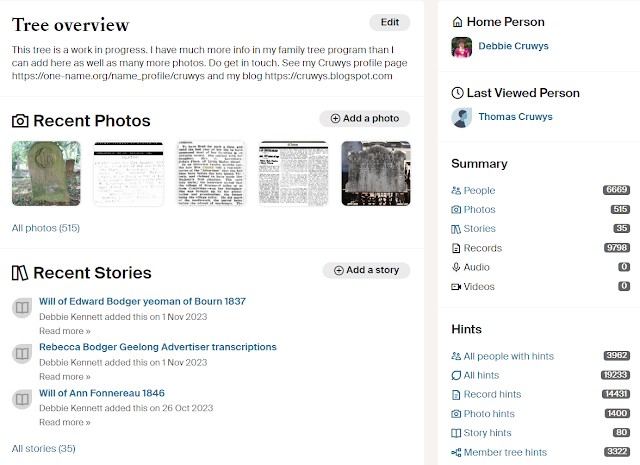
One of my next steps will be to build out trees on Ancestry for all the other Cruwys families I've researched as part of my one-name study. The Y-DNA project has shown that we have two distinct Cruwys groups which do not share a common ancestor and which belong to two completely different haplogroups. To make the work easier I am intending to upload a GEDCOM file for these other Cruwys families to a separate tree on Ancestry. I will then repeat the process of linking in all the census entries, parish registers and other records. I know it will take me some time to do this but it will be very worthwhile and will help to make my research more accessible.

Wednesday, 11 June 2014

My first autosomal DNA success story

I took the Family Tree DNA Family Finder test back in February 2010, and I took the opportunity at the same time to get my mum and dad tested too. I've been getting a steady stream of matches since then, and I now have a grand total of 267 matches, but so far I've been unable to find the genealogical connections with any of them (apart of course from my parents!). That all changed last week. I was casually glancing through my dad's matches when I was very excited to spot the surname Cruwys in bold in the list of matching surnames of one of his new matches. Cruwys is of course my maiden name. It is the surname I've spent the most time researching and is also the subject of my one-name study.
The new match was predicted to be my dad's second to fourth cousin. I checked my own match list and found that the same cousin appeared in my list and was predicted to be my fifth to distant cousin. As all my dad's ancestral lines are in the UK and the cousin's ancestors were all in Canada, it was evident by a process of elimination that there was only one possible ancestral couple that we could share in common - William Cruwys (1793-1846) and Margaret Eastmond (1792-1874) who married in Rose Ash, Devon, on 18th July 1814. On contacting my newly found genetic cousin in Canada and checking our family trees I was able to establish that he is my dad’s third cousin once removed and my fourth cousin. My dad is descended from William and Margaret's son Thomas Cruwys (1831-1890) who was baptised on 19th June 1831 in Burrington, Devon, and the Canadian cousin is descended from one of his older brothers William George Cruwys (1821-1873) who was baptised on 21st January 1821 in Burrington.

William George Cruwys last appears in the English records in the 1841 census. He was living in Chulmleigh not far from his mother and one of his other brothers and working as a male servant. William cannot be found in any of the subsequent censuses in England, and there is no record of a marriage or a death in the General Register Office indexes. However, a William of the right age appears in the Canadian censuses living in Prince Edward Island. I have a record of the 1848 marriage of William and his wife Sarah Burrows but unfortunately the PEI marriage records of this time do not provide any information about the names of the parents. I therefore do not have any documentary proof that the PEI William is the same William who was born in Burrington. However, the circumstantial evidence is strong and is bolstered by the fact that William and Sarah gave one of their sons the distinctive name Augustus. This is the name of one of William's presumed brothers from Devon, and I have not found the name Augustus used in any other Cruwys family in my one-name study. We had additional evidence of the link to PEI through my Cruwys DNA Project with two matching Y-chromosome results. The Y-DNA test proves that the two men share the same fatherline but it is not conclusive proof that their ancestors were brothers. However, the combination of evidence is very strong, and the fact that we now have an autosomal DNA match which corresponds precisely with the expected relationship is the icing on the cake, and I think the relationship is proven beyond doubt.

Another cousin from the PEI tree, who is also my fourth cousin and my dad's third cousin once removed, took the Family Finder test last year, but unfortunately she did not show up as a match either to me or my dad. This is because of the random way in which autosomal DNA is inherited. Around 90% of third cousins will share enough DNA to show up as match but only around 50% of fourth cousins would be expected to match. Perhaps around 70% of third cousins once removed would show up as a match.  

The Family Finder chromosome browser allows you to see a visual representation of the matching segment data. You can adjust the browser to see which segments you share with your matches at varying levels starting from 1 centiMorgan and going up to 10 centiMorgans (a centiMorgan is a unit of recombination which is used to measure the amount of sharing on each segment). My dad and his cousin have 10 matching segments. I share seven segments with my cousin. From the chromosome browser view you can generate a table showing the matching segment data. When I checked the data I discovered that although I seemingly shared a number of small segments with my cousin, my dad and his cousin did not share these same small segments. I therefore concluded that these were coincidental (identical by state) matching segments. The only segment that we all shared in common was on chromosome 11. The actual figures are as follows:

My dad vs. cousin  Start location 60459979  End location 78299008 17.12 cMS  4300 matching SNPs

Debbie vs. cousin   Start location 61282647  End location 78299008 16.62 cMs   4100 matching SNPs

I therefore set the chromosome browser view so that only the large matching segments were shown. The first view shows a comparison of the matching segments shared by my dad and his cousin.


The second chromosome browser view below shows a comparison of the matching segments shared by me and my cousin. You can actually see the DNA inheritance process in action here, as you can see quite clearly that I did not inherit the two large segments on chromosomes 1 and 3, leaving me with just the one segment on chromosome 11 that I share in common with my cousin.

What is really exciting about this match is that I can now ascribe this one specific segment on chromosome 11 that I inherited from my father to an ancestral couple - William Cruwys and Margaret Eastmond. Without doing further testing and triangulation I won't be able to establish whether this segment was passed down to me by William Cruwys or by Margaret Eastmond, but I know that it has been passed on to me in the Cruwys line from my great-great grandfather Thomas Cruwys to my great-grandfather Frederick Augustus Cruwys to my grandfather and then on to my dad and me. The segment has travelled on a different path in my Canadian cousin's family. He inherited the segment from his grandmother Emma Pearl Cruwys, the daughter of William George Cruwys and Sarah Burrows. Emma married George Clark Kitson in 1917 in Charlottetown, PEI, and the segment has been passed on through the Kitson line to the present day.

I'm hoping that this will be the first of many genealogical connections that I will be able to make through autosomal DNA testing. Now that the tests are so cheap (the Family Finder test costs just £47 in the current Father's Day sale at Family Tree DNA) there is really no excuse for anyone not to do the Family Finder test!

© 2014 Debbie Kennett

Friday, 16 January 2009

Frank Cruwys the royal tailor

The Cruwys genealogy group on Facebook has been very active over Christmas and I was very pleased to make contact with some newly found relatives who are all descendants of my great-uncle Frank Cruwys. Frank was born on 22nd March 1882 at 62 Lower Ashley Road in Ashley, Bristol. He married Elizabeth Seymour in 1908 and they had four children: Francis Seymour (born 1909), Richard Augustus (born 1910), Frederick "John" (born 1913), and Andrée (born 1918). The three eldest children were born in England, but Andrée was born in France. Francis, the eldest, died as a baby of scarlet fever. Frank and his family moved to France during World War I, and Frank set up in business as a tailor in Paris. He is reputed to have held three royal licences for the Duke of Windsor (Edward VIII), the Duke of Luxembourg and the Japanese Imperial Court. The photograph below shows Frank and his daughter Andrée on holiday in France in about 1924, and already looking very French.Further family photographs can be seen on Facebook in the Cruwys genealogy group. (You will need to set up an account in order to view the photos.) During World War II, probably in about 1940, Frank and the family returned to England. We have an old newspaper cutting from a local Gloucestershire newspaper recording the story of their dramatic escape:
Escaped from France

Among the visitors to Cheltenham in the past few days is Mr. Frank Cruwys, whose tailoring establishment has been one of the best known in Paris since he started it there nearly 30 years ago.

In spite of his 60 years he joined up at the outbreak of the war as an interpreter with the R.A.F. He stayed in Paris until the Germans were actually thundering up the streets and then made a dash for Nantes with his wife and 22-years-old daughter. Later on they got to England in an R.A.F. machine.

Since his return to this country Mr. Cruwys has been spending a few days in Cheltenham with his brother, Mr. H. F. Cruwys, of 238 Gloucester-road, who recently took over the business of W. Thomas at Montpellier.
During the war Frank, Richard, John and Andrée all worked at RAF Innsworth as interpreters. After the war they returned to France. Frank died in 1953 in Paris.

Wednesday, 14 January 2009

Frederick and Emma Cruwys in 1911

I have finally managed to find my elusive great-grandparents Frederick and Emma Cruwys in the 1911 census along with my grandfather Herbert. Their surname was mistranscribed as Crenny, which is a totally new mis-spelling to add to my ever-growing collection. They were eventually located by means of an address search. They were living, as expected, at 35 Byfield Gardens in Barnes. The address search was not as straightforward as might be expected as most of Byfield Gardens, apart from three houses, was transcribed as Byfeld Gardens. I'd like to thank fellow Guild member Ken Toll for pointing out the Byfeld spelling which eventually led me to find the entry for Frederick and Emma.

In 1911 Frederick, 50, was working as a tailor's cutter. His wife Emma (née Gough) gave her age as 52, though she was in fact 55. Their two youngest sons were living at home: Herbert (my grandfather), aged 24, who was also a tailor's cutter, and Tom, 21, a designer of house furniture. Their two eldest sons, Frank and Bob, were already married in 1911 and were living nearby in Hammersmith.

I have a lovely picture of Frederick, Emma and the four boys which I have reproduced below. I don't know the exact date of the photo but, judging by the age of the boys, I would guess it was probably taken within a few years of the 1911 census. It might possibly have been taken later that same year to commemorate Frederick's 50th birthday. In the photograph from left to right are: Tom (born 1890), Emma (born 1855), Frank (born 1882), Bob (born 1883) and Herbert (born 1886). Frederick (born 1861) is seated in the centre of the photograph.
Frank, Bob and Herbert were all tailors. Frank went to work in France, Herbert had a shop in Cork in Ireland, and Bob had a shop in Old Bond Street in London. Tom was a child singing star and went on to enjoy a varied career as an artist and designer. I have written about him separately in another post which can be found here.

Monday, 6 October 2008

Master Tom Cruwys the boy soprano

I bought this lovely old postcard (below) on E-bay. The Master Tom Cruwys in the picture is my great uncle. Tom was born on 18th February 1890 at 169 Ashmore Road, Kilburn, London, the fourth son of Frederick Augustus Cruwys and Emma Gough. This picture was taken in commemoration of the occasion when Tom had the honour of singing at the Alhambra Palace, Leicester Square, London, on Monday 21st November 1904 before H.M. Queen Alexandra, H.R.H. Princess Victoria, and Prince and Princess Louise of Battenburg. At that time the Alhambra was the largest theatre in the world. Tom went on to perform a tour of the north, appearing on stage with Fred Karno and Charlie Chaplin. He subsequently sang at the Queen's Hall in London and St George's Hall in Liverpool. He also played the part of the babe in the ''Babes in the Wood'' pantomime at Crystal Palace.We have an old letter card which I think belonged to my great-grandparents which has a selection of press reviews from the various local newspapers. I have transcribed the reviews below.
Press Opinions

MORNING LEADER, Nov. 19th 1904 – The newest boy singer, Master Tom Cruwys, who appeared this week at the Alhambra in a soprano part, is a remarkably confident and dignified addition to the list of musical boy prodigies of the past season, has a well formed and particular musical range, and reaches his high notes with expression and ease. For so small a performer his voice carries well to the back of the huge hall, and but for his stage personality a listener might easily suppose the vocalist to be an accomplished lady soprano.

THE STAR, Nov. 19th 1904, - The chief event of the week has been the appearance of a new boy singer at the Alhambra, Master Tom Cruwys. He possesses the ordinary range of a soprano, with the same richness and fulness of tone.

LLOYDS NEWS, Nov. 19th 1904, - A charming boy Soprano, Master Tom Cruwys, is an acquisition to this entertainment.

THE ERA, 20th Nov., 1904 – A boy singer, Master Tom Cruwys …..this week at the Alhambra. He has … of sweet quality and remarkable range … his high notes are particularly clear.

LICENSED VICTUALLERS MIRROR, 2nd Dec., 1904 – Master Tom Cruwys has an astonishingly strong, sweet and clear voice of soprano calibre. He gives a really clever rendering of "Il Bacio", and for an encore renders "The Swallows" delightfully.

SOUTHPORT GAZETTE, Feb 11th, 1905 – Master Tom Cruwys, the boy soprano possesses a voice of singular purity and fulness, his upper notes having a splendid roundness of tone. His songs are delivered in cultured style, and the way he surmounted the difficulty of "Sing Sweet Bird" was a triumph of expressive singing, which was renewed in "Mary of Argyle".

SOUTHPORT GRAPHIC February 11th 1905
Master Tom Cruwys, whose picture we give, has made quite a triumph at the Palace this week. This clever little boy has just finished a most successful pantomime engagement at the Crystal Palace this Christmas. His first hit, however, was made at the Alhambra, London, where he had the honour of singing before Her Majesty Queen Alexandra, Her Royal Highness Princess Victoria, and Prince and Princess Louise of Battenberg.
Tom's singing career sadly ended when he was shot through the nose at Thiepval in World War I. Tom served firstly with the Honourable Artillery Company and then, after receiving officer training, joined the Worcestershire Regiment at Vimy Ridge where he was made Captain. He ended up at Passchendaele where he was again severely wounded by gunshot on 31st July.

Tom was also a talented artist and before the war he had studied at the Hammersmith School of Art. After the war Tom became a civil servant at H.M. Office of Works, where he worked on the architectural side. In 1926 he joined Messrs. Trollope and Son, the West End firm of interior decorators, as senior artist. He remained there for five years and then began working for himself. Tom's designs include the ballroom at the Dorchester Hotel, and the staterooms of the Aquitania and Mauritania. Tom struggled to make a career as an artist during the Depression and in 1939 he joined his brother Herbert (my grandfather) in Cheltenham, Gloucestershire, where he found employment at Dowty Rotol. In his spare time Tom enjoyed drawing the local Cotswold scenery and churches, and I have a large collection of postcards produced from his wonderfully detailed black and white sketches.

Tom married twice and had two daughters by his first wife Clara Mascord. His younger daughter Mary married Derek Robbins, the World War II veteran. Tom died on 24th October 1963 at 82 Station Road, Bishops Cleeve, Cheltenham.

Saturday, 4 October 2008

Robbery at Woolworths

I found the following interesting newspaper article when browsing through the New York State historical newspapers on the Fulton History website. The article was published in the Rochester, New York Democrat Chronicle on 11th December 1939.
Robbers Vainly 'Burn' Safe;
Containing $2,500 Receipts

Foiled after burning off the combination on a safe in the Woolworth store at 1785 Dewey Ave., safecrackers fled early yesterday morning, leaving behind more than $2,500 in cash locked in a strong box they were unable to open.

The three-inch thick steel built-in box with a small hole cut by an acetylene torch was still hot when the attempted robbery was discovered, shortly after nine o'clock, by Paul Cruwys, store manager. A few coins were scattered about the floor of the office but none of the currency was missing.

It took several store employees more than five hours to pry open the box to determine whether any of the bills had been taken. Many of the bills were burned from the heat of the torch flames. So intense was the heat that some of the silver wrapped in packages was melted together, Cruwys said.

The robbers gained admittance to the store's second floor office by cutting a wire screen over a skylight on the roof of the building and dropping to the office floor directly below. Once inside the office the men tacked cardboard, torn from boxes, over the windows and hung a strip of oilcloth over the door to prevent any light from showing outside.

As they worked, the yeggs[?] from time to time cooled off the red hot safe door and strong box with water from the fire extinguishers. One of the extinguishers was found to be empty and another nearly empty.

In their flight the men left behind two acetylene tanks, a bolt cutter, two wrecking bars, a jimmy, some rope, a hammer and two suits of overalls. Whether they were frightened away or gave up the job after failing to open the steel box containing the $2,500 was a question police and Detectives John Fleming and Charles Sweeney, assigned to the case by Capt. of Detectives Edward Collins, could not answer.

The store, which opened for business only a few months ago, is located near the Ridge Road intersection.
Roger Paul Cruwys was born on 28th October 1905 in Somerville, Middlesex, Massachusetts. He was the son of William Crawford Cruwys and Laura May Davy. His parents were both born in Prince Edward Island, Canada, but moved to America in 1892. Paul Cruwys died on 17th December 1966 in Wellsville, New York. He had two sons by his wife Elinor Mary Walsh (1909-1970).

Saturday, 10 May 2008

Cruwys of Bristol

Last Saturday I had an enjoyable day out at the "Who do you think you are" show at Olympia in London. I came home with a number of new resources which I am only just starting to explore. One of my purchases was a CD from the Bristol and Avon Family History Society containing transcriptions of all the baptisms in the Bristol Diocese from 1813 to 1837. I was hoping to find the baptism of my great-great-grandmother Anne Cruwys née Wall. She emigrated to America in around 1901 when she was about 65 or 66 to join her son William and daughter Emily, both of whom never married. She spent the rest of her life in America living with William and Emily and died in Richmond Hill, Queens County, New York, in 1915 at the age of 79. I have her death certificate from America and her date of birth is given as 2nd October 1835. I know from the censuses that she was born in Bristol and in some of the censuses her place of birth is given as St Paul's, Bristol. Unfortunately there is no likely baptism on the CD so I can only conclude either that she was not born in Bristol after all or that she was baptised in one of the non-conformist churches. I know from her marriage certificate that her father was James Wall, a labourer, but I have also been unable to find any conclusive matches for Anne in the 1841 or 1851 censuses.

However, as always seems to be the case with family history research, sometimes new information arrives when you are least expecting it which allows pieces of another part of the jigsaw to fall into place. I found some baptisms on the CD which have now enabled me to add another branch to the Wiveliscombe/Oakford Cruwys tree. This branch begins with John Cruwys and Mary Weeks who married in 1834 at St Mary Le Port, Bristol. John was the son of Isaac Cruwys and Ann Burton. He was baptised on 29th July 1810 in Chipstable, Somerset. Like many other Cruwyses, he was a tailor. John Cruwys and Mary Weeks had two children: Selina and Alfred. Selina died at the age of 32, but Alfred married and had a family. Alfred died in a tragic accident and a report of the inquest was published in the Bristol Mercury on 24th and 28th July 1894:
Inquests in Bristol
Yesterday afternoon Mr. H. G. Dogget, the city Coroner, held the following inquests in Bristol,

Strange death of a shipwright
At the Redland police station, on the body of Alfred Cruwys, aged about 54 years, who was found dead in the Floating Harbour, on Friday, 20th. William Cruwys, of 11. Gloucester street, St. Philip's, identified the body as that of his father, a shipwright, who lived at 2, Brook cottages, Southville. Witness last saw him alive about a fortnight ago. During the last few months he had been subject to giddiness, and a short time back he had a bad cold. William Tanner stated that he knew deceased, who was working with him on the barque Liberty, alongside the New Quay, Hotwell road. On Friday morning deceased was engaged on a particular job, and witness was fastening a rail down. After breakfast they both started work, and witness noticed his companion picking his tools up, as if to leave the ship. Witness than lost sight of him. Subsequently the tools were found lying together on the deck. Thomas Bawn stated that on Friday, the 20th inst., he was engaged in ballasting the barque Liberty. He did not see Cruwys at work that day, as he was busy in other parts of the ship. At about midday a man named Tanner told witness that deceased was missing. On witness's return from dinner he found that the man was still missing, and so he got his creeps and began to drag for him, In about eight minutes he discovered his body on the port side of the bow of the ship. The vessel was lying broad side on the quay. He was in his working dress, and there were no marks of violence on the body. A verdict was returned to the effect, "That the deceased was found dead in the Floating Harbour, having probably fallen in accidentally and been drowned."

Friday, 4 April 2008

Cruwys of Prince Edward Island

Stan Cruwys in Canada has sent me some lovely photographs of his family which I am delighted to be able to share. Stan is descended from William George Cruwys and Sarah Burrows, who emigrated to Prince Edward Island, Canada, in the late 1840s from the small North Devon village of Burrington. William and Sarah settled in a place called New Wiltshire which is now part of Kingston in Lot 31 seven miles west of the island's capital Charlottetown. William had a farm of some 150 acres, which was split between his three sons upon his death in 1873.

The first photograph is of William and Sarah's second son George William Cruwys, who was born on 10th June 1850 in Lot 31, Queens, PEI. George died on 28th November 1938 in Brookfield, Queens.The second photograph is of George's wife Hannah J Howard. Hannah was the daughter of Samuel Howard and Mary Anne Pye. She was born on 5th July 1867 in Lot 31, Queens, PEI. She died on 8th February 1929 in Cornwall (Lot 32), Queens. Both William and Hannah are buried in the Cornwall United Cemetery in Queens.William and Hannah had four children, three daughters, Zella Maud, Leila Bessie, and Emma Pearl, and one son Kaymond William Cruwys. The final photograph is of the wedding of Kaymond and his bride Vera Priscilla Hardy in November 1922 in Union Road (Lot 33), Queens. Vera, the daughter of Bartholomew Cromwell Hardy and May Maria Ayers, was born on 13th February 1902 in Union Road (Lot 33).Vera tragically died at the age of 32 on 11th September 1934 in Charlottetown. The following obituary, which was found in the Cruwys family file at the Prince Edward Island Archives, was published in one of the local newspapers:

In Memoriam

Mrs. Kaymond W. Crewys

On Sunday, Sept. 16th [1934], as the Church of Jesus Christ had again called his people to worship, reminding them of the Eternal Verities, and of the fact that we are creatures of two worlds, this fact was irrevocably borne in upon the people of Brookfield and vicinity, when it was learned that one of its citizens, in the person of Mrs. Kaymond Crewys, had gone to her eternal reward.

Mrs. Crewys had entered the P.E.I. hospital a few days before, but from the first little hope was held for her recovery. Although the deceased refused to abandon hope, while to her physician and relatives it was obvious that the end was fast approaching.

Her passing so early in life, at the age of 32, when she was so much needed in the home, is hard to understand. But we shall not murmur nor complain, realising as we do that our destiny is in the hands of a wise and loving Father. The deceased leaves to mourn her passing, besides her sorrowing husband, seven children: Lloyd G., Avis M., Ralph S., Hollis K, Stanley H., Gerald W., and Vera L., her mother and father, Mrs and Mrs. Bart Hardy, of Union Road, where the deceased was born, three sisters, Mrs. Fulton Moreside, North River; Mrs. Chester Ward, Charlottetown; and Mrs. Fred Henderson, Charlottetown; also one brother, Wilfred at home.

The funeral was held on Tuesday, Sept. 18th, beginning with a short service at the home, after which the remains were taken to Cornwall United Church, where the deceased formerly worshipped, being a member of the choir and for a time organist there. The Church was crowded to capacity, scores standing throughout the service in the aisles of the church. It was one of the largest funerals ever held in that community, scores of sympathisers being unable to get inside the church.

The service, which was reverent and simple, was conducted by her pastor, Rev. Thos. Palethorpe, who was assisted in church and at the grave by Rev. D. K. Ross, Rev. Henry Pierce, Rev. T. W. Wilson and Rev. George Ayers, an uncle of the deceased. The deceased was tenderly laid to rest in the family plot in the cemetery which surrounds the Church, the grave being covered with a bank of flowers, of which the deceased was very fond.

The funeral arrangements was [sic] in the capable hands of McLean's Undertaking Parlors. The pall bearers were: Wilfred McLean, Golden Dollar, Sherman MacDuff, John Wood, Borden McLeod and Robert Andrews. "Until the day breaks, and the shadows flee away."
Acknowledgement
I am very grateful to Miriam Neill for all her help with the PEI research.

Wednesday, 12 March 2008

Another exciting DNA result

We now have another exciting result from the DNA project with a Cruwys in England and a Cruwys in America matching on 36 out of 37 markers. Based on this result, the Family Tree DNA calculator indicates that both these men have an 88.06% probability of sharing a common ancestor within eight generations. This fits in perfectly with the paper trail which indicates that both men are descended from William Cruwys and Margaret Eastmond who married in 1814 in the small village of Rose Ash in North Devon. William and Margaret had eight children, two of whom died in childhood. The English tester is descended from the youngest surviving son, Thomas Cruwys, who was baptised on 19th June 1831 in Burrington, Devon. Thomas was a tailor. He moved to Bristol where he married Anne Wall in 1860. The American tester is descended from William Cruwys and Sarah Burrows who married on 21st November 1848 in Prince Edward Island, Canada. The Canadian tree is now very well documented and accounts for nearly every single person in America and Canada with the surname Cruwys. We believe that the William who emigrated to PEI is the third son of William Cruwys and Margaret Eastmond, who was baptised on 21st January 1821 in Burrington. William junior makes his last appearance in the British records in the 1841 census when, at the age of 20, he was a male servant living in Chulmleigh, Devon. His mother Margaret and brother John were living in the same village. No trace of William can be found in any of the subsequent British censuses and there is no matching death registration in the General Register Office indexes.

Canadian research is particularly difficult because the civil registration system in PEI did not commence until 1906, and there are very few surviving passenger records. William's departure from England and his arrival in Canada are therefore not documented. His earliest appearance in the Canadian records is in 1848 with his marriage to Sarah Burrows. I have a copy of the marriage certificate from the PEI Archives but, unfortunately, unlike a British marriage record from this date, the certificate does not provide the fathers' names. There are however a number of clues which link William with Burrington, the first of which is the use of the distinctive name Augustus, which is used exclusively by the Burrington Cruwys family and was the name chosen by William and Sarah for one of their sons. William died on 19th October 1873 in Kingston, Queens, PEI. His age at death was said to be 52 years, which matches perfectly with the presumed 1821 baptism in Burrington. I have transcribed his will and published it online on Genuki. The Canadian records provide no clues as to the origins of Sarah Cruwys née Burrows. The censuses merely indicate that she was of English origin. It is however surely no coincidence that a Sarah Burrows was baptised on 3rd June 1822 in Burrington. It therefore seems highly likely that William and Sarah were childhood friends and it is quite possible that they sailed to PEI together on the same ship.

Friday, 1 February 2008

John Cruwys - from Devon to Australia

Another long-standing mystery has finally been solved which has been a very special surprise as it involves a member of my own family, my great-great-great uncle, John Cruwys. John was last sighted in the 1851 census when he was a widower aged 32 working as a gardener and living at West Street, Millbrook, in the parish of Maker in Cornwall with his 13-year-old son, William, a printer and bookbinder. I could find no trace of John and his son in any of the subsequent censuses and there was no corresponding record of their deaths in the GRO indexes. I have been aware for some time of the few Cruwyses in the Australian records, mostly in Victoria, who do not fit into the large Australian tree, but until now I had been unable to place them. Little did I realise that they were all my own relations! Sharon Hindmarsh in Australia had done some research on my John when reconstructing her own family tree to see if she could find any connection with her own family. She has very kindly sent me all the details of her research, and I now have an almost complete pedigree for John and his family in Australia.

John Cruwys was born in 1816 in the small village of Mariansleigh in North Devon. He was the son of William Cruwys, a husbandman and shoemaker, and Margaret Eastmond. John married Ann Rowe on 26th July 1838 at the Independent Chapel in Chulmleigh, Devon, and they had two children, William, born in 1839, and Mary Ann, born in 1842. John was a shoemaker at the time of the 1841 census but by 1845 he had become a labourer. The so-called Hungry Forties was a time of economic depression. The situation was compounded by the potato blight and famine in 1845-7. Many of the people from North Devon emigrated during this period, with a large contingent (including John's brother William) settling in Prince Edward Island, Canada. John stayed behind in Devon, but one can only imagine that by 1845 his circumstances had become desperate as his wife, by now expecting another baby, decided to have an abortion. Abortion had been made illegal in 1803 but the death penalty was withdrawn in 1837 and consequently the number of abortions rose dramatically in the 1840s. Abortion was widespread and easily accessible, and became a popular form of birth control. Without modern medicine and sanitation the procedure would have been a risky undertaking, which was probably done by a local woman in her own home. Tragically Ann did not survive the operation and she died on 26th February 1845, leaving John to bring up his two young children on his own. The next account of John in the English records is in 1848 when he was committed for trial at the Exeter Assizes for stealing a cow and sentenced to twelve months' hard labour. A transcript of the newspaper report of the trial and the story of John's attempted escape from prison has been published on the Chulmleigh page of Genuki.

No records of John's sojourn in prison have yet been found. It seems likely that he moved to Cornwall soon after his release to start a new life in a place where his history would not have been known. His daughter, Mary Ann, died in the South Molton Union Workhouse on 25th February 1850 at the age of six. John would have been out of prison by this time but had perhaps had been unable to find work and was therefore forced to leave his daughter behind in the workhouse. After the 1851 census the last appearance of John in the English records is that of his marriage to Eliza Warren on 22nd March 1853 at the parish church in Maker, Cornwall. Eliza is believed to be the daughter of William and Annabella Warren. She was baptised on 21st August 1825 in Tavistock, Devon.

The story now continues in Australia. The Victoria passenger indexes show that a John Crews, aged 38, arrived in Australia on the Seringapatam in January 1855. He appears in the index to unassisted passengers so he had somehow managed to save enough money to pay for his fare. A William Crowes, aged 20, arrived in Victoria in November 1858. He is almost certainly John's son, William, from his first marriage to Ann Rowe. The following year Eliza Cruwys joined her husband and stepson, arriving in Victoria in January 1859 on the Annie Wilson.

John and Eliza had two children in Australia. Their eldest son, Francis Thomas, was born in 1860 in the Sandhurst district of Victoria. It is possible that John was trying his hand at gold mining at this time as this area was experiencing a gold rush. Francis died in 1866 at the age of six from an aortic aneurysm. Some time after Francis's death John and Eliza moved to the Deniliquin district of New South Wales just north of the NSW/Victorian border. A second son, Henry J Cruwys, was born in Deniliquin in 1868.

In 1870 John hit a bad patch where he owed £23.11.00 to a sawyer by the name of Simeon Boyle which he could not repay. He decided to become bankrupt rather than face the prospect of prison, which is quite understandable after his stint in gaol in England. In the sequestration papers John says:

During the last six months I have been residing with my son assisting him as far as my years would permit in his trade of a well sinker receiving from him in return for my food & expenses and I further say that I have neither engaged in any commercial transactions of any sort nor have I kept any books or documents whatsoever.
John also says he has had sickness and death in his family – this latter would have been a reference to the death of young Francis. He also says:

I am upwards of 55 years of age and therefore have no prospect of being able to earn sufficient to satisfy said judgement debt. I have disposed of no property by sale, assignment, hedge deposit or in any other manner to the amount of ten pounds at any one time during the last sixty days nor in fact during the last four years.
John was granted his bankruptcy, but no further references to him can be found after this date. There does not appear to be any record of his death, though it is likely that the record cannot be traced because of a mis-spelling. We know he died before 1901 because this is when his second wife Eliza died at Carrathool near Hay in New South Wales. Eliza left a will and from this we learn that she is a widow with no surviving children. Her second son, Henry J Cruwys, had predeceased her in 1899. His death was registered at Albury, a town which is on the border of NSW and Victoria. In her will Eliza left her money to her brother William Warren of Churston Ferrers in South Devon. The value of her estate was £279.13 10 after debts of £32.4.6 had been deducted.

Although there were no surviving children from John and Eliza's marriage, William Cruwys, John’s eldest son (from his marriage to Ann Rowe) went on to marry and have children. He married Margaret MacKay, the daughter of John MacKay and Sarah Sweeney, in 1874 at St Kilda, Victoria. Margaret was born in 1839 in Newcastle upon Tyne in the north of England. William and Margaret had two children: Mary Ann, born in 1875 in the Hay district of New South Wales, and William John Cruwys, born on 4th July 1878 in St Kilda, Victoria. William served with the Australian Flying Corps in France in World War I. He married Ethel May Grant in 1907 in St Kilda, Victoria, and had two children, Horace Theodore Cruwys and Alvina Rita May Cruwys. There are Cruwyses living in Victoria today who appear to be the descendants of Horace Theodore Cruwys. I am hoping that it will now be possible to make contact with them to share the story.

Sunday, 2 December 2007

Peter Cruwys the unsung hero of sport

My father, Peter Cruwys, was both surprised and delighted to receive a nomination in the BBC Midlands Sports Personality of the Year Awards for 2007. He is one of five nominees in the category "Unsung heroes of sport". Details of the awards can be found on the BBC Midlands website. The video in support of the nomination can be seen here. The awards are being presented this evening at a special presentation dinner. He seems to be up against some stiff competition and is not expecting to win, but will no doubt enjoy the evening and the nomination is a reward in itself for all his hard work. There was also a brief story published in the Gloucestershire Echo about the award which can be read here.

Wednesday, 18 July 2007

RAF Tempsford Summer Reunion 2007

I was privileged to receive an invitation to attend the RAF Tempsford Summer Reunion on Saturday 14th July. The reunion was held at Tempsford airfield which is on private land owned by the Erroll Estate and is not normally open to the public. Reunions are held twice a year (in the summer and on Remembrance Sunday) and entry is restricted to veterans and relatives of those who served at Tempsford in World War II. I have a close connection with Tempsford as my uncle, Gerald Herbert Cruwys, was a navigator in the RAF and served with both 138 and 161 Squadrons at Tempsford. RAF Tempsford was the centre of the Resistance and SOE operations during the war. 138 and 161 Squadrons were known as the 'moonlight' or 'cloak and dagger' squadrons because of the clandestine nature of their work which was always carried out in the five or so days either side of the full moon. The work was so secret that the villagers knew nothing of what was going on until after the war was over. Everyone working at the base had to sign the Official Secrets Act and they were forbidden to discuss their work with family and friends. Gerry was awarded the Croix de Guerre with Bronze Palme, but the reason for the award was kept secret at the time and it was only after the war, when my grandparents went to the French Embassy to collect the medal on Gerry's behalf, that they learned he was being honoured for his work with the Resistance.

Gerry joined 138 Squadron at Tempsford on 28th November 1941. 138 Squadron was responsible for dropping and picking up agents, supplies, leaflets and equipment in occupied Europe. He transferred to 161 Squadron on 8th March 1942. 161 Squadron performed similar duties to 138 Squadron and was formed from a nucleus of personnel who had already gained experience with 138 Squadron.

I am very fortunate that Bob Body in Crete has kindly sent me digital copies of all of Gerry's ops with 161 Squadron from the ops books, the battle order books and the pilots' debriefing notes. From these I have now learnt that Gerry completed a full tour of duty with 161 Squadron flying ops mostly over France, but also in Holland, Belgium, Czechoslovakia, and Gibraltar. A tour normally consists of 30 missions, but Gerry's name is included in 33 missions. The records are however incomplete and in some cases the missions were possibly cancelled at the last minute which could account for the discrepancy. Gerry flew on the despatch missions, dropping passengers and supplies in occupied Europe. From June 1942 the Squadron also embarked on a number of bombing ventures. When Gerry first transferred to 161 Squadron all his ops were carried out in Whitleys, but from December 1942 they flew in a Halifax V.

The records provide a fascinating insight into the nature of the work and the dangers involved. Gerry must have had exceptional navigational skills to enable the pilot to reach his target and drop the passengers and equipment in a remote field with only the moonlight to guide them. The reception party usually consisted of nothing more than three people shining torches, and signalling a pre-arranged letter in Morse code. Sometimes there was only one person to greet them. On one mission on the night of 27th/28th August 1942 Gerry was the navigator on a Whitley captained by Wing Commander Edward 'Mouse' Fielden, the former royal pilot, who later that year took command of Tempsford. The mission was a combination of two operations - Turquoise and Syringa XIV. Fielden reported afterwards that there were no reception lights but "there was a man flashing a small white torch". The unnamed passenger "jumped when told" and was "quite happy".

Sometimes the records raise intriguing questions. Gerry was the navigator on a Whitley flown by Pilot Officer Wynne on Operation Lucky Shot 7 combined with Operation Secundo on the night of 24th/25th September 1942. This is the night when Lise de Baissac and Andrée Borrel became the first two female agents to be dropped into occupied France. There were however four planes which took off from Tempsford that night, and I have not been able to establish in which planes they flew.

The photograph below of Gerry and the other members of his Halifax V crew was probably taken in around January 1943. The picture shows Pilot Officer Gerry Cruwys, observer (top left), Pilot Officer Herbert Lloyd Wynne, Captain (top centre), Pilot Officer Thomas William Challoner, Rear Gunner (top right), Sergeant Shearer, Wireless Operator (bottom left) and Sergeant Thomas Bell Colwell, Flight Engineer (bottom right).

Sergeant Hugh Shearer was one of two Tempsford men from 161 Squadron who died on 15th March 1943 on Operation Director 34. Their Halifax, piloted by Flying Officer G A Osborn, was on its way to France when the engine failed. The plane crashed at Fawley, Buckinghamshire, and the wreckage caught fire. Osborn miraculously survived and managed to pull four of his injured crewmates off the plane. Shearer and the seventh crew member, Sergeant Barrie Lincoln Crane, could not be saved. Osborn was subsequently awarded the George Medal for his gallantry. Shearer is buried at Falmouth Cemetery in Cornwall.

Wynne, Challoner and Colwell were killed on the night of 19th/20th March 1943. They were flying in a Halifax on Operation Vega 3 to Norway. The plane did not return, and the crew were all lost without a trace. Their names are recorded on the Air Forces Memorial at Runnymede which commemorates those airmen who died in World War II who have no known grave.

Gerry left Tempsford at the end of January 1943 and was sent to the Officers' Training Unit at Honeybourne in Worcestershire. He would no doubt have heard the news of the loss of his crewmates and this is perhaps the reason why, rather than return to Tempsford, he transferred to Bomber Command where he joined the elite Pathfinder Force, serving firstly with 97 Squadron at Bourn in Cambridgeshire and then with the newly formed 635 Squadron at Downham Market in Norfolk. He sadly died at the age of 22 on the night of 20th/21st April 1944 when his Lancaster was shot down over Belgium by a German nightfighter. I have written a brief biography of Gerry's life for Jennie Gray's 97 Squadron website which can be seen here.

Gerry was very much in my thoughts on Saturday during the visit to Tempsford. I was unable to persuade any of my family to attend, but fortunately Derek and Daphne Eliot came to my rescue, giving me a lift there and back, and making me feel very much at home. Derek was only eight years old when his father, Sergeant Eric Marshall Eliot, an air gunner, was killed on an operation in Holland on the night of 5th/6th July 1944. The pilot on this mission was Flight Lieutenant John Watherston (Ian) Menzies. His nephew, Bob Body, has written a book ''Taking the Wings of the Morning" about the final flight of the Hudson FK790 in which they were flying, and the dramatic story of the recovery of the wreckage. Further details are provided on Bob's website.

When we arrived at Tempsford we headed for the memorial barn (pictured below), which has become the focal point of the reunions. Tempsford airfield was built on land belonging to Gibraltar Farm, which was requisitioned by the RAF during the war. The barn was one of the original farm buildings and was used as a storage room for the agents' equipment and supplies. The agents gathered here on moonlit nights before their missions, and the planes would taxi up to the barn to collect their passengers. Most of the farm buildings have long since been demolished but the barn has been lovingly restored and today stands in lonely isolation among the corn fields as a proud monument to all the Tempsford men and women who lost their lives during the war.Inside the barn the shelves are no longer filled with parachutes, poison pills and other paraphernalia. Instead the barn has become a repository for an informal collection of newspaper cuttings and other memorabilia left by visitors over the years. Poignantly the paper poppy wreaths from last year's Remembrance Service are still on display. The following plaque is displayed on the wall:Edwin Bryce, the organiser of the reunion, had advised us all to bring along our cameras for a surprise. We were not disappointed as we were treated to a flying display by a Lysander, the only airworthy Lysander left in the world, which is part of the Shuttleworth Collection at the nearby Old Warden Airfield. Unfortunately my attempts at capturing the plane on film were not particularly successful as can be seen below.After the display we had the chance to look round the makeshift museum near the main entrance. The museum has an interesting collection of newspaper cuttings, photographs, plans and models. Unfortunately, it is housed in a somewhat dilapidated building and, being on private land, there are very few opportunities for members of the public to visit. I hope that one day a more permanent and easily accessible home might be found for the collection. We then drove back to Tempsford village for a brief but moving service at St Peter's Church, which was followed by lunch at The Wheatsheaf, where I had the opportunity to get to know Derek's sister Fay and brother-in-law Peter. I was also delighted to make the acquaintance of 161 veteran Tommy Thompson, who regaled us with some remarkable stories of his wartime exploits. Tommy was an air gunner on the mail pick-up operations. During his time at Tempsford he flew on Lysanders, Hudsons and Halifaxes. For the mail pick-ups the Lysanders would hover dangerously about thirty feet off the ground. Tommy had a bamboo cane with a hook on it with which he had to snare the mail bags. It was also a privilege to meet a remarkable lady called Yvonne, who worked for the Resistance in France and was responsible for identifying suitable terrains for the moonlight landings.

After lunch the group dispersed and we all made our way home. I felt very fortunate to have the opportunity to be present on such a special day.