Showing posts with label Living DNA. Show all posts

Thursday, 17 October 2019

Big changes at Living DNA

There have been some major updates at Living DNA. Their long-awaited new website has just been launched, and they have expanded their product range. The website upgrade will allow Living DNA to speed up processing times. By January 2020 they hope to have a system in place to allow them to deliver regular matches and notifications. At the moment the matching database is only re-run every two weeks. Most importantly, the update will allow Living DNA to update the ancestry reports with new regions. Spain and Germany are apparently nearly ready to go, and there are other updates in the pipeline, though anyone waiting for Scotland and Ireland will have to wait a little longer. The ancestry maps page has also been re-designed.

The new website is designed to be more accessible to non-genealogists and will guide the user through all the steps to ensure that they are able to access all the features. There is a simplified activation process which will allow for easier kit management for elderly relatives who do not use a computer. The upgrade process has also been simplified and now includes the ability to upload zip files. You will be able to opt in to relative matching with a single click.

At the time of writing the new website is live but I don't yet have the new "onboarding" experience or the updated ancestry maps. I will update this post with screenshots as and when they are available.

In the meantime here are some screenshots provided by Living DNA showing the new portal experience. (The names are all from a dummy account.) The screenshot below shows the new dashboard.


This is the redesigned ancestry map.


New products
The product range has been revamped and Living DNA are now offering a low-priced taster kit for £49/$49. The starter test includes the following reports:
● Your global ancestry breakdown across continents
● The ability to find people around the world who you share DNA with
● A nutrition report determining if your genetics indicate that you are prone to Vitamin D deficiency
● The type of exercise your muscles respond to best

Starter kit customers can upgrade to the ancestry experience for £49/$49 and the wellbeing experience for £69/$69.

The full ancestry test remains the same as before and is priced at $99/£99.

There is now a new wellbeing test with a full range of fitness and nutrition reports. This kit costs £129/$129. It will include a selection of reports indicating:
● How your body responds to different vitamins
● How your body breaks down foods to which your body may be sensitive to such as gluten or lactose
● How your body responds to different types of fitness.
● How to understand what type of exercise best supports your body. For example, it is claimed that DNA can indicate if you are better suited to running and sprinting or weight and circuit training.

Customers who order at launch will also receive a complimentary 180-day updates package worth £39/$39 that provides new reports as they are released.

Here is a screenshot of a sample wellbeing report.


There is also a bundle priced at £179/$179 which combines the full collection of ancestry, nutrition and fitness reports.

Existing Living DNA customers will have the option to upgrade their accounts in mid-November 2019 to purchase the full wellbeing test for a reduced rate of £49/$49 (normally £69/$69) until 31st December 2019.

This blog post was updated on 17th October to include a photo of the new starter kit and screenshots of the new portal provided by Living DNA.

Sunday, 15 September 2019

New DNA and subscription bundle from Findmypast for UK subscribers

Findmypast are offering a free DNA kit to new UK subscribers for a limited time only. Findmypast have a partnership with Living DNA and the test on offer is the Living DNA test packaged under the FindmypastDNA brand name. Note that the test offered in this bundle is an autosomal test only. If you wish to have the Y-DNA and mtDNA haplogroup reports, which are included with the standard Living DNA test, you would need to upgrade.  

Full details of the offer are included in the following press release from Findmypast which I received on 4th September 2019.  As far as I'm aware this offer is still available. It is restricted to the UK market. I do not know if there are any plans to extend the offer to other countries.
FINDMYPAST ANNOUNCES NEW DNA & SUBSCRIPTION BUNDLE FOR UK MARKET
 
  • While stocks last, all 12 month Pro or Plus subscriptions now come with a free Findmypast DNA kit worth £79
  • New offering allows users to combine cutting-edge science with Findmypast’s archive of more than 9 billion historical records
Leading family history website, Findmypast, has announced that as of today, any UK customer who purchases a 12-month Plus or Pro subscription will receive a Findmypast DNA kit worth £79, completely free of charge whilst stocks last. 
The new bundle combines cutting edge science and traditional family history research methods, allowing family historians to explore their past in more depth than ever before.
Launched in partnership with fellow British brand, Living DNA in November 2018, this first of its kind service uses Living DNA’s unique test employing cutting-edge science to provide a breakdown of 21 regions across Britain and Ireland, connecting family history enthusiasts with the records they need to bring their ancestors’ stories to life. 
Those looking to take advantage of this incredible offer can choose from: 
  • A 12-month Plus subscription priced at £120 – covering all record categories, perfect for expanding your family tree and adding colour to your research
OR
  • 12-month Pro subscription priced at £156  - providing full access to everything Findmypast has to offer, including the largest online collection of British & Irish newspapers
AND…
  • They will receive a Findmypast DNA kit completely FREE plus free delivery (normally £79)
Once you have purchased your Plus or Pro Subscription, or upgraded from a starter sub, simply claim you free kit by visiting /www.findmypast.co.uk/subscribe?dnaoffer=true.  All free kits must be claimed no later than 30 days after the subscription purchase.

Thursday, 19 July 2018

New partnership between Findmypast and Living DNA

Findmypast has announced a partnership with the British-based DNA testing company Living DNA. Living DNA tests can now be purchased on the Findmypast website.

The UK price is £99 via this link: https://findmypast.co.uk/ancestry-dna-testing

The US price is $99 via this link: https://findmypast.com/ancestry-dna-testing

A new service offering co-branded kits is scheduled to be launched in the autumn.

There are further details in the following press release which has been received from Findmypast.


FINDMYPAST AND LIVING DNA ANNOUNCE PARTNERSHIP

  • The two leading British companies are creating a new DNA experience focused on uncovering British & Irish roots
  • New service will be launched in autumn 2018
  • Living DNA tests now available at Findmypast
Thursday July 19th 2018: Leading British and Irish family history website, Findmypast, has today announced a new partnership with the providers of the world’s most advanced DNA test, Living DNA.

Together, the two British companies are creating a new DNA experience that is designed to help customers explore their British and Irish roots. This new experience will combine cutting-edge science with traditional family history research methods, allowing families to discover more about their past and present.

Living DNA’s tests provide a unique breakdown of ethnic identities associated with 21 regions across Britain and Ireland by analysing unique combinations of linked DNA. This proprietary method delivers a level of detail that is currently unmatched by any other test available on the market.

By combining technology from the leading British DNA company with deep expertise and Findmypast’s vast collection of more 9 billion historical records and newspaper articles, family historian's will be able to make new discoveries about their British & Irish genetic history.

Living DNA testing kits are now available to purchase at findmypast.co.uk/ancestry-dna-testing/ and co-branded kits will be launched when the new integrated Findmypast and Living DNA service is introduced later in the year.

“Our partnership with Findmypast continues Living DNA’s mission to make DNA testing simple. We are passionate at not only providing cutting edge ways of looking at your DNA but to do so with strict privacy measures by  never selling your data. This partnership allows the most precise DNA test on the market to work together with Findmypast’s family history records in a way not done before” says Living DNA Co-Founder, David Nicholson. 
Tamsin Todd, CEO of Findmypast, said: “As the world leader for British and Irish records, we work hard every day to help our customers feel the thrill of making discoveries about their families. I’m delighted that we are partnering with a British company, Living DNA, who are pioneers in DNA technology, and look forward to combining our expertise in DNA technology and historical records to help people around the world connect with their British and Irish roots."
See also the blog post Findmypast partnership from Living DNA.

Friday, 2 March 2018

DNA interviews at Rootstech

Updated 5th March 2018.

Jill Ball has been out and about at Rootstech interviewing some of the speakers and representatives from the various companies and sharing them on her YouTube channel. She has a very interesting interview with Jonny Perl who developed the wonderful new DNA Painter website. Jonny was the very worthy winner of Rootstech's Innovator Showdown Contest.  Remarkably he only took his first DNA test in December 2016! You can watch the interview below or direct on YouTube.


Jill Ball has also interviewed Hannah Morden of Living DNA at Rootstech. You can watch the interview below or on YouTube.


See also my blog post from yesterday on Living DNA's new Family Networks feature.

Here is an interview with CeCe Moore, the genetic genealogist on the US TV programme Finding Your Roots. The direct YouTube link can be found here.


Melanie McComb, the Shamrock Genealogist, has also done a very interesting interview with CeCe, touching on some of the ethical implications of adoption searches. The interview is available on Twitter via this link. (You shouldn't need a Twitter account to watch the interview.)

If you want to keep up with what's going on at Rootstech Randy Seaver is maintaining a useful compilation of blog posts from people who are at the event. He's also written a very helpful post on how to download the free handouts from the various talks.

Louis Kessler is doing an excellent job of keeping track of events from afar. Check out his posts:
You can watch the Rootstech livestream here.

If you missed the livestream you can watch the recordings here.

Thursday, 1 March 2018

New Family Networks feature from Living DNA

Yesterday at Rootstech, Living DNA provided a sneak preview of Family Networks, their long-anticipated relative-matching system. It is described as a "new DNA-driven matching system and family tree reconstruction method". You can find out more in the video below.

Living DNA Family Networks from Living DNA on Vimeo.

Family Networks is now in private beta-testing and will be in open beta in the third quarter of this year when it will become available to all existing and new Living DNA users. I've been sent a few screenshots which I've reproduced below.

Here is a tree view.


This is the chromosome browser.


This is what the match list will look like.


Here is the official press release I received from Living DNA.
LIVING DNA PREVIEWS UNIQUE NEW “FAMILY NETWORKS” OFFERING AT ROOTSTECH 2018 
Innovative family tree and matching system will take the guesswork out of DNA relationships

Living DNA, the global consumer genetics company, has today publicly previewed its new ‘Family Networks’ platform for the first time – set to be the most precise DNA-driven matching service on the market.

Officially unveiled in Salt Lake City in Utah at RootsTech 2018, the world’s largest family-history technology conference, Living DNA’s Family Networks requires no prior user-generated family research, allowing users to build a detailed family tree based solely on their DNA, gender, and age.

Living DNA will analyse a user's unique motherline and fatherline DNA data (mtDNA and YDNA), on top of the family ancestry line (autosomal) to deliver matches – something no other company can do.

David Nicholson, managing director and co-founder at Living DNA, comments:

“With Family Networks, we will not only predict how users are related to direct matches, but we can also find and connect people to DNA matches going back up to 13 generations.

“The technology behind Family Networks automatically works out which genetic trees are possible to uncover relations. This new capability offers distinct benefits to a range of users, from avid genealogists and family history hobbyists through to adoptees and others searching for their family members. It will reduce the risk of human error and take away the tedious task of figuring out how each person in a user’s list are related to one another. We’re truly taking the guesswork out of DNA relationships.”

Living DNA’s Family Networks is scheduled to be made available to all existing and new Living DNA users by autumn 2018. The company states that the cutting-edge technology will give all customers – even those who upload from other DNA testing sites – a level of relationship prediction and accuracy that is beyond anything currently on the market.

David Nicholson adds:

“Living DNA’s precise and unique technology processes users’ DNA to identify relatives and define relationships deeper back in time. Through this rich experience, users will even be able to learn how they’re related to people with whom they share no DNA today.  
“As we don’t ask for Gedcom files or other user research to build a family tree, Family Networks can be especially useful for adoptees and family searchers who are trying to locate long-lost family members but who don’t have any information on their biological family. Just by using their gender and date of birth in conjunction with their DNA, we will be able to translate their matches into a potential family tree, giving them a clearer place to start from.”

Living DNA breaks down users’ DNA into 80 worldwide regions, including 21 in the UK, more than any other testing company. The company offers a 3-in-1 test as standard: from a simple mouth swab,

Living DNA not only covers a user’s family line ancestry, but—unlike most other tests—it also includes the user’s motherline and (if male) fatherline ancestry.

Living DNA’s test itself is run on a custom-built Living DNA Orion Chip. It is one of the first bespoke DNA chips in the world to be built using the latest GSA technology from market leader Illumina, and tests over 656,000 autosomal (family) markers, 4,700 mitochondrial (maternal) markers and 22,000 Y-chromosomal (paternal) markers.
There are a few additional details in a slightly different press release which appears on the Living DNA website. The relevant text is reproduced below.
Free DNA-Driven Family Tree Reconstruction and Matching System Method Offers Greater Accuracy Than Competing Products, Takes Guesswork Out of DNA Relationships. 
SALT LAKE CITY, Utah – Feb. 28, 2018 – Living DNA, the global consumer genetics company, today announced it will preview “Family Networks”—a new DNA-driven matching system and family tree reconstruction method—at RootsTech 2018, the world’s largest family-history technology conference taking place Feb. 28 – March 3 in Salt Lake City, Utah. Requiring no prior user-generated family research, Living DNA’s family reconstruction tree method is based solely on users’ DNA, gender, and age. Unlike competing organisations, Living DNA’s Family Networks will provide the most precise matching service on the market by analysing a user's unique motherline and fatherline DNA data (mtDNA and YDNA), on top of the family ancestry line (autosomal). 
With Family Networks, we not only predict how users are related to direct matches, but we can also infer through DNA up to 13 generations back to connect matches with whom they share no DNA with today,” said Living DNA co-founder and Managing Director David Nicholson. “The technology behind Family Networks runs through millions of ways in which users in the network are related and automatically works out which genetic trees are possible. This new capability offers distinct benefits to a range of users, from avid genealogists to family history hobbyists, to adoptees and others searching for their family members. It will reduce the risk of human error and support the task of figuring out how each person in a user’s list are related to one another. 
Family Networks will go into private beta in Q2 and open beta in Q3 2018 where it will be available to all existing and new Living DNA users. The unique computation this feature provides gives customers - even those who upload from other DNA testing sites - a level of relationship prediction and specificity beyond anything currently on the market. Where competing offerings rely solely on time-consuming and often error-prone user research, Living DNA’s amazing power tools process users’ DNA to identify relatives and define relationships deeper back in time. Through this extremely rich experience, users can even learn how they’re related to people with whom they share no DNA today. 
Users need to only provide their gender and birthdate for Living DNA to build a family tree that shows where their matches fit into their family tree, with no need of Gedcom files or any other user input. This can be especially useful for adoptees and family searchers who are trying to locate long-lost family members but who don’t have any information on their biological family, Living DNA can translate their matches into a potential family tree, giving them a clearer place to start from.
I strongly believe that genetic networks are the future of genetic genealogy so I'm excited to see that Living DNA have developed this new feature. It will be interesting to see how it works out in practice.

See also

Thursday, 26 October 2017

Living DNA updates - free transfers and the launch of the One Family One World project

Living DNA have just launched their new One Family One World project and are now accepting transfers from people who have tested with other companies. Here is the text of the e-mail I received from Living DNA:
Here at Living DNA, we have been working on an exciting new project that we have officially launched today. The One Family One World project. As you've been a great support to Living DNA I wanted to let you know first. 
Our One Family One World project is the first of its kind to attempt to analyse people’s DNA results from around the world allowing them to see where they fit into a One World Family Tree, demonstrating how everyone is related if you go back far enough in time and produce an in-country regional breakdown of DNA from around the world. 
The project involves the use of proprietary technology, artificial intelligence and machine learning, and will see tens of thousands of computers working together to identify distinctive and shared patterns in people’s DNA. 
Eventually we will be running in-country regional projects across the world, today people can join no matter where they are from and we already have a number of specific projects that can be seen here - https://www.livingdna.com/one-family/research. 
You can find out a lot more information on the project, and how to get involved by visiting the website at www.livingdna.com/onefamily. If you know anyone that’s already taken a DNA test they can upload their DNA for Free and will benefit from a new type of DNA Matching in mid 2018. 
Your support and opinion matters to us, so we would love to hear your feedback on the project. Also, let us know if you would like to get involved in any way - we always value any way in which people would like to work with us. 
We’ve put together an introduction blog post that you can read https://www.livingdna.com/en-gb/blog/291/living-dna-demonstrating-how-we-re-all-connected-through-one-world-family-tree
We hope you’re as excited as we are on this new 5-year project, and I look forward to hearing from you all soon. 
Warm regards, 
David Nicholson & Hannah Mordern 
ps. Apologies for the group email and do feel free to circulate this to other people 
pps. DNA Matching is in final stages of testing for Living DNA clients, we are still aiming to get this live by the end of the year
ppps. The press release is also online https://www.livingdna.com/en-gb/press-releases/290/dna-firm-aims-build-one-world-family-tree
pppps. People taking part and uploading their DNA for free don't get the regional UK breakdown just DNA matching when live and all the other things that will come out of the project. Therefore its not a substitute for a Living DNA test.
You can watch a video about the One Family project here.
If you are reading this by e-mail you can click here instead.

Living DNA already have projects for Ireland and Germany where they are collecting samples from people with four grandparents from the same region so it's good to see that this concept has been extended to other countries. With better sampling and larger reference datasets we can expect to see continuing improvements to the biogeographical ancestry reports with the promise of meaningful breakdowns at the regional and subregional levels.

Living DNA were the sponsors of the evening meal for the ISOGG Big Day Out in Dublin at Genetic Genealogy Ireland. I had the chance to talk to Martin Blythe of Living DNA about their forthcoming matching service. They will be delivering phased matching but they are also adopting an exciting and innovative new approach. It will be very interesting to see how their matching works out and how it compares with the services provided by the other testing companies.

If you don't want to do the transfer and prefer to get tested on Living DNA's new Orion chip (a customised version of Illumina's Global Screening Array chip) then the test is currently on sale at the reduced price of £99 ($99 in the US, €129,00 in the Eurozone). Check out the Living DNA website for prices in other countries. If you have four grandparents born within 50 miles of one another you will be eligible for a special discount on a new test.

Update 31 October 2017
Living DNA have published the following notice in the Living DNA Users' Group on Facebook in response to questions received about the One Family One World Project:
Hi Everyone, 
The One Family One World, five year scientific research project has started with great success with thousands of people delighted to be supporting the project and its purpose. 
As with all scientific projects results will take time as it requires the combined analysis of hundreds of thousands of DNA samples. 
We’ve received some questions that we want to clarify. 
How long will the project take? 
This is a five year research project and results will be announced in phases, the exact timing of the results will depend on how many people from different parts of the world take part. A critical mass for each area is required and for the overall One Family Tree. 
A number of people who requested to join the project and uploaded their data received an incorrect estimated completion date. These have now been updated to reflect when global DNA matching will be available, which is by summer 2018. This is not the date the project will be complete. 
What do I get from taking part? 
The purpose of the project is to help scientific research, and ultimately build a global family tree. To say thank you for your support, each person will be able to choose to see how they match and connect to other people both within the project and with Living DNA clients. What we can’t offer for free is your ethnic breakdown simply due to the significant data analysis costs. 
But if you buy a Living DNA kit, then you can take part in the project, receive matching when it is live and see your mtDNA/YDNA and ethnicity breakdowns. 
How do I get my ethnicity breakdown? 
Living DNA are working on delivering this, so that people who’ve already taken a DNA test can upload their results for a small fee, and receive their ethnic mix. We will announce this through our social channels as soon as we have an update.
What if I change my mind? 
With all projects run by Living DNA if you change your mind before your data is used you can contact us and we will remove your information from the system. Data used in the projects is anonymised. Please note that this means you will not have the option to find DNA Matches, help scientific research and be part of helping to build One Family genetic tree. 
We appreciate that a small number of people suggested that the information above could be made even more clear on the project website, so we are working to get these changes made by the end of the week. 
Thank you for all your support in what is an incredible project that everyone can be part of, 
Warmest Regards 
David Nicholson & Hannah Morden
Co-Founders - Living DNA
Disclosure. I shared my raw data files from AncestryDNA, 23andMe and FTDNA with Living DNA to help them test their system prior to the launch of their test in September 2016. In return I received a free Living DNA test. All views expressed here are my own.

Tuesday, 1 August 2017

My updated family ancestry maps from Living DNA

I wrote at the weekend about the new ability to download your raw data at Living DNA and upload the results to the new GEDmatch Genesis database. I'm now taking this opportunity to share my revised family ancestry maps which were updated while I was away on holiday last month.

All the results were rerun through the database following further validation checks on the new Global Screening Array chip and improvements to the algorithms. Living DNA have also introduced a feature called family DNA views. We now have the option to see our family ancestry maps at three different confidence ranges: cautious, standard and complete. Here are the descriptions from Living DNA:
  • Cautious: Here we have grouped genetically similar populations together. We are most certain about these assignments of your ancestry breakdown.
  • Standard: Here we highlight the sources of your ancestry which are likely to be present, using our best guess of the exact source. Ancestry that cannot be attributed to one of our reference populations is shown as being 'unassigned'.
  • Complete: Here we have attempted to assign all ancestry allocating 'unassigned' percentages to regions to which they look most similar. There will be more uncertainty associated with these assignments.
The family ancestry maps show your ancestral breakdown at three different levels: global, regional and subregional. The maps are intended to show "the areas of the world where you share genetic ancestry in recent times (10 generations)". 

Cautious
Here are my new results in the cautious view at the global, regional and subregional levels.


Standard
Here are my new results in the standard view at the global, regional and subregional levels.


Complete
Here are my new results in the complete view at the global, regional and subregional levels.


My genealogical ancestry
For comparison here is a chart showing the place of birth of all my ancestors going back for five generations. (The chart is inspired by the #Mycolorfulancestry meme started by J. Paul Hawthorne over at the Geneaspy blog.)

Discussion
The biggest change in my results is that the Lincolnshire component has dropped from 17.5% to just 4.1%. I was somewhat perplexed by the high Lincolnshire percentage before so this lower assignment seems more in line with what I might have expected. Devon has dropped from 16.2% to 7.3% but Cornwall has now gone up from 4.6% to 8.2%. I've also lost the small trace percentage from North Yorkshire. You can see my family ancestry maps from the first version of the Living DNA test here.

The results still broadly correlate with my known genealogical ancestry, though more of my ancestry has been assigned to the north of England and Scotland than I would have expected. I don't have any known ancestry from Cornwall or South Wales but I suspect there's a lot of overlap for neighbouring counties, and this could represent my Somerset and Bristol ancestry. And of course I still have a number of lines that I've not been able to trace back any further for various reasons.

Living DNA have further updates planned for later this year so it will be interesting to see how my results evolve over time.

Sunday, 30 July 2017

Living DNA updates and GEDmatch Genesis

While I was away on holiday in California in June Living DNA rolled out a couple of updates.

They have now provided us with the facility to download our raw data. You will find the new menu when you log into your Living DNA account.


We can use the raw data to do our own analyses and to upload the results to third-party sites to get additional interpretations. However, Living DNA uses a different chip from the other main testing companies (23andMe, AncestryDNA, Family Tree DNA and MyHeritage). The Living DNA test is run on the new Illumina Global Screening Array chip whereas the other companies are currently using the Illumina OmniExpress chip. As a result the Living DNA raw data is not compatible with other sites as there are not enough overlapping SNPs (markers) to make reliable relationship predictions. (Note, however, that if you are interested in getting health reports, you can upload your Living DNA raw data to Promethease.)

It's already been announced that 23andMe will be moving over to the GSA chip in due course, and it's likely that the other companies will eventually follow suit as the Illumina OmniExpress is being phased out. The GSA chip is designed for imputation. This is the process of inferring missing markers using statistical algorithms. Imputation can be done with a high degree of accuracy provided that sufficient reference populations are available. We will need to wait and see how the companies cope with the change but in theory the GSA chip is backwardly compatible with the OmniExpress. Much will depend on the quality of the imputation.

In the meantime the wonderful team at GEDmatch have come to the rescue. They are now beta-testing a new service called Genesis which will allow people to upload kits using formats that are not compatible with the main GEDmatch database. This includes Living DNA kits and exome sequences. The intention is that eventually the two databases will be merged.

GEDmatch are also in the process of developing an exciting new Genesis Algorithm which promises to provide more accurate matches. This is what the new Genesis home page looks like.

Here is a screenshot of the upload page.

I was successfully able to upload my Living DNA raw data to GEDmatch Genesis. When uploading your Living DNA data make sure you use the link for "Generic uploads (23andMe, FTDNA, Ancestry, most others)". Within a few minutes of uploading my raw data I was able to use the Genesis site to look at the various admixture calculators.

Here is a report using my Living DNA data with the Eurogenes K13 report. There are just 58623 SNPs used in this report.


When using the same Eurogenes K13 calculator on my standard GEDmatch kit 181512 SNPs are used in the comparison. However, as you can see from the screenshot below, the two reports are remarkably similar, despite the reduced number of SNPs used for the Living DNA comparison.


A few hours after I'd uploaded my results I was able to access my matches. Here is a screenshot of my matches with the kit numbers, names and e-mail addresses blurred out. Click on the image to enlarge it.


We are given information on the largest shared segment, the total cMs shared and the number of overlapping SNPs. Information is also provided about the confidence of the results. Confidence is very high for comparisons between two Living DNA kits but very low for comparisons with other companies.

All my matches are currently very low resolution and they go right down to matches that share a total of just 5 cMs. Few if any of these matches are likely to fall into a genealogical timeframe. Interestingly I've already spotted the names of four people I know amongst my Living DNA matches! As more people add their results to the Genesis database it will be a very useful way of making connections and doing comparisons across different testing companies. I look forward with interest to seeing how the Genesis algorithm develops.

The other new feature that Living DNA have rolled is what they call Family Views, which allows you to view your admixture results in Complete, Standard and Cautious modes. With the launch of this feature all our admixture results were completely rerun. This is because of teething problems with the new GSA chip. After initial quality control checks Illumina issued a new validation file to correct the errors. As validation continues it's possible that there will be further changes in the future. I will write separately about my updated Living DNA results in a future blog post.

There are also other updates in the pipeline as I learned at the Southern California Genealogical Society's Jamboree conference in June when a group of us attended a get-together with David Nicholson and Martin Blythe from Living DNA.

Living DNA should be able to accept uploads from other companies by the end of July. However, there are only a few days of July left and this hasn't yet happened so perhaps the launch of this feature has been delayed.

Living DNA are also working on a matching programme which they hope to start beta-testing in September.

A big update to our admixture results can be expected by the end of the year as more reference datasets are added to the collection. They will be including data from the Symons Genome Diversity Project, data from Asia and data from Aboriginals in Australia. Their Irish DNA Research Project is going well and they already have 1200 samples. They now have 450 people in their German DNA Research Project. Further projects are planned for France, Portugal, Austria, Belgium and the Netherlands.

We can look forward to some very exciting new developments in the next six months.

Further reading

Thursday, 20 April 2017

A DNA Day sale at Living DNA and the launch of a new German People project

Living DNA have announced a special sale to commemorate DNA Day. Discounted kits are available for a limited period only. There is a £20 discount when ordered from the UK, a $40 discount in the US and a €30 discount in Ireland and other European countries. For details visit the Living DNA website.

For background information on the Living DNA test see my previous articles:
The Living DNA test provides the best biogeographical ancestry analysis for British people, but note the test does not currently offer a cousin-matching service although this feature will be introduced in due course.

Living DNA recently launched an Irish DNA Research Project to improve their reference dataset from Ireland. We learnt at Who Do You Think You Are? Live this year that they now have around 1200 samples from Ireland and are expecting to roll out their Irish update in about eight weeks' time.

Living DNA have now announced a similar initiative to collect samples from Germany. The project is being run in collaboration with CompGen (Verein für Computergenealogie e.V). CompGen is the biggest genealogical society in Germany and has over 3,700 members.

To participate in the project click on one of the following pages on the Living DNA website:
There are further details of the project in the following press release from Living DNA.
Living DNA initiative seeks to identify patterns of DNA within Germany and surrounding regions

An international group of researchers from the UK and Germany today launched a large-scale appeal for people with four locally-born grandparents, to contribute to a long-term DNA project that will map the genetic history of Germany.
One Family - The German People / Eine Familie - Die Deutschen, is a collaborative project by European ancestry firm Living DNA and Germany’s largest genealogy society, Verein für Computergenealogie e.V. (CompGen). Individuals with four grandparents all born within 80 kilometres (50 miles) of each other, are being sought to take part in the project by taking a simple DNA test.

The project’s aim is to map the genetic structure of contemporary Germany and surrounding eastern regions (Silesia, Posen, Pomerania, East and West Prussia), which have been part of Germany prior to WWI, with a special focus on the former eastern provinces (now part of Poland and Russia).

By focusing on people whose grandparents were all born in close proximity, the team aims to build up the most detailed and accurate regional map of Germany’s genetic history – prior to the loss of territory and mass departures from the eastern parts of Germany that occurred as a result of WW2.

One of the biggest challenges the project faces will be identifying people across all regions of interest, some of which now lie outside of contemporary Germany (Silesia.To encourage suitable people to come forward, individuals who fit the criteria will be able to claim a discounted DNA test at only €89 + return postage (RRP €159), which includes lifetime membership to Living DNA.

Qualifying people who have already had their DNA tested, can transfer their results to the project free of charge and receive a complimentary lifetime membership to Living DNA, which means that they will receive updates to their ancestry results as the Living DNA database grows.

David Nicholson, managing director of Living DNA comments:“Within our DNA is the fact that we are all connected. At Living DNA our One Family project aims to map and connect the world’s DNA. Ultimately producing a one family tree of the world.”

Mr Nicholson also adds: “It’s a great honour to work with CompGen on this project, they have a vast understanding of the complex population structures of Germany and surrounding regions and we are all excited to see the results of the project”.

Dr. Tobias Kemper, genetic genealogist working for CompGen, says: “We are thrilled to be working on this project which will show how the history of middle Europe – from the Roman Empire through the middle ages and the early modern period – until now has left traces within German DNA and their regional distribution.

“This project is of the utmost importance for genealogy in Germany, because it will lead to the creation of the first databank containing a large amount of German DNA samples. DNA genealogy, which has already established itself in many other countries, through the special link between historical research and natural science, will finally also be available in Germany on a large scale.”

Susanne Nicola, chair of the Verein für Computergenealogie e. V. adds: “We’re very pleased the society will be able use its expertise to make a sizeable contribution to a publicly available mapping of the genetic structure of “Germany”.

The DNA research team, under the leadership of Living DNA, made a name for itself in 2015 through its work on a similar landmark study entitled “The People of the British Isles”. This study, which was published in Nature magazine, was the first to map the genetic history of Great Britain and Northern Ireland in high detail. Key members of CompGen under leadership of German genetic genealogist Dr. Tobias Kemper, are also closely involved in the project to ensure it is as academically robust as possible.

Thursday, 19 January 2017

My Living DNA results Part 2: mtDNA and Y-DNA reports

In my previous post I wrote about my family ancestry maps from Living DNA which showed the regional breakdown of my genetic ancestry in Britain based on an analysis of my autosomal DNA. I'm now reviewing the mtDNA and Y-DNA reports, which have started to be rolled out to some of the early testers at Living DNA.

The mtDNA report is a provisional report based on my own Living DNA test on the Illumina Global Screening Array. Males who take the Living DNA test also receive a report on their Y-chromosome results. As I don't have a Y-chromosome, for the purposes of this blog post I've been given access to a sample report for someone who belongs to haplogroup R1b-U106 (my father's haplogroup).

mtDNA results
The Living DNA test analyses 4,700 mtDNA SNPs. My results show that I belong to haplogroup U4c1. I have also had my full mitochondrial DNA genome sequenced (all 16569 base pairs) at Family Tree DNA. My full sequence results place me in haplogroup U4c1a. For my motherline ancestry I have received four different reports: a coverage map, a history page, a migration map and a phylogenetic tree.

Here is the coverage map which shows the present-day distribution of haplogroup U4, and the frequency of haplogroup U4 in different populations.


Here is the history page which provides background information on haplogroup U4.


Here is the phylogenetic tree which shows my placement on the mtDNA tree.


Here is the migration map which "shows the possible routes your ancient ancestors could have taken, from the point we all shared the same mtDNA (nicknamed “Eve”) to recent times".


Y-DNA results
The microarray chip used by Living DNA covers 22,500 Y-SNPs. The Y-SNPs are currently going through the quality control process, and it will be a few more weeks before the results are ready. Not all SNPs work properly on a microarray chip and it is likely that the actual number of SNPs reported will be reduced. The sample report I've been given is for haplogroup R1b-U106 (my father's haplogroup). U106 is quite high up on the Y-SNP tree but I understand that the test will give a more refined subclade assignment than this, though we don't yet know which SNPs are included on the chip. There are once again four different reports: a coverage map, a history page, a migration map and a phylogenetic tree.

Here is the U106 coverage map.


Here is the history page. I'm told that this is legacy information from the old test site, but that the content will eventually be updated and will be based on the scientific literature.


Here is a screenshot showing the upper branches of the Y-chromosome phylogenetic tree.


You can move the tree around and zoom in on the tree. Here is a close up showing the placement of U106 on the R1b tree.


Here is the migration map which "shows the possible routes your ancient ancestors could have taken, from the point all men shared the same YDNA (nicknamed "Adam") to recent times".


Conclusion
The mtDNA and Y-DNA pages are visually appealing and I like the simplicity of the presentation. The phylogenetic trees are easy to understand. The distribution maps and frequency tables are a very useful feature. It would be helpful to have the full citations with links to the actual papers, though I understand that these will be added in due course. At present the Y-DNA and mtDNA SNPs are not reported but these will also be added.

While it's good to see scientific papers used for the history pages it should be remembered that it's very difficult to provide meaningful information on haplogroup histories and migration. Much of the scientific literature on the subject is highly speculative with conclusions inappropriately drawn about ancient migrations and origins from modern DNA (Balloux 2009, Chikhi 2010, Goldstein and Chikhi 2002). The DNA of living people is not a good proxy for past populations, and direct evidence from ancient DNA is required (Pickrell and Reich 2014). However, we can expect to see many new ancient DNA publications in the coming years which will improve our understanding. I would hope that the Living DNA platform will have the ability to update the reports from time to time as and when new research is published.

The Y-DNA and mtDNA results from the Living DNA test are potentially useful for deep ancestry purposes but don't currently have a direct application for genealogical research. Y-DNA and mtDNA testing for genealogy needs to be done with a company such as Family Tree DNA which has a matching database that allows you to compare your results with other people. However, if you've already taken a Y-STR test at FTDNA and wish to refine your subclade assignment the Living DNA test could be a possible alternative to SNP testing or Y-chromosome sequencing. For SNP discovery and a detailed subclade classification it's necessary to take a Y-chromosome sequencing test (eg, the BigY from Family Tree DNA or the YElite from Full Genomes Corporation) but these tests are still relatively expensive and beyond the reach of the average genealogist.

I suspect genetic genealogists will be taking the Living DNA test primarily for the autosomal DNA family ancestry maps, but the Y-DNA and mtDNA information will be a useful bonus feature. Not everyone is interested in genealogical research and for people who just want an overview of their genetic ancestry then this is an excellent all-round test.

References

Balloux F (2009). The worm in the fruit of the mitochondrial DNA tree. Heredity 104: 419-420.

Chikhi L (2010). Update to Chikhi et al.'s "Clinal Variation in the Nuclear DNA of Europeans” (1998): Genetic Data and Storytelling - From Archaeogenetics to Astrologenetics?" Human Biology 81(5/6): 639-643.

Goldstein DB, Chikhi L (2002). Human migrations and population structure: what we know and why it matters. Annual Review of Genomics and Human Genetics 3: 129-152.

Pickrell J, Reich D (2014). Towards a new history and geography of human genes informed by ancient DNA. Trends in Genetics 2014; 30 (9): 377-389 (subscription required).

Wednesday, 11 January 2017

My Living DNA results Part 1: family ancestry maps

I've now received my long-awaited results from my Living DNA test. This test presents an overview of an individual's genetic ancestry across 80 world regions, including 21 regions from the British Isles. The methods behind the Living DNA biogeographical ancestry tools were used in the landmark People of the British Isles Project (POBI), and have since been applied to numerous populations around the world. It is the first test that allows people to see how their results compare with the POBI dataset. (See my article from September 2016 for background information about this test.)

I have received a complimentary test from Living DNA, and the results I am reporting here are based on testing done on the new Illumina Global Screening Array. In this article I will focus on the family ancestry maps. I will write about other aspects of the test, including the Y-DNA and mtDNA reports, in a separate blog post.

Only a handful of people have received their results so far, and I'm privileged to be one of the first people to receive results from this new test. Further results are slowly being rolled out but most people won't get their results until early or mid-February.

The Living DNA platform allows you to view results at different levels: a global, regional and sub-regional level. The results are reported in three different modes;
  • Cautious - Similar populations are grouped together "in order to provide the highest certainty of results possible".
  • Standard - The company highlights "the sources of your ancestry estimate that they are most certain about. Ancestry that cannot be attributed to one of these sources is shown as being "unassigned"." 
  • Complete - This provides their "best estimate of your overall genetic makeup". 
Currently only the standard mode is available. The complete and cautious modes are due to be released in late February 2017.

The family ancestry maps show me the areas of the world where I share my genetic ancestry in recent times (4-5 generations).  Update 17th February: The time frame has now been updated and my results page now states: "Your family ancestry map shows the areas of the world where you share genetic ancestry in recent times (10 generations)".

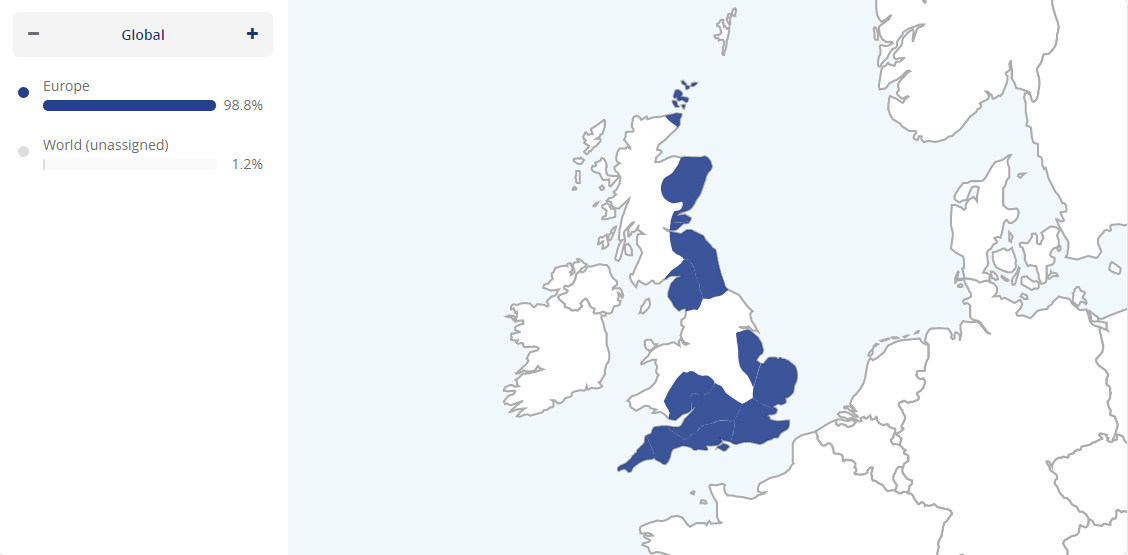
Here is my map at the global level which shows that 98.4% of my ancestry is from Europe with 1.6% unassigned.


By clicking on the + symbol I can access the submenu to view my genetic ancestry at the regional and subregional levels.

Here are my regional results in standard mode which place 98.4% of my ancestry in the British Isles with 1.6% unassigned. In my case the global and regional maps are identical because all my recent ancestry is from the same place.


Here are my subregional results in standard mode:

(I've adjusted the contrast on the above map to make the regions stand out more clearly.)

Here are my subregional results in standard mode in a tabular format:


Debbie's results
Lincolnshire
17.5%
South Central England
17%
Devon
16.2%
Southeast England
10.6%
Northumbria
9.1%
East Anglia
8.4%
Cornwall
4.6%
South Wales Border
3.9%
Aberdeenshire
3.3%
Orkney
1.8%
North Yorkshire
1.7%
British Isles (unassigned)
4.3%


World (unassigned)
1.6%


I have also been given an advance preview of my subregional results in cautious mode. These results are subject to change:


Debbie's results
Southeast England
36%
South West England
20%
South Central England
19%
North Central England
14%
North East Scottish
3%


Unassigned British Isles
7%
Unassigned European
1%

This is a full list of the 21 regional groups within Britain and Ireland identified by Living DNA: Aberdeenshire, Central England, Cornwall, Cumbria, Devon, East Anglia, Ireland, Lincolnshire, North Wales, North Yorkshire, Northwest England, Northwest Scotland, Northumbria, Orkney, South Central England, Southeast England, South England, Southwest Scotland and Northern Ireland, South Wales Border, South Wales, South Yorkshire. Descriptions of the regions can be found here.

Comparing with known genealogical ancestry
So how do these results compare to my known genealogical ancestry? I've provided a chart below showing the place of birth of all my ancestors going back for five generations. (The chart is inspired by the #Mycolorfulancestry meme started by J. Paul Hawthorne over at the Geneaspy blog.)
As can be seen, the birthplaces of seven of my 32 great-great-grandparents are unknown. I have four great-great-great-grandparents who were born in London, and two who were possibly born in Bristol. People mostly migrated to Bristol from the West Country and Wales, but ancestors who lived in London could have come from anywhere in the country. According to one estimate "one in every six English people either visited or lived in London at some stage in their lives during the early modern period" and London was also the major destination for immigrants from continental Europe (Hey 2004). Identifying the origins of ancestors in big cities like London and Bristol is often difficult unless they happen to have survived until 1851 so that their birthplace is recorded in the census.

My genealogy is probably not ideal to be used for a comparison because I have so many unknown and London ancestors. However, I was very pleased to see that my Devon ancestry was reflected in my results. The average amount of DNA inherited from a great-great-grandparent is 6.25%. My Devon ancestry has come out at 16.2% which is higher than expected, but it could be that some of my unknown ancestors are from Devon. This high percentage might also reflect my Somerset ancestry. Somerset is not identified as a specific region with the Living DNA test.

I was intrigued by the 1.7% from South Yorkshire. One of my London ancestors, my great-great-great-grandmother Elizabeth Horton, was born c.1806 in Hackney. I have some matches at 23andMe with a couple of people with the surname Horton in their family trees who have ancestry from Yorkshire. I've since discovered that Horton is a Yorkshire surname. This is a case where DNA testing has the potential to be used to inform genealogical research.

I don't have any documented ancestry from either Wales or Cornwall but these percentages could be explained by my Bristol ancestry. It's also important to remember that ancestry is not strictly defined by country or county borders. For example, during the nineteenth century many people from Devon moved to South Wales to work in the coal and copper mines so you could have people with four grandparents born in Wales who actually have a lot of ancestry from the South West. Conversely there are a lot of Welsh patronymic surnames that are found in North Devon.

I do not have any ancestry assigned to Ireland with the Living DNA test, whereas at AncestryDNA I came out with a surprisingly high percentage of Irish ancestry (20%). Living DNA are currently recruiting people with four grandparents born in Ireland to improve the Irish estimations so it may be that my results will be updated in the future and my Irish ancestry will be reflected in my results.

The big surprise is the high percentage (17.5%) assigned to Lincolnshire though I'm told that the region labelled as Lincolnshire also extends into North London. The Lincolnshire component could possibly be a reflection of my ancestry from Bedfordshire and Hertfordshire, two counties to the north of London that are en route to Lincolnshire. Alternatively it might perhaps be a clue to the origins of some of my unknown ancestors or it could represent deeper ancestry. It's very easy to speculate but with any DNA test it's important not to take the results too literally and to interpret the results in combination with the genealogical evidence.

The rest of my results broadly correlate with my known genealogical ancestry, though I have come out with more ancestry from the north of England than I expected.

Although I've only focused on my own results, Living DNA can also provide regional breakdowns for other countries, though not currently with such fine-scale resolution as for the British Isles. For example, in one set of results I've seen for a British individual with some Italian ancestry he was assigned ancestry from Southern Italy and Sardinia. Jewish and Aboriginal ancestry is not currently covered by Living DNA but should be added in the future. We can expect to see the results change over time as more studies are published and more reference populations are added to the database.

A comparison with my results from other companies.
I also have biogeographical ancestry results from 23andMe, AncestryDNA, Family Tree DNA and GPS Origins.

23andMe aims to provide a representation of our genetic ancestry within the last 500 years. My speculative results at the subregional level match 56.1% of my ancestry with Britain and Ireland.

At Family Tree DNA the MyOrigins results from my Family Finder test match 57% of my DNA with the British Isles. FTDNA do not give a timeframe for their results.

At AncestryDNA 21% of my DNA is matched with Great Britain and 20% is matched with Ireland. AncestryDNA do not claim to show genetic ancestry within the last 500 years and state that the results can "reach back hundreds, maybe even a thousand years, to tell you things that aren't in historical records". The Irish component of the AncestryDNA test seems to be elevated in people of British ancestry, and the Irish cluster actually extends into Wales and Scotland. Most English people are coming out with at least 15% "Irish" at AncestryDNA. For further details see the AncestryDNA blog post What does our DNA tell us about being Irish?.

For a detailed comparison of my results from 23andMe, Family Tree DNA and AncestryDNA see my blog post Comparing admixture results from AncestryDNA, 23andMe and Family Tree DNA.

The GPS Origins test does not have any British or Irish components and instead matches 19% of my ancestry with Fennoscandinavia, 12.9% with Western Siberia, 12.4% with Sardinia, 11.8% from Orkney, 11.3% with Southern France and 11.2% with the Basque Country, with smaller percentages from other regions. For further details see my blog post A review of the GPS Origins tests: four ethnicities and four reports.

Conclusion
The Living DNA test has given me the most accurate results of all the biogeographical ancestry tests I've taken so far, placing 98.4% of my ancestry in the British Isles which is a true reflection of my documented ancestry within the last few hundred years.

For the first time I have been given a subregional breakdown of my results which shows the regions within Britain where my ancestors possibly lived in the last few hundred years. Because I have lots of ancestors who went through the melting pot of London and Bristol my British ancestry is very mixed as people migrated to these cities from across the country. This also makes pre-1837 research in big cities before the beginning of civil registration in England and Wales very challenging. I also have some gaps in my family tree because of illegitimacies. However, my Living DNA results correlate very well with what I have been able to document about my ancestry, and might even have provided me with some clues to break through some of my brick walls. I was particularly pleased to see that my Devon ancestry had been picked up and was intrigued to see the small traces of my possible Yorkshire ancestry.

My results only provide a sample size of one and it is very easy to interpret results post hoc and make them fit with your expectations so I shall be very interested to see results from other people, and especially people who have more defined ancestry than me from specific regions.

Biogeographical ancestry testing has entered an exciting new era and we now have a test that provides a fine-scale breakdown of our genetic ancestry at a subregional level.

Update
Living DNA updated their algorithms in June 2017 and released the family views feature providing cautious, standard and complete views. See my article My updated family ancestry maps from Living DNA.

See also
Other reviews
Reference
Hey D (2004). Journeys in Family History. London: The National Archives, p.183.

© 2017 Debbie Kennett