Tuesday, 14 October 2025

MyHeritage upgrades its consumer DNA test to whole-genome sequencing


There has been exciting news today with the announcement from MyHeritage that they will be transitioning to whole-genome sequencing (WGS) for the MyHeritage DNA test test. This is a direct-to-consumer DNA test which provides customers with DNA matches with relatives along with a biogeographical ancestry report. This landmark announcement heralds a new era of whole genome sequencing for genetic genealogy with the long-anticipated use of WGS for relative matching. 

Relative-matching for genetic genealogy has been available since late 2009 but in order to keep the costs down the companies have always used microarray technology. A number of different microarrays have been made available over the years covering between 600,000 and about a million base pairs. The new MyHeritage test WGS will sequence almost the entire human genome comprising over three billion base pairs. WGS is now being applied to most new MyHeritage DNA kits currently being processed at the lab, and to every new MyHeritage DNA kit sold moving forward. Incredibly, the test is being offered at the same price as the existing MyHeritage test (including sale prices). Existing customers who have tested on the older microarray technology will not have their kits upgraded but the low cost is not likely to be a barrier for most genetic genealogists.

Update. I have now been told by MyHeritage that “You can buy the kit now, but only those arriving at the lab in Jan 2026 will be warranted to have WGS." If you order a kit I would therefore recommend delaying its return to ensure you get the WGS test.

The sequencing is being done in the Gene by Gene laboratories using technology powered by Ultima Genomics. Gene by Gene are the parent company of FamilyTreeDNA who specialise in Y-chromosome and mitochondrial DNA testing.

Technical details

I asked MyHeritage about the coverage of the new MyHeritage and was advised that they will be using  low-coverage 2x sequencing. Coverage refers to the number of times a base is read by the sequencing machine. Clinical-grade sequencing, where the goal is to detect rare variants, is normally done at 30 x or higher. FamilyTreeDNA's BigY test has a read-depth of 70 x. However, for relative matching and biogeographical ancestry analysis the depth of the reads is less important than the quantity of data available, and a few missing or incorrect reads are not going to be a major problem.

The MyHeritage scientists validated their methods in a 2020 preprint by Petter et al "Relative matching using low coverage sequencing". In that study the sequencing was done at 1 x coverage. This meant that only one of the two bases at each position in the genome was sequenced. Nevertheless, the researchers were able to replicate the performance of microarrays for identifying relatives at the third cousin level or closer. The authors estimated that the cost of 1x sequencing was around $30 and commented at the time "We envision that in the short term 1x coverage can be a good sweet spot for consumer genomics, balancing quality and price." Clearly the costs of sequencing have come down in the interim to make 2x coverage the sweet spot for the roll out of WGS for genetic genealogy.

Compatibility

MyHeritage have made all the needed measures and adjustments to make sure that users' results (Ethnicity Estimate, Genetic Groups and DNA Matches) for those who will be sequenced with WGS will be compatible with all other DNA data files. They have made the required imputation and phasing changes required in order for this to happen. In other words, those who previously tested with array chips or have uploaded their data to MyHeritage from another service will still be matched to those who will be sequenced with WGS.

Uploads

MyHeritage stopped taking uploads in May 2025 for customers from some countries with the rollout to all countries completed by the beginning of August 2025, presumably in preparation for the transition to WGS. Customers who transferred their DNA to MyHeritage will continue to receive matches with new WGS testers. There are no plans to restore uploads.

Implications

I will be ordering the new MyHeritage WGS test. I have already tested direct at MyHeritage with a microarray test and I have also transferred my AncestryDNA results to MyHeritage. I will therefore have the ability to do a three-way comparison to test the performance. I am also fortunate that both of my parents have tested and are in the MyHeritage database.

Currently with my Ancestry transfer kit I have 12,279 matches but 38% of those matches don't match either of my parents.

With my direct MyHeritage DNA test I have 11,049 matches but 47% of those matches don't match either of my parents.

The non-matching with my parents is caused either by false positive or false negative matches. Spurious matches become a particular problem with smaller segment matches. I anticipate that with the WGS test the number of false matches will be reduced and the detection of smaller segments will be improved. We don't yet have details of how the matching process will work at MyHeritage and how many markers will be used for the comparison process. I hope that a white paper will be forthcoming. 

It is also anticipated that WGS will improve the biogeographical ancestry reports and I look forward to future developments.

I will update this blog post if further information become available.

Further reading

Further details of the new MyHeritage test are provided in the press release reproduced below. 

MyHeritage Upgrades Its Consumer DNA Tests

to Whole Genome Sequencing

MyHeritage becomes the first major DNA testing company to fully adopt Whole Genome Sequencing; the upgrade leverages technology by Ultima Genomics and processing at the Gene by Gene lab

TEL AVIV, Israel & LEHI, Utah & HOUSTON & FREMONT, California October 14 , 2025 — MyHeritage, the leading global platform for family history and DNA testing, announced today a landmark move to Whole Genome Sequencing for its at-home DNA test, MyHeritage DNA. Leveraging cutting-edge sequencing technology from Ultima Genomics and processing at the Gene by Gene lab, MyHeritage is the first major consumer DNA testing company to adopt Whole Genome Sequencing at a scale of more than one million tests per year. The enriched data will empower MyHeritage to deliver more accurate ethnicity analysis and DNA matching, and unlock opportunities for future innovation in consumer genomics and genetic genealogy.

Whole Genome Sequencing reads almost the entire human genetic code, covering around 3 billion base pairs (nucleotides). This is superior to the standard genotyping arrays used by most consumer DNA tests, including MyHeritage until recently, which read only about 700,000 base pairs. More data enables deeper insights across all types of genetic analysis. Whole Genome Sequencing is now being applied to most new MyHeritage DNA kits currently being processed at the lab, and to every new MyHeritage DNA kit sold moving forward. MyHeritage DNA kits already processed with the older genotyping array technology will not be reprocessed with Whole Genome Sequencing. Customers whose MyHeritage DNA kits are processed with Whole Genome Sequencing will be able to download their entire genome from MyHeritage at no cost, in CRAM format. They may also unlock additional insights by uploading their data to other trusted genetic service providers that support such uploads.

Due to its high technological potential, MyHeritage has been eying Whole Genome Sequencing for years. A pioneering study by the MyHeritage Science Team published in 2020 validated Whole Genome Sequencing for reliable relative matching at scale. Following that study, MyHeritage has been collaborating closely with Ultima Genomics since its emergence from stealth mode in mid-2022, and later jointly with Gene by Gene, to prepare the scientific and logistical foundation for upgrading the MyHeritage DNA processing pipeline to Whole Genome Sequencing using Ultima’s technology. The upgrade was completed successfully and creates new opportunities for MyHeritage to deliver deeper insights into ethnic origins, family connections, and genetic genealogy, without any price increase to consumers. Even before this upgrade, MyHeritage was consistently the most affordable DNA test on the market among the major DNA testing companies. The upgrade to Whole Genome Sequencing makes the MyHeritage offering even more compelling.

“This is a pivotal moment for genetic genealogy,” said Gilad Japhet, Founder and CEO of MyHeritage. “We are proud to take this pioneering step into Whole Genome Sequencing together with Ultima Genomics and with our longstanding partners at Gene by Gene. MyHeritage customers will enjoy the fruits of this technological upgrade for years to come, through increased accuracy, deeper insights, and exciting new products.”

“MyHeritage’s move to Whole Genome Sequencing marks a major milestone for consumer DNA testing,” said Dr. Gilad Almogy, Founder and CEO of Ultima Genomics. “It demonstrates the scalability and maturity of Ultima’s innovative technology and accelerates the immense value that Whole Genome Sequencing can bring to consumers. It has been a pleasure collaborating with MyHeritage over the past few years, and we are proud to work together with them and Gene by Gene to bring genetic genealogy to new heights for millions of consumers worldwide.”

“The transition to Whole Genome Sequencing represents the most ambitious project in our years-long partnership with MyHeritage,” said Dr. Lior Rauchberger, CEO of Gene by Gene. “We are proud to help set a new standard in consumer genomics and support the growth of what will soon become the world’s largest database of whole genomes. The rollout is centered at Gene by Gene’s state-of-the-art laboratory in Houston, Texas, which will house a large fleet of Ultima UG100™ sequencing instruments.”

Privacy Commitment

MyHeritage is committed to the privacy and security of its customers' data. All genetic data is encrypted and stored securely, and MyHeritage does not sell or license data to third parties. MyHeritage strictly prohibits the use of its platform by law enforcement. All genetic samples are automatically destroyed by the lab after processing, except those stored securely for customers who have enrolled in the MyHeritage DNA BioBank service. This provides customers with peace of mind not offered by most other major DNA testing companies.

About MyHeritage

MyHeritage is the leading global platform for family history. It enriches the lives of people worldwide by enabling them to uncover more about themselves and where they belong. With a suite of intuitive products, billions of historical records, AI-powered photo tools, and an affordable at-home DNA test, MyHeritage creates a meaningful discovery experience that is deeply rewarding. The MyHeritage platform is enjoyed by more than 62 million people around the world who treasure and celebrate their heritage. MyHeritage is committed to the privacy and security of its customer data and is available globally in 42 languages. www.myheritage.com

About Ultima Genomics

Ultima Genomics is unleashing the power of genomics at scale. The company's mission is to continuously drive the scale of genomic information to enable unprecedented advances in biology and improvements in human health. With humanity on the cusp of a biological revolution, there is a virtually endless need for more genomic information to address biology's complexity and dynamic change—and a further need to challenge conventional next-generation sequencing technologies. Ultima's revolutionary new sequencing architecture drives down the costs of sequencing to help overcome the tradeoffs that scientists and clinicians are forced to make between the breadth, depth and frequency with which they use genomic information. The new sequencing architecture was designed to scale far beyond conventional sequencing technologies, lower the cost of genomic information and catalyze the next phase of genomics in the 21st century. www.ultimagenomics.com

About Gene by Gene
Gene by Gene is a world leader in genetic testing services with over 20 years of experience. Its laboratory holds accreditation from multiple agencies, including CAP, CLIA, New York State Department of Health, California Department of Public Health, and AABB. With a cutting-edge laboratory and highly trained team of experts, Gene by Gene is committed to excellence in the field of genetic analysis. www.genebygene.com

Wednesday, 1 November 2023

Cruwys family tree on Ancestry

When I first started my family history research over twenty years ago I began by compiling the family information in Word files. It soon became too complicated to keep track of all the different family lines in separate files and so I bought a family history program to record all the information. After researching all the available family history programs I settled on Family Historian, which has an excellent reputation and is well-suited for one-name study work. The program has stood me in good stead over the years. I use it to record my own family tree but also all the other Cruwys and Cruse trees I've researched as part of my one-name study. 

When I first tested at AncestryDNA in 2012 I only had a very basic skeleton tree on Ancestry. I didn't get much out of the DNA test in the early years and it was another three years before Ancestry officially launched their test in the UK in 2015. Since then, the database has grown exponentially, allowing me to confirm much of my existing research and also to make some exciting new discoveries. I've found that there are distinct advantages to maintaining a detailed family tree on Ancestry. Having a publicly accessible tree means that I benefit from the Common Ancestor Hints and ThruLines. The more I build out the tree and build down the collateral lines the easier it becomes to work out the relationship to my matches. 

I find that Ancestry's online tree-building platform is by far the easiest to use of all the available options. The powerful hint system makes it very easy to find records. Other family historians will often already have done research into a particular line and found all the relevant census and parish register entries which saves the hassle of spending a long time searching indexes to find the people I'm looking for, especially when the names have been horribly mistranscribed. Many people have generously shared photos as well as images of birth, marriage and death certificates which has been extremely helpful.

For all these reasons, over the last few years I've been slowly going through the process of trying to expand my tree on Ancestry by adding in all the research that I've done over the last twenty years which has been carefully stored in Family Historian. Rather than uploading a GEDCOM file and losing all the linked records and DNA matches I took the decision to curate my tree manually. I am gradually working through all the different branches of my tree adding census entries, uploading certificates and photos and linking them all to my tree. I've benefited greatly from the research that others have shared with me so I am effectively paying forwards the favour. This process has been invaluable in its own right. When I started out I was mostly working with indexed records and transcriptions. Increasingly records have been digitised and I am now able to link to census pages and original parish register records. I'm also making some very interesting new discoveries because of the consolidation process and because the hints often lead me to records which I hadn't previously discovered.

By adding sources to my tree I'm also hoping that my tree will have better exposure on Ancestry so that people can find my research. I'm also hoping that it will help to counter some of the mistakes I've found in some of the other online trees. Ancestry do not tell us how their algorithms work but it seems that the more sources you have linked to a person the more likely it is that your tree will appear in the hints list for other researchers.

I've made good progress but there is still a lot more work to do. However, I'm pleased to report that I've completed the work on my own Cruwys family. My tree on Ancestry now encompasses my own Cruwys family from Winkleigh, the Cruwys Morchard tree, and the Mariansleigh tree. The Winkleigh and Cruwys Morchard trees link together in the mid-1400s. I know from the Y-DNA testing for my Cruwys DNA Project that the Mariansleigh Cruwyses are related to the Winkleigh and Cruwys Morchard families but I have been unable to document the connection. It does not help that the parish registers for the period in question have not survived. However, I have a second connection to the Mariansleigh Cruwyses through the Eastmond family so I was able to link them into one big tree. The Mariansleigh Cruwyses are by far the most numerous branch of the family so it took me some time to add all these records. If you're connected to any of these Cruwys families do check out my tree. You can find it on Ancestry here. If you have any additional information on these families I would be delighted to hear from you.

One of my next steps will be to build out trees on Ancestry for all the other Cruwys families I've researched as part of my one-name study. The Y-DNA project has shown that we have two distinct Cruwys groups which do not share a common ancestor and which belong to two completely different haplogroups. To make the work easier I am intending to upload a GEDCOM file for these other Cruwys families to a separate tree on Ancestry. I will then repeat the process of linking in all the census entries, parish registers and other records. I know it will take me some time to do this but it will be very worthwhile and will help to make my research more accessible.

Friday, 15 April 2022

Comparing ethnicity estimates and ethnicity inheritance results from AncestryDNA for a child and her parents

I wrote about AncestryDNA's new SideView technology and the new ethnicity inheritance tool earlier this week. My results for my parents weren't yet available when I wrote the post and I thought it would be interesting to do a three-way comparison.

Ethnicity estimates


Debbie's dad
My dad's ancestry within the last few hundred years is all English apart from one maternal great-great- grandfather who is from Scotland. His paternal side is from Devon, Bristol and Gloucestershire. His maternal side is from Essex, Hertfordshire, Oxfordshire and London. Here is his updated ethnicity estimate.

The ranges are:
  • England and Northwestern Europe 49% to 69%
  • Wales 2% to 28%
  • Scotland 0% to 30%
  • Sweden and Denmark 0% to 16%
  • Norway 0% to 15%.
The ranges can be found by clicking on the country names.

Debbie's mum
My mum's ancestry in the last few hundred years is all from England apart from one paternal great-great-grandmother from Ireland. Her paternal ancestry is from Hampshire (via London), Somerset and Ireland. She has an unknown paternal great-grandfather who is probably from Oxfordshire. Her maternal ancestry is from Hertfordshire, London, Hampshire, Berkshire, Bedfordshire, Buckinghamshire, Gloucestershire and Wiltshire. Here is her updated ethnicity estimate.

The ranges are:
  • England and Northwestern Europe 70% to 100%
  • Wales 0% to 17%
  • Ireland 0% to 17%
  • Norway 0% to 5%.
Debbie
Here is my updated ethnicity estimate.
The ranges are:
  • England and Northwestern Europe 65% to 99%
  • Scotland 0% to 29%
  • Wales 0% to 18%
  • Ireland 0% to 9%
I am disregarding Norway, Sweden and Denmark in the results for my parents as noise. The reference population labelled as Wales actually stretches into North Devon, North Somerset, Bristol, Gloucestershire and Herefordshire so this may be a real representation of my dad's paternal ancestry from Devon, Bristol and Gloucestershire and my mum's maternal ancestry from Gloucestershire. There was a big migration from North Devon to South Wales in the 1800s with people moving to Wales to work in the copper and coal mines so many people from South Wales have Devon ancestry which may account for the overlap. The Scotland component is over-represented in many people at AncestryDNA and this reference population probably should have been labelled as Scotland, Ireland and England.

The genetic communities (also known as regions) are uncannily accurate. It's interesting to note how I get Gloucestershire, Wiltshire and Oxfordshire as a region despite the fact that neither of my parents has this region. This can easily explained by the fact that both of my parents have ancestry from both Gloucestershire and Oxfordshire so I actually get a double dose of DNA from these counties.

Ethnicity inheritance overview


Debbie's dad
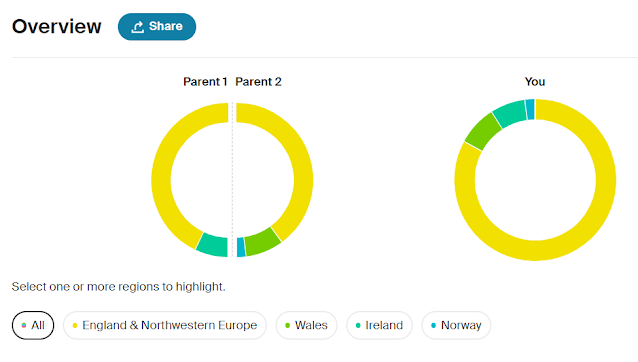
This is the ethnicity inheritance overview and detailed comparison for my dad. If the Welsh component represents my dad's paternal ancestry from Devon, Bristol and Gloucestershire then Parent 1 is his dad. However, my dad's Scottish ancestry is on his mother's side yet the Scottish percentages appear in both parents but are much higher for Parent 1 than Parent 2. I therefore do not feel confident in assigning parental sides to these results.

Debbie's mum
This is the ethnicity inheritance overview and detailed comparison for my mum. Ireland only appears in Parent 1 and Wales only appears in Parent 2 so I am assuming that Parent 1 is her father and Parent 2 is her mother.

Debbie
Here is my ethnicity inheritance overview and detailed comparison. The Scotland component is the odd one out here as it appears in both parents whereas it is only reported in my dad's results. Ireland only appears in Parent 1. I had originally assumed therefore that Parent 1 is my mum. However, the absence of Wales on my dad's side is surprising given that he had a much higher percentage of the Welsh component than my mum so it's quite possible that Parent 1 and Parent 2 are the other way round instead.

Conclusion

SideView is an innovative new technology from AncestryDNA and I remain excited by the possibilities it has opened up. While the "ethnicity" estimates are still a work in progress they are a huge improvement compared to the early days of autosomal DNA testing. When I received my first biogeographical ancestry report from 23andMe back in 2010 they were only able to tell me that I was 100% European. We are now getting much more granularity within Europe, even if the country-level assignments, especially with the low percentages, are not very accurate. We can expect the results to improve over time. AncestryDNA regularly add new regions and provide updated ethnicity estimates every year. We can probably expect a further update this summer or in the autumn. 

The genetic communities are worked out in a different way and are based not on reference populations but on large segments of DNA shared in genetic networks. They are reflective of our recent ancestry within the last 200-300 years. They are remarkably accurate and for most people generally correspond with their known ancestry. Another possible application for the SideView technology would be to assign genetic communities to parental sides though, as in my case, it may be that some communities would need to be assigned to both sides. We have much to look forward to this year!

Wednesday, 13 April 2022

SideView: a new method for assigning matches and biogeographical ancestry to paternal and maternal sides at AncestryDNA

I am fortunate that I have been able to test both of my parents at AncestryDNA which means that I am able to determine whether my matches are on the paternal or maternal sides. For matches sharing over 20 centiMorgans (cM) AncestryDNA automatically label matches as belonging to the father's side or the mother's side if you have tested your parents. This does of course mean that matches sharing lower amounts of DNA are not labelled, though I can still check to see which parent matches my cousins and I can assign the match manually using the relationship assignment tool. Some matches cannot be assigned to a side as they do not match either of my parents and are therefore probably false matches, though this is less of a problem now that AncestryDNA have removed all the 6 and 7 cM matches which accounted for the bulk of the false matches.

Sorting matches into paternal and maternal sides is a much more difficult and time-consuming process when working with DNA results when data from the parents is not available. When working with my parents' matches I use the Shared Matching Tool and the coloured dots to group the matches into clusters. If I can work out the relationship with the match or assign a common ancestral couple to the cluster I can then manually assign the matches in the cluster to the paternal or maternal side but this is a slow and laborious process.

Wouldn't it be wonderful if the parental sides could be determined automatically? Fortunately that is now likely to be a reality in the very near future thanks to some ground-breaking new research from the scientists at AncestryDNA. 

AncestryDNA have developed a new methodology known as SideView which allows them to separate out the DNA inherited from each parent throughout the genome without the parents taking a DNA test. SideView will be used to power a number of new DNA features at AncestryDNA in the coming months. It will eventually allow us to see our matches separated by parental side and there will be genetic community and journey patterns for each parental side. The sides will be labelled for all of our matches down to 8 cM but the methodology is not perfect and there will be around 15% or 20% of our matches that aren't labelled. There will also some people with both parents falling in the same group and their matches will be labelled as both sides. This applies to about 3% of the AncestryDNA database.

The technology also opens up many exciting possibilities for the future. AncestryDNA now provide traits reports so I wonder if it might one day be possible for them to identify which traits have been inherited from each parent.

"Ethnicity" inheritance
The first feature enabled by this new SideView technology is known as ethnicity inheritance. If you log into your Ancestry account you should now see this new feature which allows us to see which biogeographical ancestries we have inherited from each of our parents.  It may take a while for the feature to roll out to the entire database. (As a side note, the term ethnicity in this context is a misnomer because ethnicity refers to our social, cultural, religious and linguistic heritage and is not necessarily a reflection of our genetic ancestry inheritance though there is often some overlap.) Despite the quibble about the name, this is potentially a very useful tool, particularly for those people who know nothing about their ancestral origins.

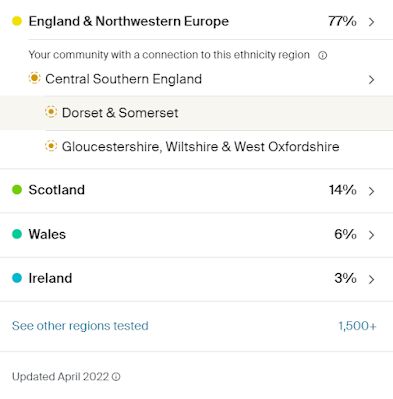
In addition to the rollout of the ethnicity inheritance feature, our "ethnicity" estimates have also been updated based on the new technology, though no new regions have been added in this latest update. Here is my updated "ethnicity" estimate: 

England has gone up from 71% to 77% since the last update in July 2021. Scotland has dropped from 20% to 14%, Wales has decreased from 8% to 6% and Ireland has gone up from 1% to 3%. The results are not too far off my documented ancestry though the Scottish percentages are still too high. I have one maternal great-great-great grandparent from Ireland and one paternal great-great-great grandparent from Scotland. All my other documented ancestry is from England. Ancestry's Wales region extends across the English border into Gloucestershire which probably explains my Welsh assignment.

As a reminder, it's always worth clicking on the country name to see the ranges for each different ancestry. As you can see, the range for my Scottish component is anywhere between 0% and 29%.

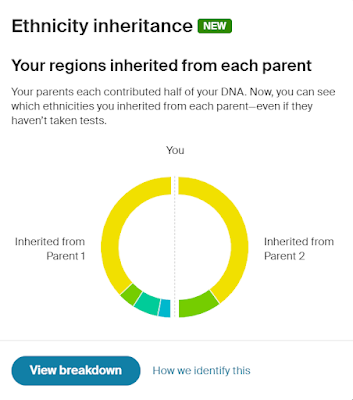
When you log into your account you will now be invited to view the new "ethnicity" inheritance feature.
Ancestry explain that your parents contributed to half of your DNA. You can see which ancestries you have inherited from each parent even if they haven't taken a DNA test. It is important to remember that this is not providing an estimate for our parents as we only have 50% of our DNA from each of our parents so they will have DNA that we don’t. If you are able to test your parents then you will receive insights into the DNA that they have inherited from your grandparents. For those of us who have tested our parents the ethnicity inheritance feature is currently based on the SideView technology rather than using the data from your parents, though of course your parents are your matches so they are considered part of the process.

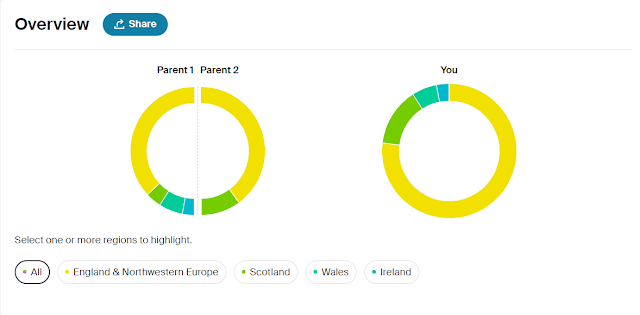
If you click on "View breakdown" you will be able to see your overview report comparing your ancestry breakdown with the two halves inherited from your parents.

There is also a detailed comparison showing the information in a tabular format.

The algorithm is not able to identify which parent has contributed the ancestries to the different parental sides but from the evidence of my family tree I can infer that Parent 1 with England, Scotland, Wales and Ireland is my mum (though she has no Scottish ancestry) and Parent 2 is my dad. Ancestry intend to provide us with an Edit Parents button which will allow us to label the parental sides if you are able to determine which parents have contributed the different ancestries to your DNA. The "ethnicity" features will be integrated with the match lists and vice versa so any changes you make will be reflected throughout the entire website.

Technical details
The new SideView system uses the power of AncestryDNA's massive database of over 21 million people and the vast networks of shared matches. It works on the premise that the DNA we share with our matches is only shared on one parental side. This means that if the matches can be sorted into two separate groups it will be possible to determine which side of your DNA is associated with each parent. Ancestry have found a way to assign matches into parental groups by looking at the segments of DNA shared in common with our matches. 

AncestryDNA claim that because of the size of their DNA database, SideView groups matches with a precision rate of 95% for 90% of Ancestry customers. With 11.5 million people in the database the accuracy drops to 85% for the majority of customers. With a database of five million the accuracy is around 65% and with a million people it is 50%.

Ancestry have published an excellent article in their Support Centre explaining how the SideView technology works.

There is also a new article in the Support Centre explaining how "ethnicity" inheritance works.

They are also planning to have some interactive educational material available soon using animated GIFs to explain how DNA inheritance works and to give people a better understanding of the new SideView technology. 

The full technical details of the methodology behind SideView have been published in a new preprint by the AncestryDNA scientists Keith Noto and Luong Ruiz. The paper is entitled "Accurate genome wide phasing of IBD data" and is available on the BioRxiv preprint server: https://doi.org/10.1101/2022.04.11.487932

AncestryDNA have also lodged a patent application with the United States Patent and Trademark Office which provides further highly technical information: https://uspto.report/patent/app/20210034647

There will also be an updated "ethnicity" white paper which will be available in a couple of months.

Further reading 

A change for e-mail subscribers to this blog

Time has flown by and for one reason or another I've not had much time for blogging in the last year. I note that my last blog post was published on 19th March 2021. I hope to rectify that in the coming weeks and months. A lot has been happening in the genealogy and genetic genealogy worlds and we can look forward to many exciting developments.

I previously used the Feedburner service to send out e-mails to my blog subscribers. Feedburner was acquired by Google in 2007. In 2021 Google announced that they were going to focus on the core Feedburner features and would no longer be supporting e-mail subscriptions. I therefore had to look for a new solution. On the recommendation of my friend David Pike, I settled on a program called Mailer Lite. There was quite a steep learning curve but I hope I've now got everything sorted. If you were previously subscribed to my blog you've now been transferred to the new list. If you're reading this in your e-mail client then the transition has worked successfully. You may wish to add my e-mail address to your address book to ensure that the e-mails don't go into spam. I will monitor how the transition goes. If anyone has any problems do get in touch.

Friday, 19 March 2021

Family History Down Under 2021 - a four-day virtual conference


Family History Down Under is going online for 2021 so everyone can join the conference regardless of where they live in the world. You can watch all the presentations from the comfort of your own home and the recordings will be available until the end of July.

I've recorded two talks for the DNA track. The first talk is entitled "DNA testing and family history: advance your genealogical research" where I provide an introduction to the practical application of DNA testing for family history research. My second talk is "Solving cold cases with genetic genealogy: can we, could we, should we?" This is an extended and updated version of the talk I did at Rootstech 2021. With the luxury of a 50-minute presentation I was able to explore all the issues and developments in much greater depth.

The conference is divided into four tracks: DNA; researching abroad; Australia and New Zealand; and methodology and general. There are lots of excellent speakers lined up covering some very interesting subjects. You can either sign up for individual tracks or you can purchase a mega bundle which gives you access to all four tracks at a discounted price.

In order to recreate the feel of an in-person conference, Facebook groups have been set up for each of the tracks where all the speakers will be popping in from time to time to answer questions. I hope to see you there.

For more information check out the Family History Down Under 2021 website.

Wednesday, 24 February 2021

MyHeritage to be acquired by Francisco Partners


News broke today that MyHeritage is to be acquired by the private equity company Francisco Partners. This is likely to result in new investment in the company so that they can expand their market share. Hopefully genealogists will benefit from the investment and we will eventually see the introduction of lots of new features and products.

You can read more about the acquisition in this article from Business Wire.

There is additional information in this article from TechCrunch.

See also the official press release from MyHeritage.

I expect that we will learn more about the plans for MyHeritage at RootsTech Connect. MyHeritage have a number of talks planned for the show. You can find a full listing on the MyHeritage blog.

Update 13th April 2021
The acquisition was completed on 8th April 2021 following regulatory approval. For details see this blog post from MyHeritage.

RootsTech Connect – the pick of the talks and the final countdown

The clock is ticking away and the virtual doors of RootsTech Connect will soon be open. The Expo Hall goes live at midnight UK time on 24th February so I will have the opportunity to have a quick look around before bedtime. Many of the exhibitors might well have special offers for the show or will be announcing new product launches.

The main website is due to go live four hours later at 4.00 am UK time. I am a night owl but 4.00 am is a bit late even for me so I will be logging on somewhat later in the morning to have a look around. Depending on where you are in the world you might get a chance to check out the website before me. One of the joys of a virtual conference is that we are not restrained by timetables and we can pick and choose the most convenient times to participate. And of course all the content will be available online for the rest of the year.


Making connections will be a key component of the show. There will be a chance to chat online with the exhibitors and most of the presenters through the Connect Chat tool. Each class and all of the exhibitors will have their own dedicated chat rooms.

To get the best out of the event I would suggest making a note of all the speakers and exhibitors you want to connect with so you get a chance to chat during the show. Once the website goes live you will be able to make a playlist of all the talks you want to watch.

I've recorded two talks for RootsTech on "Genetic Genealogy Meets CSI" and "Secrets and Surprises: Uncovering Family History Mysteries Through DNA". Do come along and join me for a chat and I will respond as soon as I can depending on the time difference. 

The main stage sessions will be viewable without signing in but you will need to register and have a FamilySearch account to get the most out of the show. 

There seems to be some confusion about the registration process but I found that I could register through my FamilySearch account. Once you've registered, click on the bell icon for the notifications and your registration will be shown.


There are also seem to be lots of informal groups and chats being set up as people do their best to meet up with friends and try to recreate the experience of attending an event in person.

Debbie's pick of the talks
I've been having a look at the English class schedule which is available from this link on the RootsTech home page. Here are my top picks of the available talks.

DNA talks

These are the DNA talks which I am most looking forward to.

The AncestryDNA talk is intriguing and I wonder if this heralds the launch of a new Custom Groups feature for sorting and filtering our matches. [Update: This talk was in fact just a demonstration of how ThruLines works and how to use the coloured dots on the mobile app to make custom groups.]

There are lots of talks for those of you who are just getting started with DNA testing. Diahan Southard of Your DNA Guide is always an engaging and inspiring speaker. She has a good understanding of the science and has the gift of being able to explain complicated subjects in easy-to-understand language. Diahan has recorded a number of talks for Rootstech and I’m sure they will all be worth watching.

There are talks on the basics of Y-DNA testing from MauriceGleeson, Mags Gaulden and Vivs Laliberte. Janine Cloud from FamilyTreeDNA has a more advanced talk on the BigY test which I am sure will be worth watching. Michelle Leonard has recorded a talk on Understanding X-Chromosome DNA Matching. Ugo Perego has a talk on mitochondrial DNA as well as a talk on his personal genetic genealogy. Ugo used to work for the now defunct Sorenson Molecular Genealogy Foundation so I am sure he will have some interesting insights to share. Look out too for Kitty Cooper's talk on "The Basics of Unknown Parentage Research Using DNA".

Surnames

Technology

English genealogy

Australia and New Zealand

Further reading
See my previous blog post RootsTech – a global family history show for further information about RootsTech Connect. 

Monday, 22 February 2021

Free upload to MyHeritageDNA from 21st to 28th February 2021

MyHeritage have a very special offer on this week. If you've tested at 23andMe, AncestryDNA, FamilyTreeDNA or Living DNA you can download your raw data and upload to the MyHeritage database to get free access to all the features which are normally only available after paying the upload fee of $29. This includes access to the new Genetic Groups feature. You can see my genetic groups in the screenshot below.


The MyHeritage "ethnicity" estimates have not yet been updated but we are expecting this feature to be revamped later this year. I suspect when that happens my 9.2% Italian ancestry will disappear

MyHeritage have a database of over 4.5 million people and have much better representation in continental Europe than any of the other companies, helped by the fact that they make their website available in many different languages. One of the most useful features at MyHeritage is the ability to filter matches by the countries where your matches live. You will find you get lots of very distant matches from many different countries which are probably not related in a genealogical timeframe but this feature allows you to search for matches in the countries where you do have known relatives. In my case I am primarily focusing on matches in the UK, Australia and New Zealand.


MyHeritage have written a blog post which you can access here with more details about this offer.

Answers to frequently asked questions about uploading data to MyHeritage can be found in their Help Centre.

You can also upload your data directly via this link.

The offer is only available until 28th February so if you've not yet transferred your data I would encourage you to take advantage of the offer while you have the chance.

Monday, 15 February 2021

Investigative genetic genealogy: current methods, knowledge and practice


I spent much of August and September last year collaborating on a big invited review paper on investigative genetic genealogy. I am very pleased to say that the paper successfully went through peer review and has now been published in the journal Forensic Science International: Genetics. The paper is free to read and you can access it via this link.

I worked on the paper with Chris Phillips from the Institute of Forensic Sciences at the University of Santiago de Compostela in Spain and Daniel Kling and Andreas Tillmar who work together at the National Board of Forensic Medicine in Linköping, Sweden. Daniel also has an affiliation with the Department of Forensic Sciences at Oslo University Hospital in Norway. We very fortunate that Oslo University very kindly provided the funding to pay for the paper to be made available open access. It was a pleasure to collaborate with these researchers. We all had complementary knowledge and skills and we have produced a very comprehensive review of investigative genetic genealogy which also highlights areas where future research and validation are needed. The paper is written for an audience of forensic geneticists and is somewhat technical in places but I think much of it will also be of general interest to genetic genealogists.

2020 was a very productive year for me in terms of scientific publications. I collaborated in 2019 with my genetic genealogy friends John Cleary, Maurice Gleeson, Donna Rutherford and Michelle Leonard on a landmark study in collaboration with the forensic science company Eurofins which helped to validate the genealogical methodology used for investigative genetic genealogy. This paper was published in Forensic Science International: Genetics in the May 2020 issue. The cluster-based methods we used for this study are equally valid for family history research. The study was cited in a publication by the UK's Biometrics and Forensics Ethics Group which looked at the potential use of genetic genealogy techniques to assist with solving crimes in the UK.

I also collaborated last year with Gabrielle Samuel from Kings College London on two studies looking at the views of UK stakeholders about investigative genetic genealogy. We found that, although there was considerable support for its use, there were also many ethical concerns raised. While all participants stressed the need for appropriate consent there was less agreement on what the consent process should look like and we concluded that individual consent is not in any case a panacea and that there needs to be societal consent. 

The first of our two papers "The impact of investigative genetic genealogy: perceptions of UK professional and public stakeholders" was published in the September 2020 issue of Forensic Science International: Genetics.

The second paper "Problematising consent: searching genetic genealogy databases for law enforcement purposes" was published online in New Genetics and Society in November 2020.

The above three papers are not available open access. If you would like a copy and don't have institutional access please feel free to write to me.

Friday, 12 February 2021

Rootstech Connect 2021 – a global family history show


Rootstech, the world's largest family history show, will take place from 25th to 27th February. For the first time this year it is going online and will be completely free. This will be a truly global event with speakers from around the world and with talks in over 40 different languages. Over 250,000 people from 219 countries and territories have so far registered to attend. 

With the new online format, the talks will be done somewhat differently this year. There will be a main stage with talks from keynote speakers which will be streamed over the course of the three days in a pre-arranged schedule. In addition there are over 800 pre-recorded classes, the vast majority of which will be available online as soon as as the show opens, and you will be free to watch them at your leisure at any time of the day or night over the next year. Think of it as Netflix for genealogy. You will be able to pick and choose the content of interest and watch it at leisure from the comfort of your own home at a time that suits you with the added advantage that you do not have to pay a subscription.

Rootstech have followed the model of TED Talks and most of the presentations will be 20 minutes long, which is considered to be the optimum length for online presentations. There are some longer tutorials which have been divided up into 20-minute blocks. 

I am privileged to have been chosen as one of the speakers at Rootstech Connect and have recorded two presentations: "Genetic genealogy meets CSI" and "Secrets and surprises: uncovering family history mysteries through DNA". There will be an opportunity to chat with the speakers during the show. I'm not yet sure how this is going to work out but do come along and I will be happy to answer any questions arising from my talks. There will be moderators monitoring the chats who will alert us when we get a question.

The organisers have been working really hard behind the scenes to get everything ready for the event and to build the infrastructure for the website. The full schedule has not yet gone up on the website but they have shared with the speakers the schedule for the main stage and the English class catalogue and we've been given permission to share these.

Below is a copy of the schedule for the main stage. You can find biographies of the keynote speakers here

You can download a copy of the English class list from this link. (The pdf is now also available via a link on the RootsTech Connect home page.) These sessions are on demand which means that they can be watched any time throughout the conference or for the rest of the year. The vast majority of sessions will be available on the first day starting at a specific time. Here's a sneak preview of the start of the list.


There are lots of interesting classes which will cater for everyone whether you've been researching for many years or you are just starting your family history research. There are also lots of interesting DNA talks.

Lists of the classes in other languages should be available soon and I will share them here as soon as I have them.

There will also be an Expo Hall where you will have the opportunity to meet with the exhibitors via video or live chat.

If you've not yet registered for RootsTech you can sign up here.

RootsTech Connect promises to be a really exciting event. I can't wait to start watching all the wonderful talks.

Update 23rd February 2021
There are now 433,255 registrants signed up for RootsTech Connect from 235 countries and territories. For a sneak preview of the website check out this short video below from Jen Allen at RootsTech.

Update 24th February 2021

Check out my follow up blog post RootsTech Connect – the pick of the talks and the final countdown.

Also check out this detailed blog post from FamilySearch on Getting the most out of RootsTech Connect 2021

Further reading

Sunday, 7 February 2021

23andMe to merge with Richard Branson's company VG Acquisition Corp


It has been an interesting start to the year in the genetic genealogy world. In January came news of the merger of MyDNA with FamilyTreeDNA and Gene by Gene. Then we heard that Ancestry were abandoning their health test and that they had appointed a new CEO and a new Chairman of the Board, potentially signalling a change of a direction and a return to their core business of genealogy.

Now we have news that 23andMe has entered into a deal to merge with Richard Branson's company VG Acquisition Corp (VGAC). VGAC is what is known as a special acquisition company (SPAC), otherwise known as a blank cheque company, which is formed by groups of investors who have set up the company with the sole purpose of making acquisitions and to get them quoted on the stock exchange.

The deal values 23andMe at around $3.5 billion. The transaction is expected to be completed by the end of the second quarter of 2021. Once the transaction has been completed the new merged company will trade on the New York Stock Exchange under the name ME.

As a result of this move, the combined company will have access to a cash fund of around $900 million which will be used to invest in "key growth initiatives across 23andMe’s consumer health and therapeutics businesses".

What are the implications for genetic genealogy?
23andMe is now firmly positioning itself as a personalised healthcare and drug development company and it very much looks as though the investment money is going to be used to expand that side of the business rather than focus on genealogy. 23andMe shared an interesting slide deck from a presentation they gave to investors. The ancestry reports are to be used as the "mass entry point to building a revolutionary database". They will therefore need to ensure that these reports are regularly updated and presented in an appealing way.

From a personal perspective I don't think we will notice much difference. 23andMe has never been particularly useful for genealogy because about 90% of the database is in the US and I've never really had any useful matches at 23andMe. I have, however, found the health and trait reports interesting to read and the company provides some very useful educational material.

I'm hoping that with Richard Branson's involvement 23andMe might pay a bit more attention to their customers outside the US. In October 2020 they launched a new subscription service known as 23andMe+. The subscription costs a modest sum of $29 a year and provides access to pharmacogenetic reports, enhanced ancestry features and access to new reports and features, but is currently restricted to US residents.

We probably won't see any changes until the transaction has been completed but it will be interesting to see how the money gets spent and how the company develops in the next few years.

Further reading

Friday, 5 February 2021

Changes at the top at Ancestry

At the beginning of December 2020 it was announced that Margo Georgiadis, Ancestry's President and CEO, was planning to step down at the end of the year. Georgiadis joined the company in 2018 and presided over the launch of the short-lived AncestryHealth test in the US which was subsequently discontinued in January 2021. During her tenure the subscriber base expanded to 3.6 million and the AncestryDNA database grew to nearly 20 million people. 

At the end of January, Ancestry announced that Mark Thompson, the former Director General of the BBC, had been appointed as Chairman of the Board at Ancestry.  Here is the text of the press release from Ancestry:
LEHI, Utah and SAN FRANCISCO -- Jan. 29, 2021-- Ancestry®, the global leader in family history and consumer genomics, today announced the appointment of Mark Thompson as chairman of the board.

Thompson formerly served as President & CEO at The New York Times Company, where he led the 170-year-old brand’s transformation into the world's fastest-growing and most successful news digital subscription business. During his tenure, digital subscriptions grew nine-fold to over five million and the company's market cap increased nearly five times.

Thompson’s appointment at The New York Times Company followed an eight-year term as Director General (CEO and Editor-in-Chief) of the BBC. He is widely credited with expanding the BBC’s digital and global reach and overseeing development of the BBC iPlayer. He joined the BBC from Channel 4, where he was Chief Executive from 2002 to 2004.

“I'm honored to be named as Chairman of the Board for Ancestry and excited to support the next chapter in the company's success,” said Thompson. “Ancestry is already the world leader in its category but I believe it has the potential to grow much further. I’m looking forward to working with the board and management team to build the business through innovation, product enhancements and investment in records, technology and data science so that many more people around the world can embark on their own journeys of personal and family discovery."

David Kestnbaum, a Senior Managing Director at Blackstone, and Sachin Bavishi, a Managing Director at Blackstone, said “Mark’s long history of leadership, coupled with his successful track record in leading subscription and content businesses makes him an ideal Chairman. He brings a great deal of skill and strategic expertise to Ancestry. The company and the board look forward to working closely with him to accelerate Ancestry’s next phase of growth.”

Thompson was educated at Stonyhurst College and Merton College, Oxford.

This week, a few day's after the announcement of Thompson's appointment, Ancestry's Board of Directors announced that they had appointed Deborah Liu as their new Chief Executive Officer. Here is the text of the press release from Ancestry:

LEHI, Utah and SAN FRANCISCO -- February 2, 2021-- Ancestry®, the global leader in family history and consumer genomics, today announced that its Board of Directors has appointed Deborah (Deb) Liu as Chief Executive Officer and a member of the company’s Board of Directors, effective March 1.

Liu joins Ancestry from Facebook where she most recently created and led Facebook's Marketplace product group. Prior to Facebook, Liu held leadership roles at eBay and PayPal. Liu is actively involved in promoting diversity and women in technology and co-created the Women in Product​ nonprofit. She is also a member of the Board of Directors of Intuit Inc.

“It’s an honor to join Ancestry. I’m excited to help craft the company’s next chapter, accelerating growth in Family History subscriptions and AncestryDNA by bringing the product to more people around the world,” said Liu. “I have tremendous admiration for Ancestry’s rich history and powerful mission to empower journeys of personal discovery to enrich lives. Finding and sharing our family history and understanding the challenges and triumphs our ancestors faced helps u​s feel a greater sense of connection and belonging and ultimately realize our shared humanity.”

“Ancestry already leads the field in its category but still has the potential to attract many new customers and grow its business still further,” said Mark Thompson, chairman of Ancestry’s Board of Directors. “In the course of an extensive search, it became clear to all of us that Deb was the perfect next CEO of Ancestry. She has a proven track record of product innovation and deep experience in building global consumer technology platforms. She is an outstanding leader able to inspire and motivate teams to achieve their goals.”

David Kestnbaum, a Senior Managing Director at Blackstone, and Sachin Bavishi, a Managing Director at Blackstone, said: “Deb is a terrific leader with a very strong track record of driving innovation and growth, as well as building world-class product and technology platforms. We are excited about Ancestry’s future and look forward to partnering with Deb as she leads the company into its next phase of growth.”
What does this mean?
These moves would appear to signal a welcome change of direction for Ancestry and a return to their core genealogy market with the aim of increasing family history subscriptions around the world and expanding sales of the AncestryDNA test in the international market. Of all the DNA testing companies, Ancestry has the smallest presence in the global market and their test is only sold in just over 30 countries so there is plenty of room for growth.