
As I side note I find that I can no longer access AncestryDNA from my Ancestry.co.uk subscriber account. When I click on the DNA button I am taken to the usual page which advises me that AncestryDNA is not yet available outside the United States.
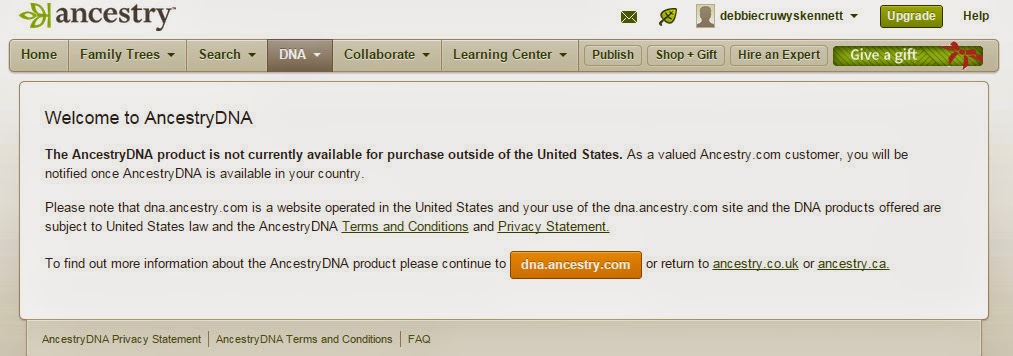
I used to be able to click on the orange DNA.ancestry.com button to view my DNA results. Now when I click on this button I get redirected to the URL http://dna.ancestry.com/interim but the page doesn't load. After much frustration yesterday I eventually discovered that I could access my results by going direct to http://dna.ancestry.com. It may be that these changes have been made to prepare the website for the launch in the UK and Ireland. (The AncestryDNA test is currently only available in the US, though a few non-Americans like me managed to place an order in the early beta-testing days before shipping outside the US was stopped. It is also possible to order a kit by using one of the package forwarder services.)
Ancestry have done a good job of providing some FAQs to explain how the new matching process works in easy-to-understand language.

They have also provided a very informative table showing the explanation of the different confidence levels. For the first time they have given us the all-important information on the range of shared centiMorgans for each of the confidence scores.

In addition there is a very detailed technical white paper which explains the methodology behind the new phasing and matching algorithms. Phasing is the process of determining which DNA you inherited from your mother and which DNA inherited from your father. There is a more detailed explanation in the ISOGG Wiki. If you have tested yourself and your parents then you can do your own phasing but currently none of the testing companies use phased trio data. The Ancestry approach involves inferring the inheritance from reference populations. It is a computationally intensive exercise and Ancestry are currently the only company who phase their customers' data before doing the matching. The new matching algorithms are based not just on the amount of DNA shared but also on the frequency of the segments in the database. Ancestry have found that there are some segments of DNA that are shared by large numbers of people and these segments are likely to be indicative of ancient ancestry rather than the sharing of a recent ancestor in a genealogical timeframe. Because 99.% of the AncestryDNA database is in America I've never been able to do anything with my matches, but the new algorithms certainly seem to be a very useful improvement, and I hope that I will reap the benefits when Ancestry start to sell their test in the UK.
The old matches have not yet been lost completely and it is now possible to download a spreadsheet with a list of all your Version 1 matches. This facility will be available for a limited time. The spreadsheet lists the Ancestry user names of your matches, the user names of the admins of the accounts, and the predicted relationship range. There are additional columns labelled "Starred", "Viewed", "Hint" "Archived" and "Note". The spreadsheet is available via the settings menu with the little gear icon on your AncestryDNA home page. When I downloaded the spreadsheet I found that I actually had 9449 matches. I'm not quite sure why there were so many more matches in the spreadsheet than I'd previously estimated by extrapolating from the number of pages in my match list. However, this new figure actually means that I've seen an 88% reduction in the number of my matches. It would be helpful if Ancestry could let us have the ability to download a spreadsheet with a list of all our new matches as well, and preferably with additional details such as the matching surnames. Both 23andMe and Family Tree DNA allow us to download a list of our matches. It is much easier to scan through a spreadsheet rather than clicking on each individual match page.
DNA Circles
The other new feature that has been introduced with this update is called DNA Circles. I'm not yet in any DNA Circles so I can't explore how this feature works. However, Roberta Estes, Blaine Bettinger, Judy Russell and Diahan Southard have all written about the DNA Circles and I suggest you read their articles to find out more:
- Ancestry's better mousetrap - DNA circles by Roberta Estes
- Goodbye false positives! AncestryDNA updates its matching algorithm by Blaine Bettinger
- Changes at AncestryDNA by Judy Russell
- AncestryDNA Review and Breaking News! Updates Launched by Diahan Southard
There is also a post on the Ancestry blog with a description of the new feature:
New AncestryDNA technology powers new kinds of discoveries
Ancestry have prepared some FAQs about the DNA Circles and have published a detailed white paper explaining the methodology. The white paper is a very interesting read but it is currently very hard to find if you are not included in any DNA circles. To get to the white paper go to your matches page (not your DNA home page) and click on the question mark. Click on the tile with the magnifying glass labelled "What can I do with my DNA matches". Scroll down to the paragraph headed "Find DNA evidence for your genealogical research". At the end of that paragraph click on the green underlined lettering "Learn more about DNA Circles". That takes you to a page explaining how the DNA Circles are created. At the very bottom of the page there is a green link labelled "Check out our DNA Circles White Paper". I hope that Ancestry will make the paper easier to find so that more people will be encouraged to read it. Note that both the AncestryDNA white papers can only be accessed by Ancestry subscribers. (Thanks to Ann Turner on the ISOGG list for alerting me to this workround which was first posted in the Ancestry forums by Laura Davenport.)
It will be interesting to see how these circles work when AncestryDNA start to roll out their test in the UK and Ireland. I can see that the feature will work well for American genealogists. This is because a large percentage of the Ancestry subscriber base in the US appears to have deep roots in Colonial America, and they all trace back to a small founding population. Consequently Americans will often be related to each other on multiple ancestral pathways in the last three or four hundred years which greatly increases the chances of them sharing DNA segments and finding connections. It also seems to be the case that family sizes in America in historical times were much larger than they were in the UK, which means that the gateway couples in America can often have literally thousands of living descendants. To put this problem into perspective it is cautionary to remember that the population of America in 1700 was just over 250,888, whereas the population of England in 1700 was over six million. It was not until some time after 1851 that the population of the US exceeded that of Great Britain and Ireland. We therefore have a much smaller population of living people who are tracing their ancestry back to a much larger population pool. Nevertheless I shall be very interested to see how this feature works when the AncestryDNA test finally becomes available over here.
Footnotes
1. The Gendocs website has a useful page on population statistics in the UK and Ireland over time:
http://homepage.ntlworld.com/hitch/gendocs/pop.html
2. For statistics on the US population see the Wikipedia article on the demographic history of the United States: http://en.wikipedia.org/wiki/Demographic history of the United States
© 2014 Debbie Kennett


 and
and  , and in return I gave him a copy of my book on
  . (All my copies of
  had already gone by this stage.)
