Tuesday, 1 August 2017

My updated family ancestry maps from Living DNA

I wrote at the weekend about the new ability to download your raw data at Living DNA and upload the results to the new GEDmatch Genesis database. I'm now taking this opportunity to share my revised family ancestry maps which were updated while I was away on holiday last month.

All the results were rerun through the database following further validation checks on the new Global Screening Array chip and improvements to the algorithms. Living DNA have also introduced a feature called family DNA views. We now have the option to see our family ancestry maps at three different confidence ranges: cautious, standard and complete. Here are the descriptions from Living DNA:
  • Cautious: Here we have grouped genetically similar populations together. We are most certain about these assignments of your ancestry breakdown.
  • Standard: Here we highlight the sources of your ancestry which are likely to be present, using our best guess of the exact source. Ancestry that cannot be attributed to one of our reference populations is shown as being 'unassigned'.
  • Complete: Here we have attempted to assign all ancestry allocating 'unassigned' percentages to regions to which they look most similar. There will be more uncertainty associated with these assignments.
The family ancestry maps show your ancestral breakdown at three different levels: global, regional and subregional. The maps are intended to show "the areas of the world where you share genetic ancestry in recent times (10 generations)". 

Cautious
Here are my new results in the cautious view at the global, regional and subregional levels.


Standard
Here are my new results in the standard view at the global, regional and subregional levels.
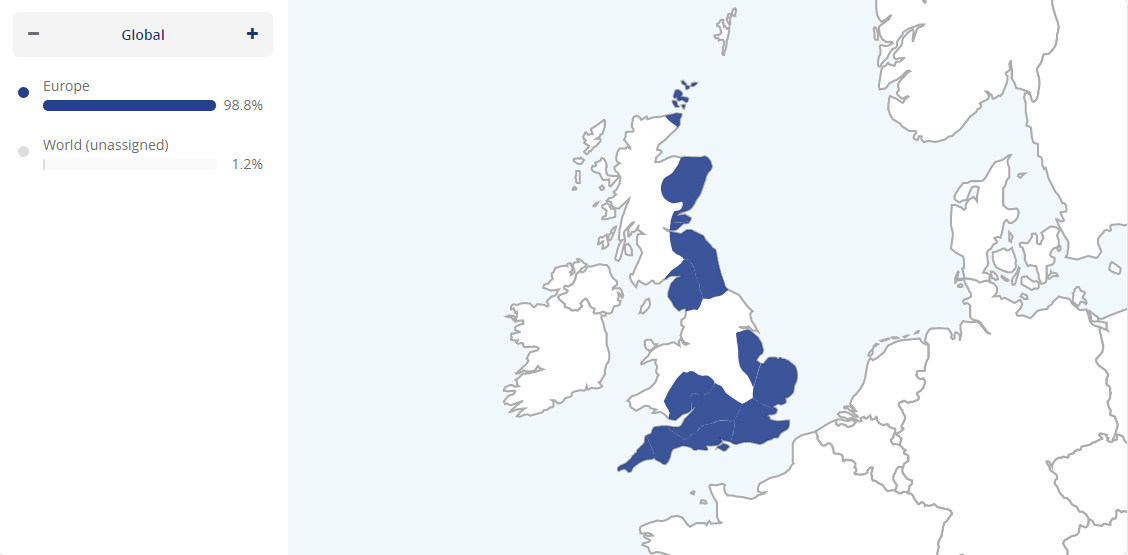


Complete
Here are my new results in the complete view at the global, regional and subregional levels.


My genealogical ancestry
For comparison here is a chart showing the place of birth of all my ancestors going back for five generations. (The chart is inspired by the #Mycolorfulancestry meme started by J. Paul Hawthorne over at the Geneaspy blog.)

Discussion
The biggest change in my results is that the Lincolnshire component has dropped from 17.5% to just 4.1%. I was somewhat perplexed by the high Lincolnshire percentage before so this lower assignment seems more in line with what I might have expected. Devon has dropped from 16.2% to 7.3% but Cornwall has now gone up from 4.6% to 8.2%. I've also lost the small trace percentage from North Yorkshire. You can see my family ancestry maps from the first version of the Living DNA test here.

The results still broadly correlate with my known genealogical ancestry, though more of my ancestry has been assigned to the north of England and Scotland than I would have expected. I don't have any known ancestry from Cornwall or South Wales but I suspect there's a lot of overlap for neighbouring counties, and this could represent my Somerset and Bristol ancestry. And of course I still have a number of lines that I've not been able to trace back any further for various reasons.

Living DNA have further updates planned for later this year so it will be interesting to see how my results evolve over time.

Monday, 31 July 2017

Family Tree DNA summer sale

I've received notification from Family Tree DNA that their summer sale will be starting tomorrow 1st August. There are discounted prices on their most popular tests and upgrades are also included in the sale. Family Finder is reduced to $69 and the BigY is reduced to $395. The sale runs until 31st August. Any items ordered on invoice must be paid within a week of the ending of the sale. Here are the details of the sale prices (in US dollars):


Sunday, 30 July 2017

Living DNA updates and GEDmatch Genesis

While I was away on holiday in California in June Living DNA rolled out a couple of updates.

They have now provided us with the facility to download our raw data. You will find the new menu when you log into your Living DNA account.


We can use the raw data to do our own analyses and to upload the results to third-party sites to get additional interpretations. However, Living DNA uses a different chip from the other main testing companies (23andMe, AncestryDNA, Family Tree DNA and MyHeritage). The Living DNA test is run on the new Illumina Global Screening Array chip whereas the other companies are currently using the Illumina OmniExpress chip. As a result the Living DNA raw data is not compatible with other sites as there are not enough overlapping SNPs (markers) to make reliable relationship predictions. (Note, however, that if you are interested in getting health reports, you can upload your Living DNA raw data to Promethease.)

It's already been announced that 23andMe will be moving over to the GSA chip in due course, and it's likely that the other companies will eventually follow suit as the Illumina OmniExpress is being phased out. The GSA chip is designed for imputation. This is the process of inferring missing markers using statistical algorithms. Imputation can be done with a high degree of accuracy provided that sufficient reference populations are available. We will need to wait and see how the companies cope with the change but in theory the GSA chip is backwardly compatible with the OmniExpress. Much will depend on the quality of the imputation.

In the meantime the wonderful team at GEDmatch have come to the rescue. They are now beta-testing a new service called Genesis which will allow people to upload kits using formats that are not compatible with the main GEDmatch database. This includes Living DNA kits and exome sequences. The intention is that eventually the two databases will be merged.

GEDmatch are also in the process of developing an exciting new Genesis Algorithm which promises to provide more accurate matches. This is what the new Genesis home page looks like.

Here is a screenshot of the upload page.

I was successfully able to upload my Living DNA raw data to GEDmatch Genesis. When uploading your Living DNA data make sure you use the link for "Generic uploads (23andMe, FTDNA, Ancestry, most others)". Within a few minutes of uploading my raw data I was able to use the Genesis site to look at the various admixture calculators.

Here is a report using my Living DNA data with the Eurogenes K13 report. There are just 58623 SNPs used in this report.


When using the same Eurogenes K13 calculator on my standard GEDmatch kit 181512 SNPs are used in the comparison. However, as you can see from the screenshot below, the two reports are remarkably similar, despite the reduced number of SNPs used for the Living DNA comparison.


A few hours after I'd uploaded my results I was able to access my matches. Here is a screenshot of my matches with the kit numbers, names and e-mail addresses blurred out. Click on the image to enlarge it.


We are given information on the largest shared segment, the total cMs shared and the number of overlapping SNPs. Information is also provided about the confidence of the results. Confidence is very high for comparisons between two Living DNA kits but very low for comparisons with other companies.

All my matches are currently very low resolution and they go right down to matches that share a total of just 5 cMs. Few if any of these matches are likely to fall into a genealogical timeframe. Interestingly I've already spotted the names of four people I know amongst my Living DNA matches! As more people add their results to the Genesis database it will be a very useful way of making connections and doing comparisons across different testing companies. I look forward with interest to seeing how the Genesis algorithm develops.

The other new feature that Living DNA have rolled is what they call Family Views, which allows you to view your admixture results in Complete, Standard and Cautious modes. With the launch of this feature all our admixture results were completely rerun. This is because of teething problems with the new GSA chip. After initial quality control checks Illumina issued a new validation file to correct the errors. As validation continues it's possible that there will be further changes in the future. I will write separately about my updated Living DNA results in a future blog post.

There are also other updates in the pipeline as I learned at the Southern California Genealogical Society's Jamboree conference in June when a group of us attended a get-together with David Nicholson and Martin Blythe from Living DNA.

Living DNA should be able to accept uploads from other companies by the end of July. However, there are only a few days of July left and this hasn't yet happened so perhaps the launch of this feature has been delayed.

Living DNA are also working on a matching programme which they hope to start beta-testing in September.

A big update to our admixture results can be expected by the end of the year as more reference datasets are added to the collection. They will be including data from the Symons Genome Diversity Project, data from Asia and data from Aboriginals in Australia. Their Irish DNA Research Project is going well and they already have 1200 samples. They now have 450 people in their German DNA Research Project. Further projects are planned for France, Portugal, Austria, Belgium and the Netherlands.

We can look forward to some very exciting new developments in the next six months.

Further reading

Saturday, 29 July 2017

Comparing match tallies for family members with Family Tree DNA's Family Finder test

I've taken a look at the total number of matches for all my family members who have taken a Family Finder test at Family Tree DNA. I've also done a comparison with the data I extracted on 26th May 2016 just before Family Tree DNA updated their matching algorithms. The results are shown in the table below. Note that I have excluded immediate family members from the totals.

Relation Number of matches
 28 July 2017
Number of matches
 26 May 2016
% increase
Debbie 1217 592 51%
Debbie's dad 1344 643 52%
Debbie's mum 1038 495 52%
Debbie's husband 905 443 51%
Debbie's eldest son 1138 542 52%

If my matches are representative of the wider Family Finder database then there has been over a 50% increase in the size of the database in the last 14 months.

I've also looked at the number of matches I share with my parents and taken stock of the number of matches which don't match either parent.

I share 501 matches with my dad. Of these, 320 were assigned to the paternal side with FTDNA's Family Matching tool. The remaining 181 matches were in common with my dad but did not meet the threshold for Family Matching.

I share 402 matches with my mum. Of these, 276 were assigned to the maternal side with the Family Matching tool. The remaining 126 matches did not meet the threshold for Family Matching.

I therefore have a total of 903 matches (74%) which match my mum or my dad. However, this means that 314 of my 1217 matches (26%) do not appear in the match lists of either of my parents.

All the matches that don't match my parents have a longest segment under 15 cMs. This is the breakdown.

Longest block  Number
10-14 cMs 28
7-9 cMs 286

The last time I did a comparison of parent and child matches I found that 23% of my matches did not match either of my parents.

These matches are either false positives or false negatives but without further investigation it is not possible to tell.

Have you tested both of your parents at Family Tree DNA? What are your statistics?

Related blog posts